 TaxTMI
 Login
 TaxTMI
Login
Loading...
Press 'Enter' to add multiple search terms. Rules for Better Search

Press 'Enter' after typing page number.
Press 'Enter' after typing page number.


No Folders have been created
Are you sure you want to delete "My most important" ?
NOTE:
Press 'Enter' after typing page number.
Press 'Enter' after typing page number.

All News
Press 'Enter' after typing page number.
All News

Note

Bookmark

Share


Economic Survey Strongly recommends increase in public health spending from 1% to 2.5-3% of GDP
“Increased healthcare spending can reduce out-of-pocket expenditure from 65% to 35% of overall healthcare spend”
Emphasizes that healthcare policy must not become beholden to “SALIENCY BIAS”; Healthcare infrastructure needs to be “AGILE”
Actively shaping the Structure of the Healthcare Market Highlighted as a key role for the Government
Recommends Continuation of NHM in Conjunction with Ayushman Bharat Yojana
“Sectoral regulator for regulation and supervision of the healthcare sector must be seriously considered”
Underlines Mitigation of Information Asymmetry to help Lower Insurance Premiums
“Technology-Enabled solutions need to be harnessed to the fullest for last mile Healthcare Services Delivery”
The Economic Survey 2020-21 has strongly recommended an increase in public spending on healthcare services from 1 percent to 2.5-3 percent of GDP, as envisaged in the National Health Policy 2017. It notes that this can significantly reduce the Out-of-Pocket-Expenditure (OOPE) from 65 per cent to 35 per cent of the overall healthcare spend. The Union Minister for Finance & Corporate Affairs, Smt Nirmala Sitharaman tabled the Economic Survey 2020-21 in Parliament today.
The Survey observes that the health of a nation depends critically on its citizens having access to an equitable, affordable and accountable healthcare system. The OOPE as a share of total health expenditure drops precipitously when public health expenditure increases. The Survey also underlines that OOPE for health increases the risk of vulnerable groups slipping into poverty because of catastrophic health expenditures. The life expectancy in a country correlates positively with per-capita public health expenditure, it notes. Significantly, it also observes that from a financial perspective, India has one of the highest levels of OOPE in the world, contributing directly to the high incidence of catastrophic expenditures and poverty. In addition, the Survey also applauds that Pradhan Mantri Jan Arogya Yojana (PMJAY) has been a marquee evolution in the direction of providing financial affordability to a large percentage of the Indian population.
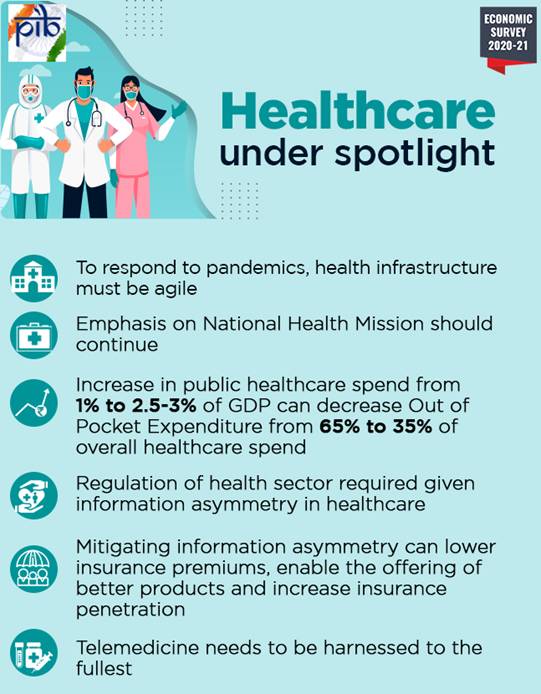
In the chapter focused on healthcare, the Survey points out that the recent COVID-19 pandemic has emphasised the importance of healthcare sector and its inter-linkages with other key sectors of the economy. A key learning emerging from the ongoing pandemic is that it has showcased how a healthcare crisis can be transformed into an economic and social crisis. In addition, it also cautions that healthcare policy must not become beholden to “saliency bias”, where policy over-weights a recent phenomenon. To enable India to respond to pandemics, the health infrastructure must be agile, it has strongly advised. Also, India’s healthcare policy must continue focusing on its long-term healthcare priorities.
The Survey importantly observes that countries with more fragmented health systems tend to have lower performance as reflected in higher costs, lower efficiency, and poor quality. Therefore, in addition to providing healthcare services and financing healthcare, a key role for the government is to actively shape the structure of the healthcare market. Observing that the National Health mission (NHM) has played a critical role in mitigating inequity as the access of the poorest to pre-natal and post-natal care as well as institutional deliveries has increased significantly, the Survey has recommended that the NHM should be continued in conjunction to with Ayushman Bharat Yojana.
The Economic Survey has deeply examined the issue of information asymmetry in the healthcare sector. It notes that as a bulk of the healthcare in India is provided by the private sector, it is critical for policymakers to design policies that mitigate information asymmetry in healthcare, which creates market failures and thereby renders unregulated private healthcare sub-optimal. Therefore, information utilities that help mitigate the information asymmetry can be very useful in enhancing overall welfare, it surmises. A key finding notes that the mitigation of information asymmetry would also help lower insurance premiums, enable the offering of better products and help increase the insurance penetration in the country. Information utilities that help mitigate the information asymmetry in healthcare sector can be very useful in enhancing overall welfare. Noting that WHO has highlighted the growing importance of the same, the Economic Survey has recommended a sectoral regulator in the healthcare landscape to regulate and supervise the healthcare sector given the market failures stemming from information asymmetry. Best practices from several countries such as Australia, England, Finland, Germany, The Netherlands and USA have been shared.
Drawing from the lessons learned during the ongoing global pandemic of COVID-19, the Economic Survey makes a strong case for complete adoption of telemedicine for meeting the last-mile challenges of healthcare delivery in the country. Noting that the ongoing COVID-19 pandemic has helped showcase the role of technology-enabled platforms (such as eSanjeevani) as an alternate distribution channel for remote delivery of healthcare services, it is recommended to harvest the potential of technology-enabled platforms coupled with digitization and artificial intelligence at-scale. As telemedicine depends crucially on internet connectivity, and health infrastructure and number of telemedicine consultations correlate strongly with the internet penetration in a region, both Central and the State governments have been advised to invest in telemedicine on a mission mode to complement the government’s Digital Health Mission and thereby enable greater access to the masses.

