

Loading...

⚠ ✕
❮ Top
☎ Help
☰
×

By creating an account you can:

Logo TaxTMI
Call Us / Help / Feedback✕

Contact Us At :

✉ E-mail: [email protected]

✆ Call / WhatsApp at: +91 99117 96707

For more information, Check Contact Us

FAQs :

To know Frequently Asked Questions, Check FAQs

Most Asked Video Tutorials :

For more tutorials, Check Video Tutorials

Submit Feedback/Suggestion :

Email :
Please provide your email address so we can follow up on your feedback.
Category :
Description :
Min 15 characters 0/2000
Make Most of Text Search ✕
  1. Checkout this video tutorial: How to search effectively on TaxTMI.
  2. Put words in double quotes for exact word search, eg: "income tax"
  3. Avoid noise words such as : 'and, of, the, a'
  4. Sort by Relevance to get the most relevant document.
  5. Press Enter to add multiple terms/multiple phrases, and then click on Search to Search.
  6. Text Search
  7. The system will try to fetch results that contains ALL your words.
  8. Once you add keywords, you'll see a new 'Search In' filter that makes your results even more precise.
  9. Text Search
╳
Add to...
You have not created any category. Kindly create one to bookmark this item!
✕
Create New Category
Hide
Title :
Description :
❮❮ Hide
❮ Default View
Expand ❯❯
Close ✕
🔎 Filters / Advanced Search ❯
TEXT

Press 'Enter' to add multiple search terms. Rules for Better Search

Search In
Main Text + AI Text ❯
  • Main Text
  • Main Text + AI Text
  • AI Text
Category: ?
Categorized by AI
---- All Categories ---- ❯
  • ---- All Categories ----
  • Income Tax
  • GST
  • Customs, DGFT & SEZ
  • FEMA & RBI
  • Corp. Laws, SEBI & IBC
  • PMLA, Black Money & ED
  • Budget
  • News and Press Release
  • PTI News
Month:
---- All Months ---- ❯
  • ---- All Months ----
  • January
  • February
  • March
  • April
  • May
  • June
  • July
  • August
  • September
  • October
  • November
  • December
Year:
---- All Years ---- ❯
  • ---- All Years ----
  • 2026
  • 2025
  • 2024
  • 2023
  • 2022
  • 2021
  • 2020
  • 2019
  • 2018
  • 2017
  • 2016
  • 2015
  • 2014
  • 2013
  • 2012
  • 2011
Sort By: ?
In Sort By 'Default', exact matches for text search are shown at the top, followed by the remaining results in their regular order.
Relevance Default Date
    China, US hold 'candid, in-depth' talks on tariffs, AI issues ahead of Xi-Trump meeting
    Rupee rises 24 paise to 95.72 against US dollar in early trade
    Advisory on use of version 3.3 of emSigner
    Conference on “Financing India’s Journey towards Viksit Bharat” concludes in New Delhi
    IICA’s Meet the Legend Programme Explores ‘PMLA–IBC Interface’
    IICA hosts important session on ‘IBC as an Evolving Law Through the Amendments’,.
    Trump used to slam China. Here's why he's now rolling out the red carpet for Xi
    RBI orders removal of Maharashtra minister Babasaheb Patil, 7 others as directors of Latur DCC Bank
    LPG subsidy: Aadhaar biometric authentication mandatory for subsidised refills from Oct 1
    RBI orders removal of Maharashtra minister Babasaheb Patil, 7 others as directors of Latur DCC Bank
    US tariffs on Indian goods: A Chronology
    Graft case: Kerl BJP chief alleges 'fixed match' between Congress, CPM
    India's FTAs opening new career opportunities for youth: PM Modi
    AutomationEdge Launched Assist-Edge at Global Fintech Fest 2026, Redefining How Enterprises Build and Scale Automation
    BC.GAME's BC Engine Rewards Surpass $8.6 Million as Ecosystem Growth Accelerates
    NLMC’s 21st Board Meeting Reviews progress of monetisation programme; stresses on Accelerated Asset Monetisation;
    IDFC FIRST Bank introduces Zero Forex Markup across all its Credit Cards, existing and new.
    India's forex reserves drop by USD 4.924 billion to USD 780.782 billion: RBI data
    Govt eases sugar stockholding limit for bulk users to 30 days ahead of festive season
    25th Meeting of SCO Ministers Responsible for Economic and Foreign Trade Activities Held in Tajikistan
❮
❯
❯❯
Maximize Maximize Maximize
0 / 200
Expand Note
Add to Folder

No Folders have been created

+

Are you sure you want to delete "My most important" ?

NOTE:

News
Showing Results for :
Reset Filters
Results Found:
Show All Summaries Hide All Summaries
September 21, 2026
Show AI Summary
Tariff sanctions and AI trade consultations examine reciprocal tariff reduction amid energy-purchase measures and objections to unilateral sanctions.
Expanded sanctions and tariff measures form the immediate trade-policy backdrop. The Lindsey O. Graham Sanctioning Russia and Iran Act of 2026 authorises expanded sanctions and tariffs targeting Russia and countries that buy its energy exports. China contests the application of tariffs to its purchases and opposes long-arm jurisdiction and unilateral sanctions asserted without a basis in international law or a UN Security Council mandate. Parallel negotiations contemplate a reciprocal tariff-reduction arrangement.
September 21, 2026
Show AI Summary
Rupee appreciation in early trade reflects lower crude prices and stronger domestic equities despite dollar demand.
Rupee appreciation in early interbank trading saw the currency strengthen by 24 paise to 95.72 per US dollar. Lower Brent crude prices, gains in domestic equities and improved foreign fund sentiment supported the currency, while importer demand for dollars and broader US-dollar strength limited gains. Market commentary identified a broad near-term trading range, and foreign-exchange reserves declined because foreign-currency and gold reserves fell.
September 21, 2026
Show AI Summary
Digital signature compatibility requires updated signing software for newly issued tokens, while functioning existing certificates remain usable until expiry.
Digital-signature users with tokens issued on or after 21 September 2026 must install emSigner v3.3, while users whose existing certificates and tokens function normally may retain their current version. Version 3.3 supports existing tokens and is required where signing fails or certificates cannot be selected despite correctly installed drivers. Certificates downloaded to FIPS 140-2 dongles on or before that date remain valid until expiry; later renewal or fresh issuance generally requires FIPS 140-3 dongles, subject to specified exceptions.
September 21, 2026
Show AI Summary
Private capital mobilisation for development financing requires predictable investment conditions, credible projects, fiscal transparency, and strengthened State capital expenditure.
Development financing for Viksit Bharat is framed as a joint Union-State and private-sector task requiring higher savings and investment, fiscally resilient public finances, and mechanisms to mobilise private capital. Fiscal sustainability requires State-wise debt assessments and fuller disclosure of off-budget borrowings, guarantees, arrears and borrowings through State-owned entities. Public resources are expected to play a catalytic role in attracting private investment, supported by predictable rules, enforceable contracts, faster dispute resolution and stronger investment protections.
September 21, 2026
Show AI Summary
PMLA-IBC interface examines challenges in harmonising insolvency resolution with money-laundering asset attachment, investigation, tracing and enforcement.
The PMLA-IBC interface addresses reconciliation of insolvency resolution with anti-money-laundering enforcement where corporate debtor assets are attached during resolution. Section 32A is central to this interaction, although harmonised implementation remains challenging. The framework also considers money-laundering stages, hawala transactions, financial investigation, asset tracing, and evolving judicial approaches to aligning insolvency objectives with enforcement measures.
September 21, 2026
Show AI Summary
Evolving insolvency law relies on legislative amendments and regulatory mechanisms to respond effectively to changing market conditions.
Subordinate legislation and regulatory mechanisms are important tools for maintaining responsiveness within the insolvency framework. Regulations may be framed for provisions of the Code and for fulfilment of its purposes and objectives, enabling practical responses to emerging issues. The interaction between primary legislation, regulations and market developments supports continuing refinement of insolvency law in line with changing conditions.
September 20, 2026
Show AI Summary
Tariff policy and trade truce reshape bilateral engagement as rare-earth leverage limits coercive economic measures.
United States-China trade relations are being conducted through continued tariff policy, prior export restrictions, and a trade truce after escalating tariffs did not achieve their intended effect of changing Chinese economic conduct. China's concentrated supply of rare-earth inputs used in electronics provided negotiating leverage and contributed to the trade armistice. Indications that Chinese goods are routed through third countries to lessen tariff exposure qualify the decline in the bilateral goods imbalance. Continued tariffs have not constrained China's manufacturing expansion or its access to export markets.
September 20, 2026
Show AI Summary
Ten-year director tenure cap governs removal of ineligible cooperative bank board members after regulatory review.
RBI required Latur District Central Cooperative Bank to remove directors considered ineligible for exceeding the ten-year maximum tenure applicable to district central cooperative bank directors. The action invoked director ineligibility under the Banking Regulation Act. Following a complaint and a court-directed timeline for regulatory action, RBI sought responses from the concerned directors, seven of whom resigned. An issue was raised over whether the tenure cap could apply retrospectively to appointments made before its stated commencement and whether it was being applied uniformly.
September 19, 2026
Show AI Summary
Biometric Aadhaar authentication becomes essential for domestic LPG consumers seeking regulated subsidised refill bookings, while market-price supply remains available.
Biometric Aadhaar authentication is required from October 1 for domestic LPG consumers to book subsidised refills at the regulated retail selling price. Authentication can be completed through delivery personnel, distributor showrooms or designated mobile applications. Consumers unwilling or unable to authenticate may obtain LPG at the applicable market price without subsidy after registering their choice through specified digital channels. The framework distinguishes subsidised LPG linked to Aadhaar-authenticated consumers from market-priced LPG and seeks targeted subsidy delivery, reduced leakage, and prevention of diversion, duplicate connections and ineligible access.
September 19, 2026
Show AI Summary
Cooperative bank director tenure limits require disqualification and removal when service exceeds the statutory maximum period.
Directors of District Central Cooperative Banks and Central Cooperative Banks are subject to a maximum 10-year tenure under the Banking Regulation Act, 1949, as amended by the Banking Laws (Amendment) Act, 2025. RBI directed removal of a director ineligible to continue under section 10A(2A)(i), read with section 56, following concerns that directors of Latur District Central Cooperative Bank had exceeded the permitted tenure.
September 19, 2026
Show AI Summary
Tariff treatment of Indian exports shifted from reciprocal duties to targeted trade measures, sectoral duties, and specified exemptions.
Upon expiry of the temporary global measure, an India-targeted 10 per cent Section 301 tariff, linked to forced-labour concerns, replaced it; the effective charge for most covered exports remained MFN duty plus 10 per cent. The current regime applies the Section 301 tariff to Indian exports except specified goods, with separate sectoral duties on steel, aluminium and auto components. Smartphones, medicines and energy products are exempt.
September 19, 2026
Show AI Summary
PMLA-based FIR request over alleged consultancy payments remains under legal examination amid criticism of non-registration.
Enforcement Directorate sought registration of an FIR concerning alleged fraudulent payments by Cochin Minerals and Rutile Ltd to Exalogic Solutions, represented as IT consultancy fees. The request relied on evidence gathered through investigation and searches under the Prevention of Money Laundering Act. Registration remained under consideration after receipt of the Advocate General's legal opinion, with the Home Department examining the matter.
September 19, 2026
Show AI Summary
Free trade agreements expand market access, entrepreneurial partnerships and youth career opportunities alongside public-sector recruitment and development participation.
Free Trade Agreements are presented as mechanisms for expanding cross-border partnerships, market access for entrepreneurs, and career opportunities for young persons. Youth employment is also linked to the expansion of the startup ecosystem beyond major cities and to public-sector recruitment through Rozgar Melas. Newly selected candidates are to join central government ministries, departments and organisations. Public service is framed around citizen-centred administration and decisions supporting a developed and self-reliant India.
September 19, 2026
Show AI Summary
AI governance for regulated financial services enables natural-language automation while preserving enterprise security, auditability, control, and scalable deployment.
Assist-Edge enables teams to describe intended processes in natural language and use AI to create, modify, and enhance executable workflows. Working with reusable AI agents and workflows, it supports discovery, customisation, deployment, and scaling of enterprise automation. For banking, financial services, and insurance operations, its use is positioned alongside security, governance, auditability, and control, supporting governed adoption of scalable AI capabilities and movement from isolated experimentation to enterprise-wide intelligent automation.
September 19, 2026
Show AI Summary
Recurring token reward distributions connect eligible holdings, platform activity, and partner participation through hourly settlement cycles.
BC Engine permits eligible $BC holdings to participate in hourly settlement rounds distributing BCD rewards. Participants can monitor active balances, cumulative rewards, unclaimed BCD, and settlement history through the Engine interface. Settlement amounts vary with ecosystem activity, while the mechanism links platform activity, token utility, user participation, and commercial partners through repeated value distribution rather than one-time promotional incentives.
September 19, 2026
Show AI Summary
Asset monetisation of surplus public land and buildings is accelerated through transparent, value-oriented processes and stakeholder coordination.
NLMC's Board recommended monetisation proposals involving surplus land and building assets valued at over Rs. 5,000 crore. Monetisation is facilitated through asset identification, due diligence, valuation and appropriate process structuring, with emphasis on transparency, efficiency and value realisation. Sustained coordination with asset-owning entities is intended to expedite implementation and support timely, commercially appropriate monetisation of underutilised public assets.
September 19, 2026
Show AI Summary
Zero forex markup on credit cards applies automatically to international transactions without conditions while preserving applicable rewards.
Zero Forex Markup applies automatically to international transactions made through all existing and new credit cards, without a new-card application, upgrade, spending threshold or other stated condition. International card spends do not attract forex markup charges. Reward Points or Cashback, where applicable to the relevant card, continue on international transactions. Existing credit cards may be used for overseas and cross-border payments without requiring a separate forex card solely to avoid such charges.
September 18, 2026
Show AI Summary
Foreign exchange reserve valuation reflects currency movements as foreign currency assets and gold holdings decline.
India's foreign exchange reserves declined to USD 780.782 billion for the week ended September 11, driven by reductions in foreign currency assets and gold holdings. Foreign currency assets fell to USD 645.796 billion, with their dollar value reflecting movements in reserve currencies against the US dollar. Gold reserves also declined, while Special Drawing Rights increased to USD 18.845 billion. The reserve position with the IMF stood at USD 4.916 billion.
September 18, 2026
Show AI Summary
Bulk sugar stockholding limits now allow expanded inventories only where additional supplies derive from designated import channels.
Bulk sugar consumers using more than 10 tonnes monthly as a raw material may hold up to 30 days' requirement instead of 15 days. Holdings above 15 days must consist exclusively of sugar imported under the Tariff Rate Quota or Advance Authorisation Scheme; sugar obtained from the open market remains restricted to 15 days' consumption. Bulk consumers must declare and disclose their sugar inventories every Friday through the food ministry's online portal.
September 18, 2026
Show AI Summary
Trade facilitation and digitalisation support regional economic cooperation through simpler customs procedures, paperless exchange, resilient supply chains, and MSME access.
Priority measures included expanded intra-SCO trade, lower trade costs, resilient and diversified supply chains, trusted multimodal connectivity, greater market access, simplified customs processes, paperless trade and electronic document exchange. Digital and cross-border payments and accessible trade finance were identified to enable MSMEs and start-ups to participate in trade and value chains. Ministers agreed an Action Plan for 2026-2030 for further approval and approved regulations for a special working group on creative-economy development.

News

Back

All News

Showing Results for :
Reset Filters
No Records Found

News

Back

All News

Customs, DGFT & SEZ

Third Bi-monthly Monetary Policy Statement, 2016-17 (By Dr. Raghuram G. Rajan, Governor)

August 9, 2016

Contents
Summary
Note

Note

-

Bookmark

Print

Print

Monetary and Liquidity Measures

On the basis of an assessment of the current and evolving macroeconomic situation, it has been decided to:

  • keep the policy repo rate under the liquidity adjustment facility (LAF) unchanged at 6.5 per cent;
  • keep the cash reserve ratio (CRR) of scheduled banks unchanged at 4.0 per cent of net demand and time liabilities (NDTL); and
  • continue to provide liquidity as required but progressively lower the average ex ante liquidity deficit in the system from one per cent of NDTL to a position closer to neutrality.

Consequently, the reverse repo rate under the LAF will remain unchanged at 6.0 per cent, and the marginal standing facility (MSF) rate and the Bank Rate at 7.0 per cent.

Assessment

2. Since the second bi-monthly statement of June 2016, several developments have clouded the outlook for the global economy. Across advanced economies (AEs), growth in Q2 of 2016 has been slower than anticipated, and the outlook is still mixed. Headwinds in the United States from declining inventory investment were offset somewhat by strong payroll numbers. In the Euro area, the re-emergence of stress in some parts of the banking sector and the Brexit vote increased uncertainty. In Japan, downside risks have intensified in the form of a stronger yen, deflationary risks and contracting industrial production, triggering monetary and fiscal stimuli.

3. Among emerging market economies, activity remains varied. GDP growth stabilised in China in Q2, on the back of strong stimulus. Manufacturing activity was weak in July due to adverse weather and subdued export demand, although smaller firms recorded an uptick in new orders. Recessionary conditions are gradually diminishing in Brazil and Russia, but the near-term outlook is still fragile due to policy uncertainties and soft commodity prices.

4. World trade remains sluggish in the first half of 2016. International financial markets did not anticipate the Brexit vote and equities plunged worldwide, currency volatility increased and investors herded into safe havens. Since then, however, equity markets have regained lost ground. Currencies, barring the pound sterling, have stabilised, with the yen appreciating the most on risk-on demand as well as the announcement of fresh stimulus. Yields on government bonds have fallen further and the universe of negative yielding assets is expanding at a fast pace, reflecting high risk aversion and expectations of further monetary accommodation by systemic central banks. Crude prices, which had risen to an intra-year high in May on supply disruptions, remain volatile. Other commodity prices, barring those of precious metals, remain soft due to weak demand.

5. On the domestic front, several factors are helping to support the recovery. After a delayed onset, the south west monsoon picked up vigorously from the third week of June. By early August, the cumulative rainfall was 3 per cent higher than the long period average, with more than 80 per cent of the country receiving normal to excess precipitation. Kharif sowing strengthened after a lacklustre start, particularly with respect to pulses. Barring cotton, jute and mesta, sowing of all crops is currently above last year’s acreage. These developments engender greater confidence about the near-term outlook for value added in agriculture. The target for kharif production set by the Ministry of Agriculture appears within reach.

6. Industrial production picked up in May on the back of manufacturing and mining, following a contraction in the preceding month. The uneven performance of industrial output reflects the lumpy and order-driven contraction of insulated rubber cables, a component of capital goods. Excluding this item, industrial production rose at 3.0 per cent in the current financial year. In fact, capital goods production excluding insulated rubber cables expanded by 8.0 per cent. Nonetheless, the prolonged sluggishness in the capital goods sector is indicative of weak investment demand. The rate of contraction in consumer non-durables slowed, pointing to some revival in rural demand. On the other hand, the pace of growth of consumer durables has been stable and buoyed by urban consumption demand, although it eased in May on base effects. Barring the contraction in natural gas and crude oil on account of structural bottlenecks, the core sector has been resilient as of 2016-17 so far, and should support industrial activity going forward. There are some signs of green shoots in manufacturing too, with purchasing managers and the Reserve Bank’s industrial outlook survey indicating a pick-up in new orders, both domestic and external. Business confidence is also looking up in recent months, though the Reserve Bank’s survey for March 2016 suggests that capacity utilisation, seasonally adjusted, is still weak.

7. Service sector purchasing managers polled the thirteenth successive month of expansion in July on the basis of a sharp acceleration in new business. Business expectations remained optimistic on better economic conditions and planned increases in marketing budgets. High frequency indicators of service sector activity are still, however, emitting mixed signals, although a larger number of indicators are in acceleration mode in Q1 of 2016-17 than in the preceding quarter. Automobile sales across most segments, railway, port and international air freight traffic, foreign tourist arrivals, and domestic air passenger traffic are providing the underlying momentum for the upturn. The gradual improvement in the services sector is getting broad-based.

8. Retail inflation measured by the headline consumer price index (CPI) rose to a 22-month high in June, with a sharp pick-up in momentum overwhelming favourable base effects. The rise was mainly driven by food, with vegetable inflation higher than the usual seasonal rise at this time of the year. Sugar prices also firmed up due to a decline in domestic production after two successive years of drought. While pulses inflation started moderating, prices of pulses have been rising again since April after a short-lived correction in the previous quarter. Inflation pressures are also incipient in cereals. These developments fed through into households’ inflation expectations three months ahead, reversing the decline seen in the last two quarters.

9. Fuel inflation remained subdued, mainly due to sustained deflation in prices of liquefied petroleum gas. Excluding food and fuel, inflation eased across major sub-groups. Further excluding petrol and diesel from transport, inflation fell below 5 per cent for the first time since the introduction of the combined CPI. Softer inflation readings were recorded across services constituents in health, education, personal care and effects, and other categories of household consumption. Rural wage growth has been rising albeit moderately, driven up by wages of agricultural labourers. On the other hand, staff costs in the organised sector were relatively restrained.

10. Liquidity conditions eased significantly during June and July on the back of increased spending by the Government which more than offset the reduction in market liquidity because of higher-than-usual currency demand. The injection of durable liquidity through purchases under open market operations (OMOs), amounting to ₹ 805 billion so far, also helped in easing liquidity conditions, bringing the system-level ex ante liquidity deficit to close to neutrality (albeit without seasonal adjustment). Accordingly, the average daily liquidity operation switched from net injection of liquidity of ₹ 370 billion in June to net absorption of ₹ 141 billion in July and ₹ 405 billion in August (up to August 8). The Reserve Bank conducted variable rate repos and reverse repos of varying tenors in order to manage evolving liquidity conditions, with a more active use of reverse repos to manage the surplus liquidity. Reflecting the easy liquidity conditions, the weighted average call rate (WACR) and money market weighted average rate remained on average 15 basis points below the policy repo rate since June. Interest rates on other money market instruments such as certificates of deposit (CDs) and commercial paper (CPs) have also declined in both the primary and secondary markets.

11. In the external sector, merchandise export growth moved into positive territory in June after eighteen months. This upturn was reasonably widespread, covering chemicals, marine products, handicraft, plastic, rice, electronic and engineering goods. On the other hand, imports continued to decline, albeit at a slower pace than in recent months. While lower crude oil prices continued to compress the POL import bill, domestic demand for gold remained muted, with domestic gold prices trading at a discount vis-a-vis international prices. Non-oil non-gold imports continued to shrink, pulled down by coal, fertilisers, ores, iron and steel and machinery and transport equipment. Cumulatively, the trade deficit narrowed in Q1 of 2016-17 on a year-on-year basis. Net receipts on account of services remained flat in April-May 2016, with net outflow under communication services and sluggish software earnings. While the pace of foreign direct investment inflows slowed in the first two months of 2016-17, net portfolio flows were stronger after the Brexit vote, notwithstanding considerable volatility characterising these flows. The level of foreign exchange reserves rose to US$ 365.7 billion by August 5, 2016.

Policy Stance and Rationale

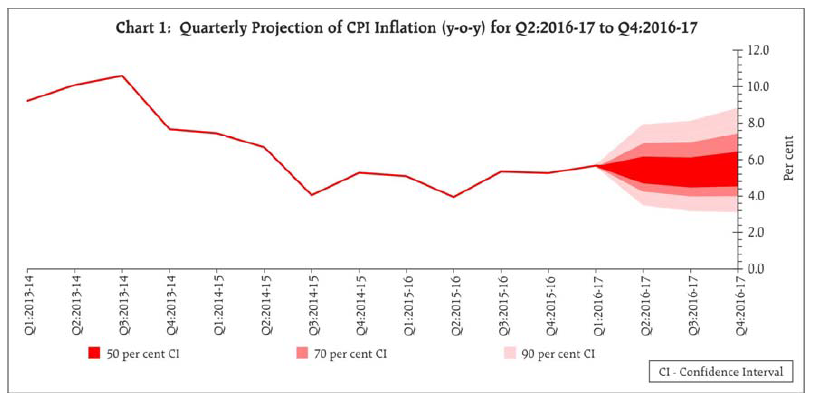
12. The recent sharper-than-anticipated increase in food prices has pushed up the projected trajectory of inflation over the rest of the year. Moreover, prices of pulses and cereals are rising and services inflation remains somewhat sticky. There are early indications, however, that prices of vegetables are edging down. Going forward, the strong improvement in sowing on the back of the monsoon’s steady progress, along with supply management measures, augers well for the food inflation outlook. The prospects for inflation excluding food and fuel are more uncertain; if the current softness in crude prices proves to be transient and as the output gap continues to close, inflation excluding food and fuel may likely trend upwards and counterbalance the benefit of the expected easing of food inflation. In addition, the full implementation of the recommendations of the 7th central pay commission (CPC) on allowances will affect the magnitude of the direct effect of house rents on the CPI. On balance, inflation projections as given in the June bi-monthly statement, i.e. of a central trajectory towards 5 per cent by March 2017 with risks tilted to the upside, are retained (Chart 1).
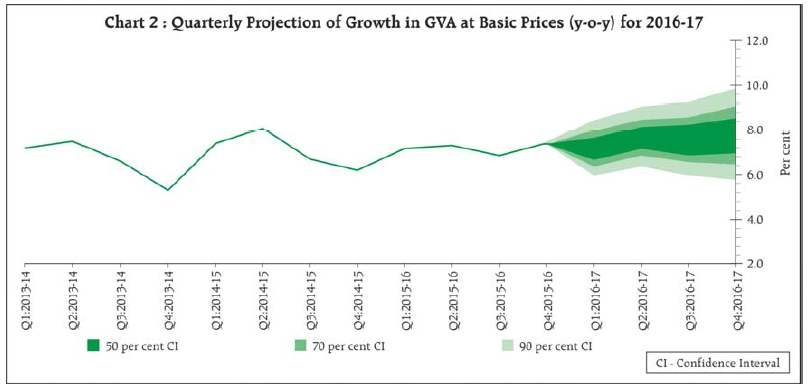
13. Looking ahead, the momentum of growth is expected to be quickened by the normal monsoon raising agricultural growth and rural demand, as well as by the stimulus to consumption spending that can be expected from the disbursement of pay, pension and arrears following the implementation of the 7th CPC’s award. The passage of the Goods and Services Tax (GST) Bill augurs well for the growing political consensus for economic reforms. While timely implementation of GST will be challenging, there is no doubt that it should raise returns to investment across much of the economy, even while strengthening government finances over the medium-term. This should boost business sentiment and eventually investment. The current accommodative stance of monetary policy and comfortable liquidity conditions should also provide a congenial environment for the reinvigoration of aggregate demand conditions. However, successive downgrades of global growth projections by multilateral agencies and the continuing sluggishness in world trade points to further slackening of external demand going forward. Accordingly, the GVA growth projection for 2016-17 is retained at 7.6 per cent, with risks facing the economy at this juncture evenly balanced around it (Chart 2).
14. Risks to the inflation target of 5 per cent for March 2017 continue to be on the upside. Furthermore, while the direct statistical effect of house rent allowances under the 7th CPC’s award may be looked through, its impact on inflation expectations will have to be carefully monitored so as to pre-empt a generalisation of inflation pressures. In terms of immediate outcomes, much will depend on the benign effects of the monsoon on food prices.

15. In view of this configuration of risks, it is appropriate for the Reserve Bank to keep the policy repo rate unchanged at this juncture, while awaiting space for policy action. The stance of monetary policy remains accommodative and will continue to emphasise the adequate provision of liquidity. Easy liquidity conditions are already prompting banks to modestly transmit past policy rate cuts through their MCLRs and pro-active liquidity management should facilitate more pass-through.

16. It may be recalled that the refinements to the liquidity management framework effected in April 2016 were intended to smooth the supply of durable liquidity over the year using asset purchases and sales as needed, and progressively lower the average ex ante liquidity deficit in the system to a position closer to neutrality. The Reserve Bank intends to continue with this strategy, with the intention of closing the underlying liquidity deficit over time so that the system moves to a position of structural balance. As regards the management of the imminent FCNR(B) redemptions, the Reserve Bank has been frontloading liquidity provision through open market operations and spot interventions/deliveries of forward purchases. The Reserve Bank will continue with both domestic liquidity operations and foreign exchange interventions that should also enable management of the FCNR(B) redemptions without market disruptions. With a view to further front-loading the provision of liquidity, it has been decided to conduct an open market purchase auction on August 11, 2016. Details are being announced separately.

17. The fourth bi-monthly monetary policy statement will be announced on October 4, 2016.

Alpana Killawala
Principal Adviser

Topics

Acts Income Tax