

Loading...

⚠ ✕
❮ Top
☎ Help
Draft upto 3 replies to a
tax notice — FREE 🎉 ✕

150 credits · 30 days

• Basic Search → 1 Credit
• Advanced Search → 3 Credits
• Drafter → 20 to extract + 25 per issue
(≈ upto 2-3 drafts on us)

Already used our earlier 20-Credit Demo?
You are still eligible for this new 150-Credit Demo.

Activate your FREE Demo →
☰
×

By creating an account you can:

Logo TaxTMI
Call Us / Help / Feedback✕

Contact Us At :

✉ E-mail: [email protected]

✆ Call / WhatsApp at: +91 99117 96707

For more information, Check Contact Us

FAQs :

To know Frequently Asked Questions, Check FAQs

Most Asked Video Tutorials :

For more tutorials, Check Video Tutorials

Submit Feedback/Suggestion :

Email :
Please provide your email address so we can follow up on your feedback.
Category :
Description :
Min 15 characters 0/2000
Make Most of Text Search ✕
  1. Checkout this video tutorial: How to search effectively on TaxTMI.
  2. Put words in double quotes for exact word search, eg: "income tax"
  3. Avoid noise words such as : 'and, of, the, a'
  4. Sort by Relevance to get the most relevant document.
  5. Press Enter to add multiple terms/multiple phrases, and then click on Search to Search.
  6. Text Search
  7. The system will try to fetch results that contains ALL your words.
  8. Once you add keywords, you'll see a new 'Search In' filter that makes your results even more precise.
  9. Text Search
╳
Add to...
You have not created any category. Kindly create one to bookmark this item!
✕
Create New Category
Hide
Title :
Description :
❮❮ Hide
❮ Default View
Expand ❯❯
Close ✕
🔎 Filters / Advanced Search ❯
TEXT

Press 'Enter' to add multiple search terms. Rules for Better Search

Search In
Main Text + AI Text ❯
  • Main Text
  • Main Text + AI Text
  • AI Text
Category: ?
Categorized by AI
---- All Categories ---- ❯
  • ---- All Categories ----
  • Income Tax
  • GST
  • Customs, DGFT & SEZ
  • FEMA & RBI
  • Corp. Laws, SEBI & IBC
  • PMLA, Black Money & ED
  • Budget
  • News and Press Release
  • PTI News
Month:
---- All Months ---- ❯
  • ---- All Months ----
  • January
  • February
  • March
  • April
  • May
  • June
  • July
  • August
  • September
  • October
  • November
  • December
Year:
---- All Years ---- ❯
  • ---- All Years ----
  • 2026
  • 2025
  • 2024
  • 2023
  • 2022
  • 2021
  • 2020
  • 2019
  • 2018
  • 2017
  • 2016
  • 2015
  • 2014
  • 2013
  • 2012
  • 2011
Sort By: ?
In Sort By 'Default', exact matches for text search are shown at the top, followed by the remaining results in their regular order.
Relevance Default Date
    Gross and Net GST revenue collections for the month of September, 2026
    Release of the Annual Survey of Industries (2024-25) results
    5th Kautilya Economic Conclave to be held in New Delhi from 3 to 5 October 2026 under the theme “Resilience in an Age of Flux”
    CCI approves the acquisition of certain equity share capital in IndiaFirst Life Insurance Co. Ltd. by BNP Paribas Cardif
    CCI approves acquisition of certain equity shareholding in Continuum Green Energy Ltd by Chubu Electric Power Company Netherlands B.V.
    CCI approves acquisition of majority of the shares and voting rights in Volkswagen subsidiary Everllence SE by funds managed and/or advised by Bain Ca...
    CCI approves acquisition of 100% shareholding of FMC India by Crystal Crop Protection Ltd
    Commerce and Industry Minister Shri Piyush Goyal Arrives in Milwaukee, U.S. to Attend G20 Trade Ministers’ Meeting
    Monthly Review of Accounts of Union Government of India upto the month of August 2026 (FY 2026-27)
    Union Minister of Commerce and Industry Shri Piyush Goyal to Visit the United States to Participate in G20 Trade Ministers’ Meeting
    14th India-UAE High Level Joint Task Force Meeting Held in Mumbai
    CBDT extends due date for furnishing Return of Income for AY 2026-27 in respect of persons subject to audit under the Income-tax Act, 1961
    DRI busts pan-India gold smuggling network and seizes around 6.6 kg of foreign-origin gold worth more than Rs. 10 crore; 11, including a mastermind, a...
    CBN conducts anti-drug awareness programme for students under Mission Yuva Raksha for Nasha Mukt Bharat in Jaora, Madhya Pradesh
    CBN Rajasthan Unit seizes nearly four tonnes of contrabands in intensified enforcement operations across Rajasthan
    Union Minister of Commerce and Industry Shri Piyush Goyal Highlights Uttar Pradesh’s Growing Global Trade and Investment Opportunities
    Union Minister for Finance & Corporate Affairs Smt. Nirmala Sitharaman will embark on an official visit to Qatar from 27 to 29 September 2026
    USIBC bats for early conclusion of India-US trade deal
    Banks advise customers to complete essential transactions ahead of 3-day strike
    Centre to borrow Rs 7.86 lakh cr in Oct-Mar, FY27 borrowing slashed by Rs 1.2 lakh cr
❮
❯
❯❯
Maximize Maximize Maximize
0 / 200
Expand Note
Add to Folder

No Folders have been created

+

Are you sure you want to delete "My most important" ?

NOTE:

News
Showing Results for :
Reset Filters
Results Found:
Show All Summaries Hide All Summaries
October 1, 2026
Show AI Summary
GST revenue accounting distinguishes gross collections, refunds, net domestic and customs revenue, and SGST-IGST settlement reporting.
Gross GST revenue for September 2026 distinguishes domestic collections and IGST on imports; after domestic and ICEGATE refund adjustments, net revenue is calculated separately for domestic and customs GST. Cumulative collections through September similarly distinguish gross receipts, refunds and net revenue. SGST reporting compares pre-settlement receipts with post-settlement amounts that include the SGST portion of IGST settled to States and Union Territories. State and Union Territory revenue comparisons exclude GST on imported goods, while April-September domestic collections are split between Central and State formations.
October 1, 2026
Show AI Summary
Annual Survey of Industries results record broad manufacturing growth and define survey coverage, enumeration, digital data collection, and reliability limits.
ASI 2024-25 records broad-based growth in registered manufacturing, including establishments, output, Gross Value Added, employment, emoluments, fixed capital, invested capital, net income and net profit. The survey covers specified registered factories, bidi and cigar establishments, certain electricity undertakings, and qualifying large units in State-maintained business registers. Data are collected electronically under the statutory framework for collection of statistics using an establishment-based approach, with quality checks and caution required because the estimates arise from a sample survey.
October 1, 2026
Show AI Summary
Economic resilience policy dialogue examines financial stability, digital governance, trade fragmentation, and investment priorities amid global uncertainty.
The fifth Kautilya Economic Conclave will examine economic resilience amid global shocks through discussions on macroeconomic stability, monetary policy, financial stability, investment, fiscal federalism and capital-market development. Its agenda also covers digital economy governance, artificial intelligence, trade fragmentation, strategic autonomy, climate resilience, food systems, demographic change and global health security. Plenaries, parallel sessions and closed-door roundtables will consider policy responses and mobilisation of domestic and foreign capital for long-term investment.
September 30, 2026
Show AI Summary
Equity acquisition in a life insurer receives competition clearance for BNP Paribas Cardif's proposed investment.
Competition Commission of India approval covers a proposed combination under which BNP Paribas Cardif will acquire certain equity share capital in IndiaFirst Life Insurance Company Limited. The transaction is an acquisition of an ownership interest in an Indian life insurer. IndiaFirst Life Insurance Company Limited is incorporated in India, is an IRDAI-licensed insurer, and provides life insurance in India.
September 30, 2026
Show AI Summary
Merger control clearance permits Chubu's acquisition of equity in Continuum Green Energy through primary and secondary transactions.
Competition Commission of India approval covers the acquisition of certain equity shareholding in Continuum Green Energy Limited by Chubu Electric Power Company Netherlands B.V. The proposed combination comprises a primary subscription for, and secondary purchase of, the Target's equity shares from Continuum Green Energy Holdings Ltd., Singapore. The Target and its Indian subsidiaries primarily generate and sell renewable power from wind and solar sources.
September 30, 2026
Show AI Summary
Competition clearance authorises Bain Capital funds to acquire majority control of Everllence through a share transfer from Volkswagen.
Competition approval covers the indirect acquisition of a majority of the shares and voting rights in Everllence SE and its direct and indirect subsidiaries by funds managed or advised by Bain Capital Investors, LLC, from Volkswagen Aktiengesellschaft through a share transfer. Nikolaus (BC) Bidco GmbH acts as the purchaser and is a special purpose vehicle ultimately controlled by Bain Capital-managed or advised funds.
September 30, 2026
Show AI Summary
Full-shareholding acquisition in crop protection receives competition clearance, combining businesses spanning agrochemicals, seeds, and agricultural equipment.
Competition Commission of India approved Crystal Crop Protection Limited's acquisition of the entire, fully diluted shareholding of FMC India Private Limited from FMC Netherlands Holdings II B.V. and its affiliates. The approved combination comprises the acquisition of 100% of FMC India's shareholding by Crystal Crop. Crystal Crop is an Indian public limited company engaged in development, manufacture, and distribution of crop protection products, seeds, and agricultural equipment.
September 30, 2026
Show AI Summary
Investment facilitation supports cross-border manufacturing, technology, supply-chain, and business expansion partnerships between the two economies.
India-U.S. economic engagement extends beyond conventional trade to investment, manufacturing, technology, innovation, resilient supply chains, and high-value capabilities. Business engagement with manufacturing and technology companies addresses opportunities in India and expansion of partnerships. The Government of India indicates readiness to facilitate corporate operations, expansion, and investments in India.
September 30, 2026
Show AI Summary
Monthly fiscal accounts report receipts, tax devolution, and revenue and capital expenditure against budget estimates.
Monthly accounts up to August 2026 record total receipts of Rs.13,67,709 crore, comprising net tax revenue, non-tax revenue and non-debt capital receipts. Tax devolution to State Governments totals Rs.5,90,391 crore. Total expenditure is Rs.20,77,958 crore, divided between revenue expenditure of Rs.15,68,009 crore and capital expenditure of Rs.5,09,949 crore, with revenue expenditure including interest payments and major subsidies.
September 28, 2026
Show AI Summary
Rules-based multilateral trade engagement supports bilateral agreement negotiations, enterprise opportunities, investment partnerships, and developing-country policy space.
India's G20 trade engagement promotes a rules-based, open and non-discriminatory multilateral trading system while preserving policy space for developing countries. Bilateral discussions seek to expand opportunities for farmers, fishermen, women entrepreneurs, startups, MSMEs and other enterprises. India-United States engagement is intended to advance a balanced Bilateral Trade Agreement and an interim trade deal, alongside investment and industry outreach promoting manufacturing partnerships with Indian enterprises.
September 28, 2026
Show AI Summary
Cross-border investment facilitation under CEPA supports local-currency settlement, payment integration, joint projects and timely resolution of investor concerns.
Financial-sector cooperation covers local-currency settlement, integration of payment and messaging systems, and central-bank digital currencies, with steps to support timely implementation for more efficient, accessible and resilient bilateral trade and investment. The UAE-India Fast Track Mechanism remains available for addressing outstanding concerns affecting investments and companies in both jurisdictions, and the parties agreed to support timely resolution of such matters.
September 28, 2026
Show AI Summary
Return filing and tax audit deadlines are extended for the identified taxpayer category under the applicable statutory framework.
CBDT extends the Assessment Year 2026-27 Return of Income filing deadline for persons identified at serial no. 2 in the Table below Explanation 2 to section 139(1) of the Income-tax Act, 1961, from 31 October 2026 to 21 November 2026. The specified date for furnishing the audit report for the same class is extended from 30 September 2026 to 21 October 2026.
September 28, 2026
Show AI Summary
Courier-based gold smuggling enforcement targets concealed distribution through paper entities and foreign-origin gold consignments nationwide.
Coordinated customs enforcement targeted an organised gold-smuggling network that used courier consignments to distribute foreign-origin gold after cross-border entry. The operation led to seizure of 6.61 kg of gold bars under the Customs Act, 1962, and arrests of eleven associated persons. The network allegedly split gold into small consignments and used paper entities or persons without legitimate gold transactions to conceal distribution through courier channels.
September 28, 2026
Show AI Summary
Anti-drug awareness and cultivator outreach combine prevention, direct grievance redressal, and safeguards against illicit narcotics diversion.
Jan Sunwayi programmes provide direct, prompt and accessible grievance redressal for opium cultivators, including name corrections, Namantaran, and eligibility connected with the upcoming Settlement Operation. Cultivators are advised to avoid middlemen or intermediaries and seek clarification or assistance directly. These measures complement anti-drug awareness and preventive outreach aimed at preventing illegal trafficking, diversion and abuse of narcotic drugs and psychotropic substances.
September 28, 2026
Show AI Summary
NDPS enforcement targets concealed poppy straw, opium and cannabis trafficking through seizures, arrests, and continuing supply-chain investigation.
Narcotics enforcement operations in Rajasthan led to seizures of poppy straw, opium, hydroponic cannabis, cash, vehicles and a loaded country-made pistol, with four arrests. Poppy straw was recovered from vehicles and premises, including a truck where it was concealed beneath cement bags. Opium and cash were recovered from residential premises, while hydroponic cannabis concealed in an international parcel was recovered at the Foreign Post Office, Jaipur. The seized articles were taken under relevant provisions of the Narcotic Drugs and Psychotropic Substances Act, 1985, and supply-chain investigation continues.
September 28, 2026
Show AI Summary
Free trade agreement market access is positioned to expand export opportunities and international investment for local entrepreneurs.
Free Trade Agreement-led market access is positioned to expand international opportunities for entrepreneurs in Uttar Pradesh by supporting exports, investment inflows and access to overseas markets. International trade engagement is supported through direct business access to global markets, buyer-seller meetings and promotion of the State's products, cuisines and services. Export expansion, international investment, tourism and global recognition of State brands form the stated next phase of economic development, supported by coordination between governments and trade and industrial stakeholders.
September 28, 2026
Show AI Summary
Multilateral infrastructure cooperation guides annual development bank participation and bilateral engagement on sustainable investment and economic connectivity.
The official visit includes participation, as India's Governor, in the Annual Meeting of the Board of Governors of the Asian Infrastructure Investment Bank, alongside bilateral meetings and engagement with governmental leadership, business leaders and investors. The AIIB focuses on sustainable infrastructure and productive-sector investment in Asia to promote sustainable economic development, wealth creation and infrastructure connectivity.
September 25, 2026
Show AI Summary
Reciprocal trade agreement negotiations face tariff and subsidy pressures as both governments pursue lower bilateral trade barriers.
India-US bilateral trade negotiations seek completion of the first-phase Bilateral Trade Agreement through a reciprocal trade arrangement lowering trade barriers and tariffs. Further negotiations are required because of changed US tariff conditions, forced-labour tariffs on Indian goods, a possible investigation into excess industrial capacity and subsidies, and sanctions legislation relating to Russia. Ministerial and bilateral engagements will review progress on the proposed reciprocal arrangement.
September 25, 2026
Show AI Summary
Banking strike contingency measures direct customers toward advance transactions and digital channels as branch operations may be disrupted.
Banking-service continuity measures anticipate possible disruption from a three-day employee strike. Customers are advised to complete essential transactions in advance and use ATMs/ADWMs, mobile and internet banking, UPI, business correspondent points and other digital channels. Branch and office operations at participating institutions may be affected, while essential services are to be maintained where possible. Union demands include a five-day banking week, pension improvements and transition options from the National Pension System to the old pension scheme.
September 25, 2026
Show AI Summary
Government borrowing calendar: Reduced dated-securities borrowing will use weekly auctions, green bonds, switches and buyback operations.
Second-half dated-security borrowing will be completed through weekly auctions across maturities ranging from 3 years to 50 years, including Sovereign Green Bonds. Switching and buyback operations will continue to smooth the redemption profile, while a greenshoe option may permit retention of additional subscriptions. Treasury Bill borrowing will proceed through 91-day, 182-day and 364-day instruments. Auctions will offer non-competitive bidding for specified retail investors, and flexibility is retained to modify issuance terms or introduce non-standard maturity instruments, floating-rate bonds and inflation-indexed bonds.

News

Back

All News

Showing Results for :
Reset Filters
No Records Found

News

Back

All News

Customs, DGFT & SEZ

Third Bi-monthly Monetary Policy Statement, 2016-17 (By Dr. Raghuram G. Rajan, Governor)

August 9, 2016

Contents
Summary
Note

Note

-

Bookmark

Print

Print

Monetary and Liquidity Measures

On the basis of an assessment of the current and evolving macroeconomic situation, it has been decided to:

  • keep the policy repo rate under the liquidity adjustment facility (LAF) unchanged at 6.5 per cent;
  • keep the cash reserve ratio (CRR) of scheduled banks unchanged at 4.0 per cent of net demand and time liabilities (NDTL); and
  • continue to provide liquidity as required but progressively lower the average ex ante liquidity deficit in the system from one per cent of NDTL to a position closer to neutrality.

Consequently, the reverse repo rate under the LAF will remain unchanged at 6.0 per cent, and the marginal standing facility (MSF) rate and the Bank Rate at 7.0 per cent.

Assessment

2. Since the second bi-monthly statement of June 2016, several developments have clouded the outlook for the global economy. Across advanced economies (AEs), growth in Q2 of 2016 has been slower than anticipated, and the outlook is still mixed. Headwinds in the United States from declining inventory investment were offset somewhat by strong payroll numbers. In the Euro area, the re-emergence of stress in some parts of the banking sector and the Brexit vote increased uncertainty. In Japan, downside risks have intensified in the form of a stronger yen, deflationary risks and contracting industrial production, triggering monetary and fiscal stimuli.

3. Among emerging market economies, activity remains varied. GDP growth stabilised in China in Q2, on the back of strong stimulus. Manufacturing activity was weak in July due to adverse weather and subdued export demand, although smaller firms recorded an uptick in new orders. Recessionary conditions are gradually diminishing in Brazil and Russia, but the near-term outlook is still fragile due to policy uncertainties and soft commodity prices.

4. World trade remains sluggish in the first half of 2016. International financial markets did not anticipate the Brexit vote and equities plunged worldwide, currency volatility increased and investors herded into safe havens. Since then, however, equity markets have regained lost ground. Currencies, barring the pound sterling, have stabilised, with the yen appreciating the most on risk-on demand as well as the announcement of fresh stimulus. Yields on government bonds have fallen further and the universe of negative yielding assets is expanding at a fast pace, reflecting high risk aversion and expectations of further monetary accommodation by systemic central banks. Crude prices, which had risen to an intra-year high in May on supply disruptions, remain volatile. Other commodity prices, barring those of precious metals, remain soft due to weak demand.

5. On the domestic front, several factors are helping to support the recovery. After a delayed onset, the south west monsoon picked up vigorously from the third week of June. By early August, the cumulative rainfall was 3 per cent higher than the long period average, with more than 80 per cent of the country receiving normal to excess precipitation. Kharif sowing strengthened after a lacklustre start, particularly with respect to pulses. Barring cotton, jute and mesta, sowing of all crops is currently above last year’s acreage. These developments engender greater confidence about the near-term outlook for value added in agriculture. The target for kharif production set by the Ministry of Agriculture appears within reach.

6. Industrial production picked up in May on the back of manufacturing and mining, following a contraction in the preceding month. The uneven performance of industrial output reflects the lumpy and order-driven contraction of insulated rubber cables, a component of capital goods. Excluding this item, industrial production rose at 3.0 per cent in the current financial year. In fact, capital goods production excluding insulated rubber cables expanded by 8.0 per cent. Nonetheless, the prolonged sluggishness in the capital goods sector is indicative of weak investment demand. The rate of contraction in consumer non-durables slowed, pointing to some revival in rural demand. On the other hand, the pace of growth of consumer durables has been stable and buoyed by urban consumption demand, although it eased in May on base effects. Barring the contraction in natural gas and crude oil on account of structural bottlenecks, the core sector has been resilient as of 2016-17 so far, and should support industrial activity going forward. There are some signs of green shoots in manufacturing too, with purchasing managers and the Reserve Bank’s industrial outlook survey indicating a pick-up in new orders, both domestic and external. Business confidence is also looking up in recent months, though the Reserve Bank’s survey for March 2016 suggests that capacity utilisation, seasonally adjusted, is still weak.

7. Service sector purchasing managers polled the thirteenth successive month of expansion in July on the basis of a sharp acceleration in new business. Business expectations remained optimistic on better economic conditions and planned increases in marketing budgets. High frequency indicators of service sector activity are still, however, emitting mixed signals, although a larger number of indicators are in acceleration mode in Q1 of 2016-17 than in the preceding quarter. Automobile sales across most segments, railway, port and international air freight traffic, foreign tourist arrivals, and domestic air passenger traffic are providing the underlying momentum for the upturn. The gradual improvement in the services sector is getting broad-based.

8. Retail inflation measured by the headline consumer price index (CPI) rose to a 22-month high in June, with a sharp pick-up in momentum overwhelming favourable base effects. The rise was mainly driven by food, with vegetable inflation higher than the usual seasonal rise at this time of the year. Sugar prices also firmed up due to a decline in domestic production after two successive years of drought. While pulses inflation started moderating, prices of pulses have been rising again since April after a short-lived correction in the previous quarter. Inflation pressures are also incipient in cereals. These developments fed through into households’ inflation expectations three months ahead, reversing the decline seen in the last two quarters.

9. Fuel inflation remained subdued, mainly due to sustained deflation in prices of liquefied petroleum gas. Excluding food and fuel, inflation eased across major sub-groups. Further excluding petrol and diesel from transport, inflation fell below 5 per cent for the first time since the introduction of the combined CPI. Softer inflation readings were recorded across services constituents in health, education, personal care and effects, and other categories of household consumption. Rural wage growth has been rising albeit moderately, driven up by wages of agricultural labourers. On the other hand, staff costs in the organised sector were relatively restrained.

10. Liquidity conditions eased significantly during June and July on the back of increased spending by the Government which more than offset the reduction in market liquidity because of higher-than-usual currency demand. The injection of durable liquidity through purchases under open market operations (OMOs), amounting to ₹ 805 billion so far, also helped in easing liquidity conditions, bringing the system-level ex ante liquidity deficit to close to neutrality (albeit without seasonal adjustment). Accordingly, the average daily liquidity operation switched from net injection of liquidity of ₹ 370 billion in June to net absorption of ₹ 141 billion in July and ₹ 405 billion in August (up to August 8). The Reserve Bank conducted variable rate repos and reverse repos of varying tenors in order to manage evolving liquidity conditions, with a more active use of reverse repos to manage the surplus liquidity. Reflecting the easy liquidity conditions, the weighted average call rate (WACR) and money market weighted average rate remained on average 15 basis points below the policy repo rate since June. Interest rates on other money market instruments such as certificates of deposit (CDs) and commercial paper (CPs) have also declined in both the primary and secondary markets.

11. In the external sector, merchandise export growth moved into positive territory in June after eighteen months. This upturn was reasonably widespread, covering chemicals, marine products, handicraft, plastic, rice, electronic and engineering goods. On the other hand, imports continued to decline, albeit at a slower pace than in recent months. While lower crude oil prices continued to compress the POL import bill, domestic demand for gold remained muted, with domestic gold prices trading at a discount vis-a-vis international prices. Non-oil non-gold imports continued to shrink, pulled down by coal, fertilisers, ores, iron and steel and machinery and transport equipment. Cumulatively, the trade deficit narrowed in Q1 of 2016-17 on a year-on-year basis. Net receipts on account of services remained flat in April-May 2016, with net outflow under communication services and sluggish software earnings. While the pace of foreign direct investment inflows slowed in the first two months of 2016-17, net portfolio flows were stronger after the Brexit vote, notwithstanding considerable volatility characterising these flows. The level of foreign exchange reserves rose to US$ 365.7 billion by August 5, 2016.

Policy Stance and Rationale

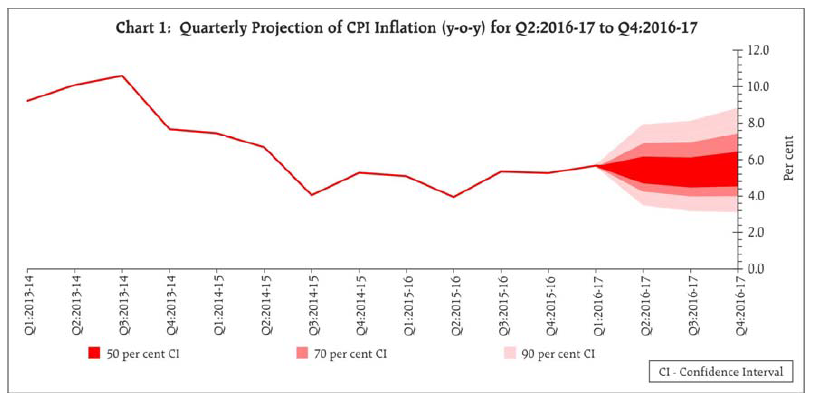
12. The recent sharper-than-anticipated increase in food prices has pushed up the projected trajectory of inflation over the rest of the year. Moreover, prices of pulses and cereals are rising and services inflation remains somewhat sticky. There are early indications, however, that prices of vegetables are edging down. Going forward, the strong improvement in sowing on the back of the monsoon’s steady progress, along with supply management measures, augers well for the food inflation outlook. The prospects for inflation excluding food and fuel are more uncertain; if the current softness in crude prices proves to be transient and as the output gap continues to close, inflation excluding food and fuel may likely trend upwards and counterbalance the benefit of the expected easing of food inflation. In addition, the full implementation of the recommendations of the 7th central pay commission (CPC) on allowances will affect the magnitude of the direct effect of house rents on the CPI. On balance, inflation projections as given in the June bi-monthly statement, i.e. of a central trajectory towards 5 per cent by March 2017 with risks tilted to the upside, are retained (Chart 1).
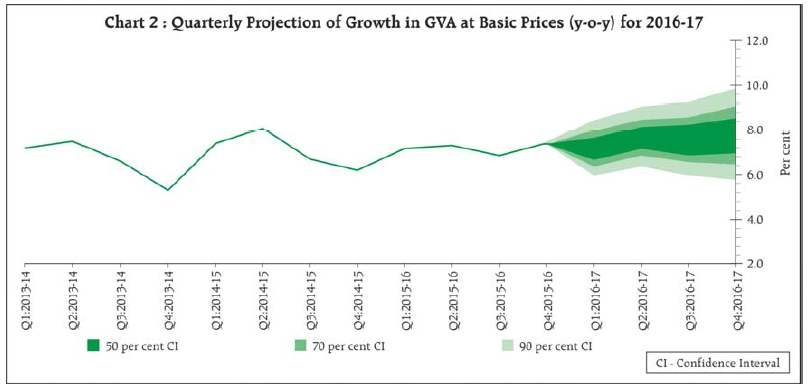
13. Looking ahead, the momentum of growth is expected to be quickened by the normal monsoon raising agricultural growth and rural demand, as well as by the stimulus to consumption spending that can be expected from the disbursement of pay, pension and arrears following the implementation of the 7th CPC’s award. The passage of the Goods and Services Tax (GST) Bill augurs well for the growing political consensus for economic reforms. While timely implementation of GST will be challenging, there is no doubt that it should raise returns to investment across much of the economy, even while strengthening government finances over the medium-term. This should boost business sentiment and eventually investment. The current accommodative stance of monetary policy and comfortable liquidity conditions should also provide a congenial environment for the reinvigoration of aggregate demand conditions. However, successive downgrades of global growth projections by multilateral agencies and the continuing sluggishness in world trade points to further slackening of external demand going forward. Accordingly, the GVA growth projection for 2016-17 is retained at 7.6 per cent, with risks facing the economy at this juncture evenly balanced around it (Chart 2).
14. Risks to the inflation target of 5 per cent for March 2017 continue to be on the upside. Furthermore, while the direct statistical effect of house rent allowances under the 7th CPC’s award may be looked through, its impact on inflation expectations will have to be carefully monitored so as to pre-empt a generalisation of inflation pressures. In terms of immediate outcomes, much will depend on the benign effects of the monsoon on food prices.

15. In view of this configuration of risks, it is appropriate for the Reserve Bank to keep the policy repo rate unchanged at this juncture, while awaiting space for policy action. The stance of monetary policy remains accommodative and will continue to emphasise the adequate provision of liquidity. Easy liquidity conditions are already prompting banks to modestly transmit past policy rate cuts through their MCLRs and pro-active liquidity management should facilitate more pass-through.

16. It may be recalled that the refinements to the liquidity management framework effected in April 2016 were intended to smooth the supply of durable liquidity over the year using asset purchases and sales as needed, and progressively lower the average ex ante liquidity deficit in the system to a position closer to neutrality. The Reserve Bank intends to continue with this strategy, with the intention of closing the underlying liquidity deficit over time so that the system moves to a position of structural balance. As regards the management of the imminent FCNR(B) redemptions, the Reserve Bank has been frontloading liquidity provision through open market operations and spot interventions/deliveries of forward purchases. The Reserve Bank will continue with both domestic liquidity operations and foreign exchange interventions that should also enable management of the FCNR(B) redemptions without market disruptions. With a view to further front-loading the provision of liquidity, it has been decided to conduct an open market purchase auction on August 11, 2016. Details are being announced separately.

17. The fourth bi-monthly monetary policy statement will be announced on October 4, 2016.

Alpana Killawala
Principal Adviser

Topics

Acts Income Tax