

Loading...

⚠ ✕
❮ Top
☎ Help
☰
×

By creating an account you can:

Logo TaxTMI
Call Us / Help / Feedback✕

Contact Us At :

✉ E-mail: [email protected]

✆ Call / WhatsApp at: +91 99117 96707

For more information, Check Contact Us

FAQs :

To know Frequently Asked Questions, Check FAQs

Most Asked Video Tutorials :

For more tutorials, Check Video Tutorials

Submit Feedback/Suggestion :

Email :
Please provide your email address so we can follow up on your feedback.
Category :
Description :
Min 15 characters 0/2000
Make Most of Text Search ✕
  1. Checkout this video tutorial: How to search effectively on TaxTMI.
  2. Put words in double quotes for exact word search, eg: "income tax"
  3. Avoid noise words such as : 'and, of, the, a'
  4. Sort by Relevance to get the most relevant document.
  5. Press Enter to add multiple terms/multiple phrases, and then click on Search to Search.
  6. Text Search
  7. The system will try to fetch results that contains ALL your words.
  8. Once you add keywords, you'll see a new 'Search In' filter that makes your results even more precise.
  9. Text Search
╳
Add to...
You have not created any category. Kindly create one to bookmark this item!
✕
Create New Category
Hide
Title :
Description :
❮❮ Hide
❮ Default View
Expand ❯❯
Close ✕
🔎 Filters / Advanced Search ❯
TEXT

Press 'Enter' to add multiple search terms. Rules for Better Search

Search In
Main Text + AI Text ❯
  • Main Text
  • Main Text + AI Text
  • AI Text
Category: ?
Categorized by AI
---- All Categories ---- ❯
  • ---- All Categories ----
  • Income Tax
  • GST
  • Customs, DGFT & SEZ
  • FEMA & RBI
  • Corp. Laws, SEBI & IBC
  • PMLA, Black Money & ED
  • Budget
  • News and Press Release
  • PTI News
Month:
---- All Months ---- ❯
  • ---- All Months ----
  • January
  • February
  • March
  • April
  • May
  • June
  • July
  • August
  • September
  • October
  • November
  • December
Year:
---- All Years ---- ❯
  • ---- All Years ----
  • 2026
  • 2025
  • 2024
  • 2023
  • 2022
  • 2021
  • 2020
  • 2019
  • 2018
  • 2017
  • 2016
  • 2015
  • 2014
  • 2013
  • 2012
  • 2011
Sort By: ?
In Sort By 'Default', exact matches for text search are shown at the top, followed by the remaining results in their regular order.
Relevance Default Date
    India-New Zealand FTA to Enter into Force from 20 October 2026
    Bengaluru customs arrest passengers for smuggling ganja, gold at airport
    Third-country goods routed via New Zealand into India won't get FTA duty benefits
    Govt urges bank employees to refrain from strikes, resolve issues through dialogue
    Ex-Punjab DIG Bhullar case: ED arrests 'middleman' Kirshanu Sharda for corruption
    RBI revises foreign currency deposit inflows under FCNR(B) upward to USD 133 bn
    CBI arrests 'absconding' IRS officer in Rs 40-lakh bribery case
    Haryana plans Rs 2,295-crore rural infra push
    IPL betting syndicate: ED arrests 'principal bookie' in Guwahati money-laundering case
    ED chargesheets EaseMyTrip promoter Nishant Pitti in Mahadev betting app case
    “Sources and Methods for Compilation of National Accounts Statistics”
    Nearly 5 lakh Nagaland voters to receive notices over SIR mapping discrepancies
    India, Canada to hold next round of talks from Oct 5 for proposed trade pact: Goyal
    India's Semiconductor Market Projected to Grow Threefold to USD 200 billion by 2035: EY-IESA Report
    VKDL NPA Advisory Council Chairman V. K. Dubey Felicitated by Uttar Pradesh Women Commission Chairperson Babita Singh Chauhan
    Rupee rises 15 paise to close at 95.81 against US dollar
    Xi to visit US from Sept 23 to 25 for talks with Trump; China calls it ‘milestone of historic significance’
    Supporting PM Modi's call, IIFL Finance's Mayank Sharma believes recycling household gold is the fastest way to cut import bill
    How will tribunals function if no infrastructure? SC directs Centre to identify amenities required
    India-New Zealand trade pact to come into force on Oct 20: Goyal
❮
❯
❯❯
Maximize Maximize Maximize
0 / 200
Expand Note
Add to Folder

No Folders have been created

+

Are you sure you want to delete "My most important" ?

NOTE:

News
Showing Results for :
Reset Filters
Results Found:
Show All Summaries Hide All Summaries
September 22, 2026
Show AI Summary
Tariff liberalisation under the India-New Zealand FTA grants Indian exports duty-free access while protecting sensitive agricultural products.
From 20 October 2026, the India-New Zealand Free Trade Agreement applies duty-free treatment to all tariff lines covering Indian exports to New Zealand, while preserving exclusions for sensitive Indian agricultural products. Market access for New Zealand apples, kiwifruit, and Manuka honey remains subject to tariff rate quotas, minimum import prices, seasonal windows, and safeguards. Services commitments, mobility routes, investment facilitation, agricultural cooperation, and recognition of specified international inspection approvals form further components.
September 21, 2026
Show AI Summary
Airport smuggling enforcement targets concealed ganja and gold, leading to passenger interceptions and arrests under customs law.
Customs enforcement at Bengaluru airport involved interception and arrest of passengers allegedly attempting to smuggle hydroponic ganja and gold by concealing the goods in cabin baggage, other baggage, undergarments, or on the body. Cases involved arrivals from Vietnam, Bangkok, Kuala Lumpur, and Abu Dhabi. The Abu Dhabi gold-ornament case involved an arrest under the Customs Act.
September 21, 2026
Show AI Summary
Rules of origin prevent third-country transshipment from receiving preferential tariffs under bilateral trade arrangements between partner economies.
India-New Zealand free trade preferences apply only to goods satisfying Rules of Origin. Third-country goods routed through New Zealand cannot receive preferential Indian tariff treatment, as bilateral cumulation is confined to originating materials and goods of India and New Zealand. Sensitive sectors receive no duty concessions, while a bilateral safeguard mechanism addresses sudden import surges after duty elimination or reduction. Temporary Employment Entry, student mobility commitments, post-study work opportunities, and exemption from directly funded social-security contributions for temporary Indian residents form part of the services framework.
September 21, 2026
Show AI Summary
Banking service continuity is prioritised through dialogue as employee welfare measures and wage negotiations address outstanding demands.
Banking-sector industrial relations are addressed through an appeal to bank employees to avoid strike action and pursue outstanding demands through dialogue, in order to keep banking services uninterrupted. Most union concerns are considered substantially addressed, while a remaining demand continues to be examined. The demand for withdrawal of the Performance Linked Incentive scheme had been addressed by placing that scheme in abeyance following detailed discussions. Employee welfare measures, wage revisions, and negotiations for the forthcoming Bipartite Settlement are intended to support workforce welfare and banking-sector efficiency.
September 21, 2026
Show AI Summary
Money-laundering investigation addresses alleged use of a middleman to demand, receive, move and conceal corruption proceeds.
Money-laundering proceedings were initiated from corruption FIRs alleging that a middleman was used to demand and receive illegal gratification. Investigation concerns the alleged facilitation of receipt and movement of funds, supported by searches yielding cash seizure and freezing of financial accounts. Financial records and digital devices allegedly indicated unexplained deposits, investments, transactions involving the officer, and possible involvement of other public servants. The inquiry is tracing alleged proceeds of crime and the role of associated persons and entities.
September 21, 2026
Show AI Summary
FCNR(B) foreign-currency deposits use a swap facility to mobilise non-resident funds without direct rupee exchange-rate risk.
RBI's special USD-INR foreign-exchange swap facility mobilised foreign-currency inflows through FCNR(B) deposits, Overseas Foreign Currency Borrowings and External Commercial Borrowings. The FCNR(B) deposit window closed on 31 August 2026 after its mobilisation objective was achieved, while the facility remained available for the other two channels until 31 December 2026. FCNR(B) collections were revised upward to approximately USD 133 billion. Such deposits are fixed-term foreign-currency deposits with principal and interest repayable in the same currency, avoiding direct rupee exchange-rate risk for non-resident depositors.
September 21, 2026
Show AI Summary
GST bribery investigation concerns alleged illegal gratification sought to resolve quarry firm's tax and royalty proceedings.
GST-related corruption allegations concern an alleged demand for illegal gratification from a stone-quarrying firm to resolve GST and royalty proceedings. A Customs House Agent was apprehended in a trap operation while allegedly accepting the negotiated amount on behalf of a CGST Superintendent and an Additional Commissioner. Custody proceedings involved written communication of arrest grounds and intimation to relevant family members and advocates.
September 21, 2026
Show AI Summary
Rural infrastructure financing supports irrigation, roads, water supply, warehousing and micro-irrigation through structured lending and implementation oversight.
Haryana's 2026-27 rural infrastructure financing plan comprises six proposals for irrigation, roads, drinking-water supply and warehousing, with loan assistance proposed under the Rural Infrastructure Development Fund. Infrastructure Development Assistance has been sanctioned for the India International Horticulture Market, while further micro-irrigation proposals have been recommended under the Micro Irrigation Fund. Implementation oversight emphasises faster project execution and timely drawal claims, alongside borrowing approval and prospective support for water security, groundwater recharge, efficient irrigation and treated-wastewater reuse.
September 21, 2026
Show AI Summary
Money laundering allegations in illegal cricket betting prompted investigative custody and examination of suspected routing of betting proceeds.
Money-laundering investigation into an organised illegal cricket-betting syndicate concerns the alleged use of online platforms, encrypted messaging channels, and a principal bookie to solicit, accept, and settle bets. Betting-derived funds were allegedly routed through a partnership firm represented as non-operational, whose account recorded substantial corresponding credits and debits. Property and vehicle records, digital data, and statements under the PMLA are relied upon to allege the acquisition, possession, use, transfer, and projection of proceeds of crime as untainted property.
September 21, 2026
Show AI Summary
Money laundering allegations concern foreign portfolio investments, alleged share-price manipulation, attachment, and proposed confiscation of betting proceeds.
PMLA proceedings name Nishant Pitti in relation to allegations that proceeds from illegal online betting were introduced into Indian equity markets as foreign portfolio investments. The allegations attribute to him a role in facilitating and layering such proceeds through pre-arranged share-price manipulation involving Easy Trip Planners Ltd. Property action includes provisional attachment of his DEMAT shares, described as proceeds of crime, and a request for confiscation.
September 21, 2026
Show AI Summary
National accounts modernisation adopts updated data sources, revised sector methods, and proportional Denton benchmarking for improved GDP estimates.
National Accounts Statistics in the new series use base year 2022-23, replacing the 2011-12 series. The series was updated to reflect changes flowing from the new Producer Price Index and Index of Industrial Production series. Methodological modernization expands corporate and financial-sector data coverage, refines general-government treatment, and adopts direct household-sector estimation from the Annual Survey of Unincorporated Sector Enterprises and the Periodic Labour Force Survey. Private Final Consumption Expenditure adopts COICOP 2018, while Quarterly National Accounts use the Proportional Denton approach and greater Goods and Services Tax and administrative-data use.
September 21, 2026
Show AI Summary
Electoral roll verification requires unmapped voters to establish linkage or submit prescribed documents before final enrolment.
Special Intensive Revision of Nagaland's electoral roll applies a mapping and verification process by reference to the 2005 electoral roll. Electors recorded under no-mapping or mapping-anomaly categories, including persons unable to establish linkage to an elector in the 2005 roll, are to receive notices from Electoral Registration Officers or Assistant Electoral Registration Officers. They must furnish prescribed supporting documents, calibrated to their date or year of birth, for verification. Non-registration in the 2005 roll does not itself cause automatic exclusion.
September 21, 2026
Show AI Summary
Trade pact negotiations and Russian energy tariffs shape market-access commitments and potential import-duty exposure for exporters.
India and Canada have accelerated negotiations for a Comprehensive Economic Partnership Agreement to establish a bilateral trade framework for goods and services. A United States law concerning sanctions on Russia and Iran authorises tariffs of up to 100 per cent on imports from leading purchasers of Russian crude oil or natural gas, creating potential tariff exposure for Indian exports. The India-European Union trade pact contemplates immediate duty elimination on 90 per cent of Indian goods and phased elimination on a further three per cent over seven years, subject to ratification.
September 21, 2026
Show AI Summary
Semiconductor ecosystem policy requires predictable regulation, integrated clusters, and coordinated support to convert domestic demand into local value creation.
Semiconductor ecosystem development in India is centred on converting expanding domestic demand into local manufacturing, innovation and supply-chain resilience. A predictable fiscal and regulatory environment, alignment of central and state semiconductor policies, integrated manufacturing clusters and talent-certification programmes are important to project viability and commercialisation. Advanced packaging, compound semiconductors, photonics and chip-to-system integration offer high-potential areas, requiring policy certainty, streamlined approvals and long-term support for research, talent and supplier development.
September 21, 2026
Show AI Summary
Legal and NPA advisory services receive recognition for social welfare, women's employment, legal awareness, and financial dispute-resolution work.
Felicitation of Advocate V. K. Dubey recognised his stated work in women's employment, public welfare, banking, NPA resolution, legal awareness, and social service. His profile encompasses civil, criminal, non-performing asset, banking, corporate, and settlement matters; leadership of bodies engaged in financial-dispute resolution; and legal assistance and public awareness intended to improve access to justice for marginalised persons. Associated initiatives include education and support for disadvantaged communities and wider social empowerment.
September 21, 2026
Show AI Summary
Rupee appreciation reflected lower crude oil prices, stronger domestic equities, and improved risk sentiment amid diplomatic expectations.
Rupee appreciation against the US dollar followed lower crude oil prices, improved global risk sentiment, positive domestic equity markets, and softer US Treasury yields. Dollar index strength, geopolitical developments, and possible increases in oil supplies remained relevant to currency movements. Market commentary anticipated a slight positive rupee bias if crude oil prices continued to ease, while renewed geopolitical tensions could weaken risk sentiment. Net foreign institutional investment and a decline in foreign exchange reserves also formed part of the market context.
September 21, 2026
Show AI Summary
Reciprocal tariffs and AI incident notifications frame bilateral talks on trade, security, technology and arms sales.
US sanctions legislation authorises the President to impose tariffs, including up to 100 per cent, on countries purchasing Russian oil and gas. China rejects tariffs directed at its Russian energy purchases and opposes unilateral sanctions and long-arm jurisdiction absent an international-law basis or a UN Security Council mandate. Washington and Beijing are also negotiating a reciprocal tariff-reduction framework covering products from both sides.
September 21, 2026
Show AI Summary
Gold recycling and financialisation can reduce import dependence by mobilising household holdings through exchange, credit and non-physical investment.
Organised gold recycling, responsible sourcing, gold loans and financialised gold products are identified as ways to reduce reliance on fresh gold imports. Exchanging old jewellery can meet retail demand from existing domestic holdings, while gold loans unlock credit without requiring households to sell their gold. Gold ETFs and digital gold permit exposure to gold's value without physical possession and may reduce physical import demand. Transparency, trust and supporting infrastructure are necessary to integrate household gold into an organised formal economy.
September 21, 2026
Show AI Summary
Tribunal infrastructure and member vacancies: amenities assessment and bench-level data collection address reduced sittings across company-law benches.
The Supreme Court required the Central Government urgently to identify, in consultation with the Tribunal President, infrastructural amenities needed by tribunal benches. The Principal Bench Bar Association was required to compile tabulated infrastructure data for every regional bench. At least 18 benches were asserted to conduct half-day sittings because of member shortages, against a sanctioned complement that remained unchanged despite expanded insolvency jurisdiction.
September 21, 2026
Show AI Summary
Duty-free access for Indian exports under the India-New Zealand trade agreement begins with its entry into force.
The India-New Zealand Free Trade Agreement will grant duty-free access in New Zealand to all Indian exports, displacing existing peak tariffs on products such as ceramics, carpets, automobiles, and auto components. Scheduled to enter into force on 20 October 2026, the agreement also includes New Zealand's long-term investment commitment in India.

News

Back

All News

Showing Results for :
Reset Filters
No Records Found

News

Back

All News

Customs, DGFT & SEZ

Third Bi-monthly Monetary Policy Statement, 2016-17 (By Dr. Raghuram G. Rajan, Governor)

August 9, 2016

Contents
Summary
Note

Note

-

Bookmark

Print

Print

Monetary and Liquidity Measures

On the basis of an assessment of the current and evolving macroeconomic situation, it has been decided to:

  • keep the policy repo rate under the liquidity adjustment facility (LAF) unchanged at 6.5 per cent;
  • keep the cash reserve ratio (CRR) of scheduled banks unchanged at 4.0 per cent of net demand and time liabilities (NDTL); and
  • continue to provide liquidity as required but progressively lower the average ex ante liquidity deficit in the system from one per cent of NDTL to a position closer to neutrality.

Consequently, the reverse repo rate under the LAF will remain unchanged at 6.0 per cent, and the marginal standing facility (MSF) rate and the Bank Rate at 7.0 per cent.

Assessment

2. Since the second bi-monthly statement of June 2016, several developments have clouded the outlook for the global economy. Across advanced economies (AEs), growth in Q2 of 2016 has been slower than anticipated, and the outlook is still mixed. Headwinds in the United States from declining inventory investment were offset somewhat by strong payroll numbers. In the Euro area, the re-emergence of stress in some parts of the banking sector and the Brexit vote increased uncertainty. In Japan, downside risks have intensified in the form of a stronger yen, deflationary risks and contracting industrial production, triggering monetary and fiscal stimuli.

3. Among emerging market economies, activity remains varied. GDP growth stabilised in China in Q2, on the back of strong stimulus. Manufacturing activity was weak in July due to adverse weather and subdued export demand, although smaller firms recorded an uptick in new orders. Recessionary conditions are gradually diminishing in Brazil and Russia, but the near-term outlook is still fragile due to policy uncertainties and soft commodity prices.

4. World trade remains sluggish in the first half of 2016. International financial markets did not anticipate the Brexit vote and equities plunged worldwide, currency volatility increased and investors herded into safe havens. Since then, however, equity markets have regained lost ground. Currencies, barring the pound sterling, have stabilised, with the yen appreciating the most on risk-on demand as well as the announcement of fresh stimulus. Yields on government bonds have fallen further and the universe of negative yielding assets is expanding at a fast pace, reflecting high risk aversion and expectations of further monetary accommodation by systemic central banks. Crude prices, which had risen to an intra-year high in May on supply disruptions, remain volatile. Other commodity prices, barring those of precious metals, remain soft due to weak demand.

5. On the domestic front, several factors are helping to support the recovery. After a delayed onset, the south west monsoon picked up vigorously from the third week of June. By early August, the cumulative rainfall was 3 per cent higher than the long period average, with more than 80 per cent of the country receiving normal to excess precipitation. Kharif sowing strengthened after a lacklustre start, particularly with respect to pulses. Barring cotton, jute and mesta, sowing of all crops is currently above last year’s acreage. These developments engender greater confidence about the near-term outlook for value added in agriculture. The target for kharif production set by the Ministry of Agriculture appears within reach.

6. Industrial production picked up in May on the back of manufacturing and mining, following a contraction in the preceding month. The uneven performance of industrial output reflects the lumpy and order-driven contraction of insulated rubber cables, a component of capital goods. Excluding this item, industrial production rose at 3.0 per cent in the current financial year. In fact, capital goods production excluding insulated rubber cables expanded by 8.0 per cent. Nonetheless, the prolonged sluggishness in the capital goods sector is indicative of weak investment demand. The rate of contraction in consumer non-durables slowed, pointing to some revival in rural demand. On the other hand, the pace of growth of consumer durables has been stable and buoyed by urban consumption demand, although it eased in May on base effects. Barring the contraction in natural gas and crude oil on account of structural bottlenecks, the core sector has been resilient as of 2016-17 so far, and should support industrial activity going forward. There are some signs of green shoots in manufacturing too, with purchasing managers and the Reserve Bank’s industrial outlook survey indicating a pick-up in new orders, both domestic and external. Business confidence is also looking up in recent months, though the Reserve Bank’s survey for March 2016 suggests that capacity utilisation, seasonally adjusted, is still weak.

7. Service sector purchasing managers polled the thirteenth successive month of expansion in July on the basis of a sharp acceleration in new business. Business expectations remained optimistic on better economic conditions and planned increases in marketing budgets. High frequency indicators of service sector activity are still, however, emitting mixed signals, although a larger number of indicators are in acceleration mode in Q1 of 2016-17 than in the preceding quarter. Automobile sales across most segments, railway, port and international air freight traffic, foreign tourist arrivals, and domestic air passenger traffic are providing the underlying momentum for the upturn. The gradual improvement in the services sector is getting broad-based.

8. Retail inflation measured by the headline consumer price index (CPI) rose to a 22-month high in June, with a sharp pick-up in momentum overwhelming favourable base effects. The rise was mainly driven by food, with vegetable inflation higher than the usual seasonal rise at this time of the year. Sugar prices also firmed up due to a decline in domestic production after two successive years of drought. While pulses inflation started moderating, prices of pulses have been rising again since April after a short-lived correction in the previous quarter. Inflation pressures are also incipient in cereals. These developments fed through into households’ inflation expectations three months ahead, reversing the decline seen in the last two quarters.

9. Fuel inflation remained subdued, mainly due to sustained deflation in prices of liquefied petroleum gas. Excluding food and fuel, inflation eased across major sub-groups. Further excluding petrol and diesel from transport, inflation fell below 5 per cent for the first time since the introduction of the combined CPI. Softer inflation readings were recorded across services constituents in health, education, personal care and effects, and other categories of household consumption. Rural wage growth has been rising albeit moderately, driven up by wages of agricultural labourers. On the other hand, staff costs in the organised sector were relatively restrained.

10. Liquidity conditions eased significantly during June and July on the back of increased spending by the Government which more than offset the reduction in market liquidity because of higher-than-usual currency demand. The injection of durable liquidity through purchases under open market operations (OMOs), amounting to ₹ 805 billion so far, also helped in easing liquidity conditions, bringing the system-level ex ante liquidity deficit to close to neutrality (albeit without seasonal adjustment). Accordingly, the average daily liquidity operation switched from net injection of liquidity of ₹ 370 billion in June to net absorption of ₹ 141 billion in July and ₹ 405 billion in August (up to August 8). The Reserve Bank conducted variable rate repos and reverse repos of varying tenors in order to manage evolving liquidity conditions, with a more active use of reverse repos to manage the surplus liquidity. Reflecting the easy liquidity conditions, the weighted average call rate (WACR) and money market weighted average rate remained on average 15 basis points below the policy repo rate since June. Interest rates on other money market instruments such as certificates of deposit (CDs) and commercial paper (CPs) have also declined in both the primary and secondary markets.

11. In the external sector, merchandise export growth moved into positive territory in June after eighteen months. This upturn was reasonably widespread, covering chemicals, marine products, handicraft, plastic, rice, electronic and engineering goods. On the other hand, imports continued to decline, albeit at a slower pace than in recent months. While lower crude oil prices continued to compress the POL import bill, domestic demand for gold remained muted, with domestic gold prices trading at a discount vis-a-vis international prices. Non-oil non-gold imports continued to shrink, pulled down by coal, fertilisers, ores, iron and steel and machinery and transport equipment. Cumulatively, the trade deficit narrowed in Q1 of 2016-17 on a year-on-year basis. Net receipts on account of services remained flat in April-May 2016, with net outflow under communication services and sluggish software earnings. While the pace of foreign direct investment inflows slowed in the first two months of 2016-17, net portfolio flows were stronger after the Brexit vote, notwithstanding considerable volatility characterising these flows. The level of foreign exchange reserves rose to US$ 365.7 billion by August 5, 2016.

Policy Stance and Rationale

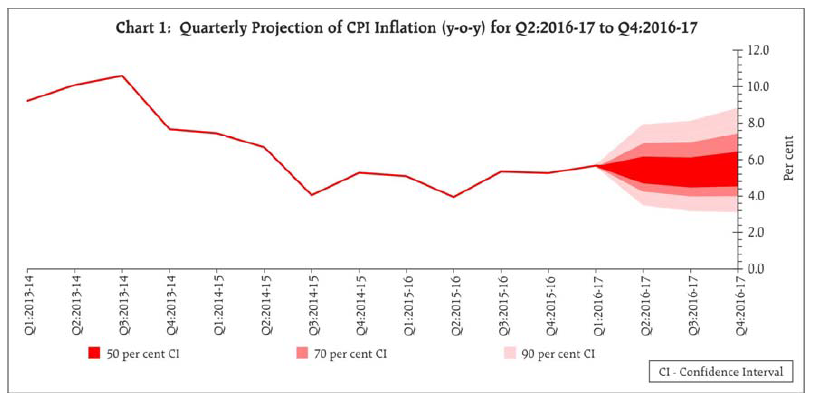
12. The recent sharper-than-anticipated increase in food prices has pushed up the projected trajectory of inflation over the rest of the year. Moreover, prices of pulses and cereals are rising and services inflation remains somewhat sticky. There are early indications, however, that prices of vegetables are edging down. Going forward, the strong improvement in sowing on the back of the monsoon’s steady progress, along with supply management measures, augers well for the food inflation outlook. The prospects for inflation excluding food and fuel are more uncertain; if the current softness in crude prices proves to be transient and as the output gap continues to close, inflation excluding food and fuel may likely trend upwards and counterbalance the benefit of the expected easing of food inflation. In addition, the full implementation of the recommendations of the 7th central pay commission (CPC) on allowances will affect the magnitude of the direct effect of house rents on the CPI. On balance, inflation projections as given in the June bi-monthly statement, i.e. of a central trajectory towards 5 per cent by March 2017 with risks tilted to the upside, are retained (Chart 1).
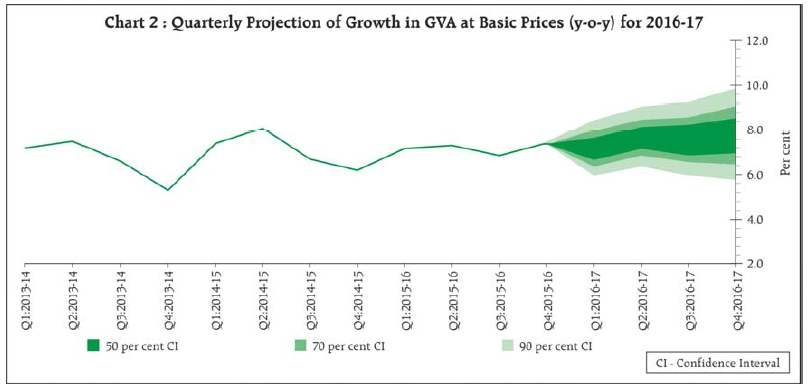
13. Looking ahead, the momentum of growth is expected to be quickened by the normal monsoon raising agricultural growth and rural demand, as well as by the stimulus to consumption spending that can be expected from the disbursement of pay, pension and arrears following the implementation of the 7th CPC’s award. The passage of the Goods and Services Tax (GST) Bill augurs well for the growing political consensus for economic reforms. While timely implementation of GST will be challenging, there is no doubt that it should raise returns to investment across much of the economy, even while strengthening government finances over the medium-term. This should boost business sentiment and eventually investment. The current accommodative stance of monetary policy and comfortable liquidity conditions should also provide a congenial environment for the reinvigoration of aggregate demand conditions. However, successive downgrades of global growth projections by multilateral agencies and the continuing sluggishness in world trade points to further slackening of external demand going forward. Accordingly, the GVA growth projection for 2016-17 is retained at 7.6 per cent, with risks facing the economy at this juncture evenly balanced around it (Chart 2).
14. Risks to the inflation target of 5 per cent for March 2017 continue to be on the upside. Furthermore, while the direct statistical effect of house rent allowances under the 7th CPC’s award may be looked through, its impact on inflation expectations will have to be carefully monitored so as to pre-empt a generalisation of inflation pressures. In terms of immediate outcomes, much will depend on the benign effects of the monsoon on food prices.

15. In view of this configuration of risks, it is appropriate for the Reserve Bank to keep the policy repo rate unchanged at this juncture, while awaiting space for policy action. The stance of monetary policy remains accommodative and will continue to emphasise the adequate provision of liquidity. Easy liquidity conditions are already prompting banks to modestly transmit past policy rate cuts through their MCLRs and pro-active liquidity management should facilitate more pass-through.

16. It may be recalled that the refinements to the liquidity management framework effected in April 2016 were intended to smooth the supply of durable liquidity over the year using asset purchases and sales as needed, and progressively lower the average ex ante liquidity deficit in the system to a position closer to neutrality. The Reserve Bank intends to continue with this strategy, with the intention of closing the underlying liquidity deficit over time so that the system moves to a position of structural balance. As regards the management of the imminent FCNR(B) redemptions, the Reserve Bank has been frontloading liquidity provision through open market operations and spot interventions/deliveries of forward purchases. The Reserve Bank will continue with both domestic liquidity operations and foreign exchange interventions that should also enable management of the FCNR(B) redemptions without market disruptions. With a view to further front-loading the provision of liquidity, it has been decided to conduct an open market purchase auction on August 11, 2016. Details are being announced separately.

17. The fourth bi-monthly monetary policy statement will be announced on October 4, 2016.

Alpana Killawala
Principal Adviser

Topics

Acts Income Tax