 TaxTMI
Login

Login
Loading...
Press 'Enter' to add multiple search terms. Rules for Better Search

Press 'Enter' after typing page number.
Press 'Enter' after typing page number.


No Folders have been created
Are you sure you want to delete "My most important" ?
NOTE:
Press 'Enter' after typing page number.
Press 'Enter' after typing page number.

All News
Press 'Enter' after typing page number.
Press 'Enter' after typing page number.
All News
 Get Daily Updates

Note

Bookmark

Share


Download

Marking its historic Foundation Day, the Central Bureau of Narcotics (CBN) celebrated its 77th foundation Day on 6th November 2026. On this occasion a programme was organised at CBN Headquarters Gwalior in which all the officers and staff participated.
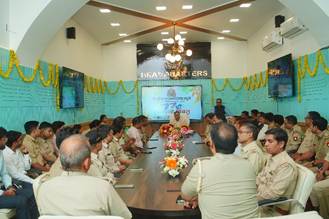
Image: 77th CBN foundation Day celebration programme organised at CBN Headquarters Gwalior.
Deputy Narcotics Commissioner on welcome remarks said that Central Bureau of Narcotics (CBN), is a premier and the oldest agency working in the field of Drug Law Enforcement under the Department of Revenue, Ministry of Finance, regulating Licit Cultivation of Opium Poppy, Overseeing Import and Export of Narcotic Drugs, Psychotropic Substances and Precursor Chemicals, and undertaking intelligence-driven enforcement operations to prevent trafficking of contrabands which falls under NDPS Act 1985.
Underlining the Government of India's zero-tolerance policy against drug trafficking and aligning with the vision of a ‘Drug-Free Youth for a Developed India’, the Bureau has significantly scaled up its operational footprint. Originally established on November 6, 1950, to unify regional opium administrations, CBN has evolved into a premier National Law Enforcement Powerhouse and India's Competent National Authority (CNA) under United Nations Conventions.
On this Special occasion, CBN also unveiled its Hindi Magazine- ‘संयम 2.0’.
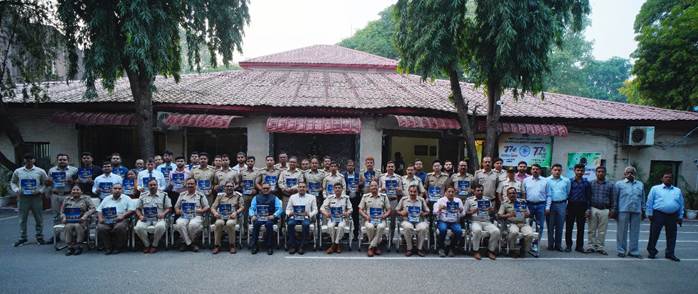
Image: Group Photo on CBN Raising day on which CBN also unveiled its Hindi Magazine- ‘संयम 2.0’.
CBN at Glance:
1. SEVENTY-SIX YEARS OF CHRONOLOGICAL EVOLUTION
From its roots in the All-India Narcotics Board created on April 2, 1949, the unified Opium Department was formally centralized into the Central Bureau of Narcotics (CBN) on November 6, 1950 with its Headquarters at Shimla. To place leadership directly alongside the core traditional poppy-growing belts and to effectively monitor the same, the headquarters was permanently relocated from Shimla to Gwalior, Madhya Pradesh, in 1960. The enactment of the landmark Narcotic Drugs and Psychotropic Substances (NDPS) Act, 1985, completely modernized the agency, converting the CBN from a regulatory administrative department into a multi-role national law enforcement, facilitator and regulatory agency.
2. DISMANTLING TRANSNATIONAL SYNTHETIC DRUG SYNDICATES
From 2022 through October 2026, the CBN's specialized Preventive and Intelligence (P&I) Cells mounted an effective enforcement campaign, booking over 1,000 cases and arresting 1,325 individuals.
3. SOURCE-LEVEL ELIMINATION: ILLICIT CROP DESTRUCTION DRIVES
From 2022 to October 2026, Central Bureau of Narcotics (CBN) mapped and eradicated huge volume of illegal crops directly at the source. CBN has destructed more than 1,11,300 Acres of illicit cultivation of opium and cannabis across high-risk states including Himachal Pradesh, Arunachal Pradesh, Manipur and Uttarakhand.
4. MISSION "YUVA RAKSHA": SAFEGUARDING INDIA'S YOUTH
Marking a major transition toward combining statutory enforcement with grassroots social interventions, the CBN’s flagship initiative—Mission "Yuva Raksha" and CBN outreach initiatives empowered and educated over 20,000 participants across Madhya Pradesh, Rajasthan, Uttar Pradesh, and Delhi during the 2026 calendar year.
5. DIGITAL GOVERNANCE AND EASE OF DOING BUSINESS (EoDB)
The CBN has successfully transitioned from traditional workflows into an automated, single-window digital architecture. By integrating its LPCO (License, Permit, Certificate, and Other documents) onto the centralized ICEGATE SWIFT 2.0 Portal, the Bureau seamlessly processes more than 15,000 import and export applications annually.
To secure international bulk drug and API supply chains while facilitating rapid trade clearances and awareness, the Bureau has progressively signed strategic MoUs with premier trade promotion bodies: the Indian Chemical Council (ICC) in 2022, CHEMEXCIL on April 28, 2025, and PHARMEXCIL on August 24, 2026.
FUTURE ROADMAP
Looking ahead, the modernized CBN is building an advanced technological ecosystem designed to pre-emptively counter emerging narcotic threats and New Psychoactive Substances (NPS). Future frameworks include the deployment of advanced crop-tracking tools, the establishment of a dedicated Chemical Management Division (CMD) to monitor high-risk non-scheduled industrial chemicals and the nationwide expansion of its holistic alternative development strategy.
| “Drugs Out, Dreams In” | “Safe Supply Chain from Farm to Pharmacy” | "Drug-Free Youth for a Developed India" |

