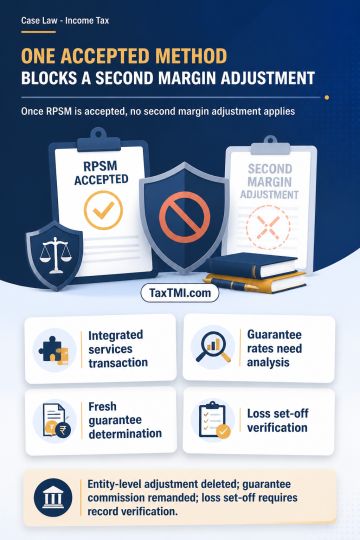
Form 26AS evidence requires successor-entity accounting verification after business transfer, while invoice-supported related-party advertising expend...
Money-laundering judgment timing requires awaiting the scheduled-offence decision despite continuation of the underlying trial where outcomes directly...
Accredited investor eligibility expands through securities-market exposure, while alternative investment fund disputes require prescribed resolution a...
Page of 4916
Press 'Enter' after typing page number.
41 to 60 of 98302 Results
❮
❯
❯❯
0 / 200
Expand Note
Add to Folder
No Folders have been created
+
Are you sure you want to delete "My most important" ?
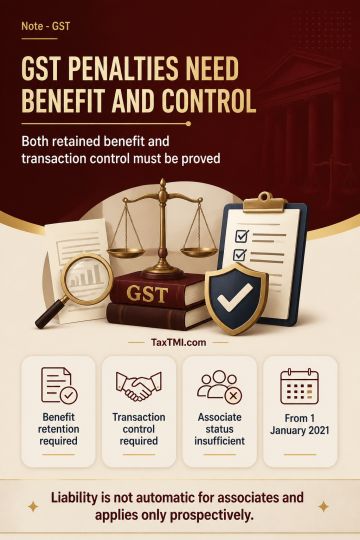
Section 122(1A) of the CGST Act extends penalty exposure to registered and unregistered persons, not only taxable persons, for specified invoice and input tax credit contraventions. Liability requires cumulative proof that the person retained the benefit of the identified transaction and that it was conducted at that person's instance; status as a director, employee, signatory or associate is insufficient. Proceedings must identify the covered underlying contravention and make person-specific, evidence-based findings on both elements, consistent with natural justice and reasoned adjudication. The provision does not create general vicarious liability and applies prospectively only to underlying acts or transactions occurring on or after 1 January 2021.
Section 122(1A) of the CGST Act extends penalty exposure to registered and unregistered persons, not only taxable persons, for specified invoice and input tax credit contraventions. Liability requires cumulative proof that the person retained the benefit of the identified transaction and that it was conducted at that person's instance; status as a director, employee, signatory or associate is insufficient. Proceedings must identify the covered underlying contravention and make person-specific, evidence-based findings on both elements, consistent with natural justice and reasoned adjudication. The provision does not create general vicarious liability and applies prospectively only to underlying acts or transactions occurring on or after 1 January 2021.
Note: It is a system-generated summary and is for quick reference only.
 TaxTMI
 TaxTMI

 of 4916