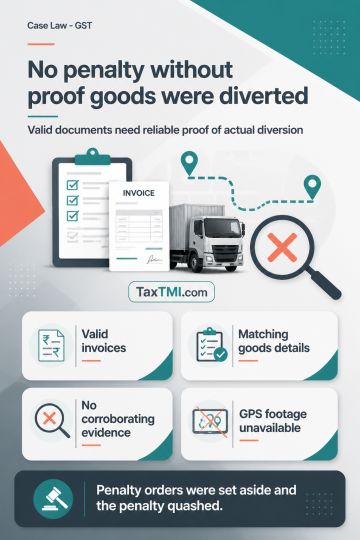
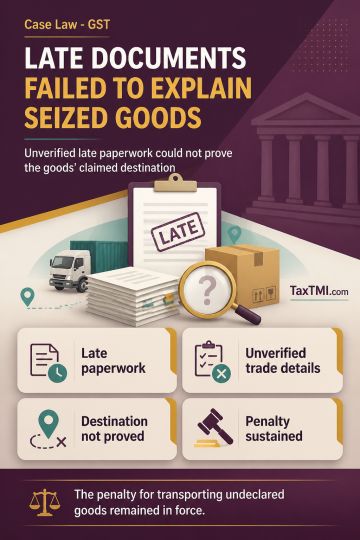
Delayed transport documents failed to validate intercepted goods, sustaining transit-state penalties where the claimed interstate destination remained...
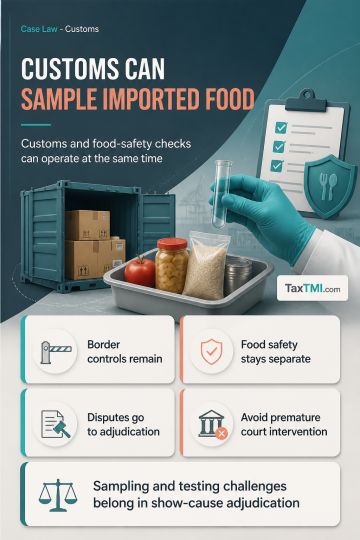
Customs and food-safety legislation operate concurrently: border control, tariff classification, valuation and anti-fraud enforcement remain within Customs powers, while food-safety compliance is regulated separately. A Customs Proper Officer may draw samples of imported food before Bill of Entry routing through FICS for Customs examination and investigation; routine FSSAI sampling does not create exclusive jurisdiction. Executive instructions cannot restrict statutory Customs powers. Challenges to sampling, testing methods, chain of custody and laboratory-report admissibility should be resolved in show-cause adjudication. Judicial review should not prematurely quash those processes or impose fresh-sampling, testing, cargo-release, or charge-waiver directions beyond the writ relief sought.
Customs and food-safety legislation operate concurrently: border control, tariff classification, valuation and anti-fraud enforcement remain within Customs powers, while food-safety compliance is regulated separately. A Customs Proper Officer may draw samples of imported food before Bill of Entry routing through FICS for Customs examination and investigation; routine FSSAI sampling does not create exclusive jurisdiction. Executive instructions cannot restrict statutory Customs powers. Challenges to sampling, testing methods, chain of custody and laboratory-report admissibility should be resolved in show-cause adjudication. Judicial review should not prematurely quash those processes or impose fresh-sampling, testing, cargo-release, or charge-waiver directions beyond the writ relief sought.
Note: It is a system-generated summary and is for quick reference only.
 TaxTMI
 TaxTMI