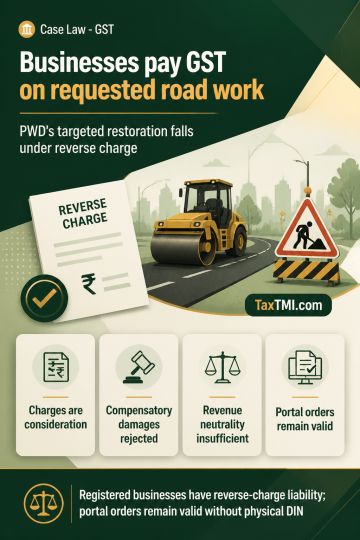
Request-driven road restoration attracts reverse-charge GST, not governmental-function treatment or compensatory-damages status for business recipient...
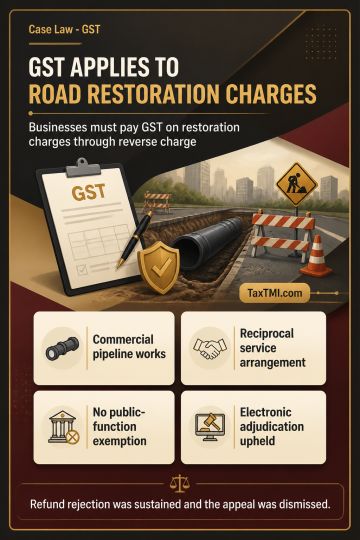
Road restoration charges for commercial pipeline works are taxable Government services, with reverse charge liability and no public-function exemption...
Model-wise import cap monitoring cannot justify withholding used multifunction machines where all-India tracking is absent and full security is furnis...
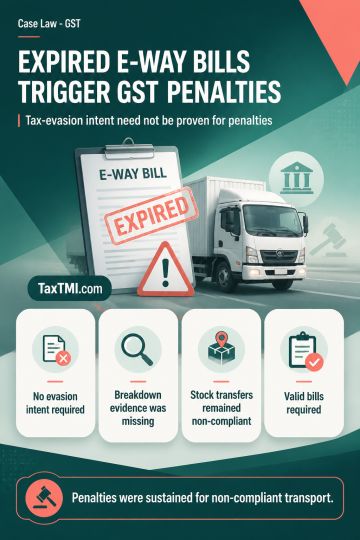
Section 129(1) of the GST Act applies where goods in transit are transported or stored contrary to the Act or Rules; proof of intent to evade tax is not a condition for detention or penalty because the provision addresses breach of a civil obligation and does not require mens rea. Transportation under e-way bills that had expired remained non-compliant where the asserted vehicle breakdown lacked supporting evidence and no extension or amendment was sought. Stock-transfer documentation and e-invoices did not cure the e-way bill lapse, while circular-based exceptions applied only to consignments accompanied by valid e-way bills. Penalties were sustained.
Section 129(1) of the GST Act applies where goods in transit are transported or stored contrary to the Act or Rules; proof of intent to evade tax is not a condition for detention or penalty because the provision addresses breach of a civil obligation and does not require mens rea. Transportation under e-way bills that had expired remained non-compliant where the asserted vehicle breakdown lacked supporting evidence and no extension or amendment was sought. Stock-transfer documentation and e-invoices did not cure the e-way bill lapse, while circular-based exceptions applied only to consignments accompanied by valid e-way bills. Penalties were sustained.
Note: It is a system-generated summary and is for quick reference only.
 TaxTMI
  TaxTMI
 of 4912