Cost-to-cost reimbursement of seconded employees is not service consideration; transfer-pricing markup was deleted and amalgamation amortisation allow...
Crystallisation of liability supports prior-period expense deduction, while functionally distinct divisions require separate transfer-pricing benchmar...
Functional comparability under TNMM requires transaction-specific FAR analysis before benchmarking business-support services provided to associated en...
Advance pricing agreement methodology can guide benchmarking for non-covered years when functions, assets, risks and activities remain materially unch...
Tax-audit exemption for substantially State-funded educational universities prevents audit-failure penalties where income qualifies for statutory exem...
Functional, asset and risk analysis excludes diversified technology companies from captive software development comparables under cost-plus arrangemen...
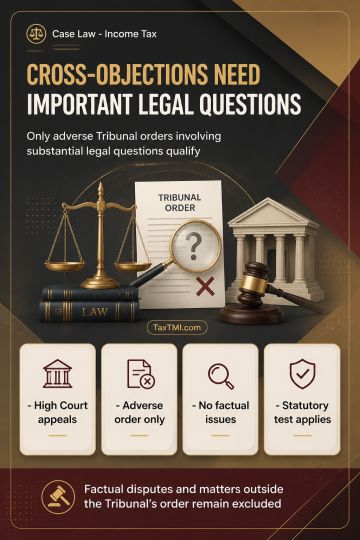
Section 260A(7) imports CPC appellate procedure into High Court income-tax appeals to the extent compatible with Section 260A. Because such appeals resemble second appeals and Order XLII applies Order XLI to them, Order XLI Rule 22 can permit cross-objections despite no express provision in Section 260A. A cross-objection remains limited to the adverse part of the Tribunal's order and must raise a substantial question of law. It cannot expand jurisdiction to factual issues or matters outside that order. Maintainability therefore depends on satisfying the statutory substantial-question-of-law requirement.
Section 260A(7) imports CPC appellate procedure into High Court income-tax appeals to the extent compatible with Section 260A. Because such appeals resemble second appeals and Order XLII applies Order XLI to them, Order XLI Rule 22 can permit cross-objections despite no express provision in Section 260A. A cross-objection remains limited to the adverse part of the Tribunal's order and must raise a substantial question of law. It cannot expand jurisdiction to factual issues or matters outside that order. Maintainability therefore depends on satisfying the statutory substantial-question-of-law requirement.
Note: It is a system-generated summary and is for quick reference only.
 TaxTMI
  TaxTMI
 of 4913