Cost-to-cost reimbursement of seconded employees is not service consideration; transfer-pricing markup was deleted and amalgamation amortisation allow...
Crystallisation of liability supports prior-period expense deduction, while functionally distinct divisions require separate transfer-pricing benchmar...
Functional comparability under TNMM requires transaction-specific FAR analysis before benchmarking business-support services provided to associated en...
Advance pricing agreement methodology can guide benchmarking for non-covered years when functions, assets, risks and activities remain materially unch...
Tax-audit exemption for substantially State-funded educational universities prevents audit-failure penalties where income qualifies for statutory exem...
Functional, asset and risk analysis excludes diversified technology companies from captive software development comparables under cost-plus arrangemen...
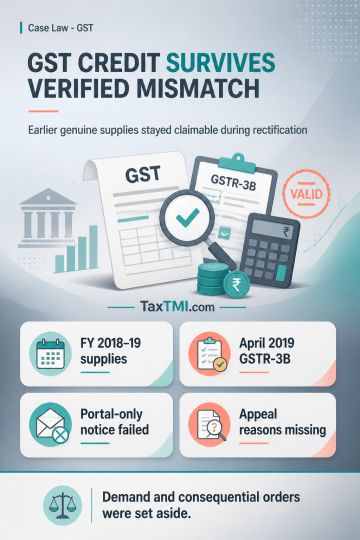
Input tax credit for genuine inward supplies from FY 2018-19, inadvertently omitted from corresponding returns, remained available when claimed in the April 2019 GSTR-3B within the then-permitted rectification period. At that time, GSTR-2A was facilitative; therefore, a GSTR-2A/GSTR-3B mismatch alone could not support reversal once the underlying supplies and credit were verified. Effective notice and a personal hearing were mandatory before an adverse GST decision. Notices placed only in a secondary portal tab, without hearing particulars, and orders issued on uncommunicated dates breached natural justice. Failure to consider appeal grounds and evidence or give reasons also invalidated the appellate decision. The demand and consequential orders were set aside.
Input tax credit for genuine inward supplies from FY 2018-19, inadvertently omitted from corresponding returns, remained available when claimed in the April 2019 GSTR-3B within the then-permitted rectification period. At that time, GSTR-2A was facilitative; therefore, a GSTR-2A/GSTR-3B mismatch alone could not support reversal once the underlying supplies and credit were verified. Effective notice and a personal hearing were mandatory before an adverse GST decision. Notices placed only in a secondary portal tab, without hearing particulars, and orders issued on uncommunicated dates breached natural justice. Failure to consider appeal grounds and evidence or give reasons also invalidated the appellate decision. The demand and consequential orders were set aside.
Note: It is a system-generated summary and is for quick reference only.
 TaxTMI
  TaxTMI
 of 4913