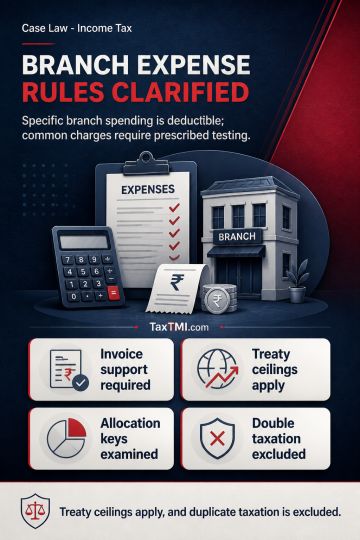
Head Office cost allocation requires prescribed transfer-pricing methods; treaty ceilings bar surcharge and cess, while duplicate taxation is excluded...
Cost-to-cost reimbursement of seconded employees is not service consideration; transfer-pricing markup was deleted and amalgamation amortisation allow...
Crystallisation of liability supports prior-period expense deduction, while functionally distinct divisions require separate transfer-pricing benchmar...
Functional comparability under TNMM requires transaction-specific FAR analysis before benchmarking business-support services provided to associated en...
Page of 4908
Press 'Enter' after typing page number.
121 to 140 of 98141 Results
❮
❯
❯❯
0 / 200
Expand Note
Add to Folder
No Folders have been created
+
Are you sure you want to delete "My most important" ?
Section 127 transfers for centralised assessment require...
Centralised assessment transfers: participation after requesting centralisation can bar technical jurisdictional challenges, while assessment disputes require statutory appeal.
Contents
Summary
Note
Bookmark
Share
✓ Copied successfully !
Print
Print Options
For full text, please login
Login to TaxTMI
Verification Pending
The Email Id has not been verified. Click on the link we have sent on
Section 127 transfers for centralised assessment require recorded and communicated reasons, and transfers between officers subordinate to different Commissioners require the prescribed inter-Commissioner agreement; an opportunity of hearing depends on feasibility. Taxpayers who requested centralisation, filed returns, responded to notices and participated before the transferee officer were treated as having acquiesced in the transferred jurisdiction, preventing a later technical challenge to the transfer. Challenges to consequential assessment orders were not entertained in writ jurisdiction where an effective statutory appellate remedy was available. The writ petitions challenging the transfers and assessments were dismissed.
Section 127 transfers for centralised assessment require recorded and communicated reasons, and transfers between officers subordinate to different Commissioners require the prescribed inter-Commissioner agreement; an opportunity of hearing depends on feasibility. Taxpayers who requested centralisation, filed returns, responded to notices and participated before the transferee officer were treated as having acquiesced in the transferred jurisdiction, preventing a later technical challenge to the transfer. Challenges to consequential assessment orders were not entertained in writ jurisdiction where an effective statutory appellate remedy was available. The writ petitions challenging the transfers and assessments were dismissed.
Note: It is a system-generated summary and is for quick reference only.
 TaxTMI
  TaxTMI
 of 4908