Cost-to-cost reimbursement of seconded employees is not service consideration; transfer-pricing markup was deleted and amalgamation amortisation allow...
Crystallisation of liability supports prior-period expense deduction, while functionally distinct divisions require separate transfer-pricing benchmar...
Functional comparability under TNMM requires transaction-specific FAR analysis before benchmarking business-support services provided to associated en...
Advance pricing agreement methodology can guide benchmarking for non-covered years when functions, assets, risks and activities remain materially unch...
Tax-audit exemption for substantially State-funded educational universities prevents audit-failure penalties where income qualifies for statutory exem...
Functional, asset and risk analysis excludes diversified technology companies from captive software development comparables under cost-plus arrangemen...
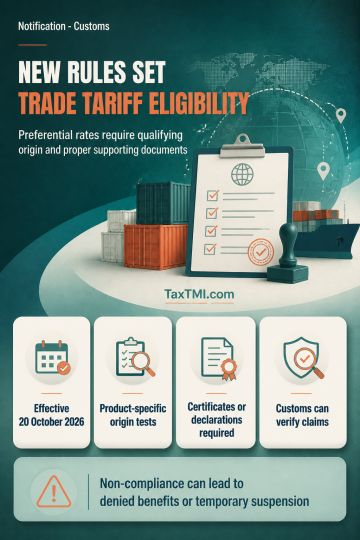
The Customs Tariff (Determination of Origin of Goods under the Free Trade Agreement between India and New Zealand) Rules, 2026 prescribe origin criteria for preferential tariff treatment from 20 October 2026. Goods must be wholly obtained or satisfy applicable product-specific rules, including tariff-classification changes, qualifying value content or process requirements, subject to bilateral cumulation, de minimis allowances and direct-consignment conditions. Minimal processing does not confer origin. Claims require a valid Certificate of Origin or eligible origin declaration, supported by prescribed records. Customs may verify origin through information requests and verification visits, deny preferences for non-compliance or insufficient information, and temporarily suspend treatment for persistent or deliberate origin misrepresentation.
The Customs Tariff (Determination of Origin of Goods under the Free Trade Agreement between India and New Zealand) Rules, 2026 prescribe origin criteria for preferential tariff treatment from 20 October 2026. Goods must be wholly obtained or satisfy applicable product-specific rules, including tariff-classification changes, qualifying value content or process requirements, subject to bilateral cumulation, de minimis allowances and direct-consignment conditions. Minimal processing does not confer origin. Claims require a valid Certificate of Origin or eligible origin declaration, supported by prescribed records. Customs may verify origin through information requests and verification visits, deny preferences for non-compliance or insufficient information, and temporarily suspend treatment for persistent or deliberate origin misrepresentation.
Note: It is a system-generated summary and is for quick reference only.
 TaxTMI
  TaxTMI
 of 4913