Constitutional personal-liberty safeguards limit PMLA twin bail conditions where completed investigations lead to prolonged incarceration before trial...
Automated airline software subscriptions without human intervention fail technical-services characterisation and do not make available underlying tech...
Business support recruitment and training receipts qualify for presumptive business taxation, not professional taxation under technical consultancy ru...
Treaty exemption for foreign permanent-establishment management fees prevailed, while dividend expense disallowance remained limited to an accepted al...
Centralised assessment transfers: participation after requesting centralisation can bar technical jurisdictional challenges, while assessment disputes...
Binding precedent remains operative despite pending challenge, supporting deletion of interest disallowance when debt is converted into preference sha...
Page of 4912
Press 'Enter' after typing page number.
121 to 140 of 98239 Results
❮
❯
❯❯
0 / 200
Expand Note
Add to Folder
No Folders have been created
+
Are you sure you want to delete "My most important" ?
Section 132 of the CGST Act distinguishes cognizable and...
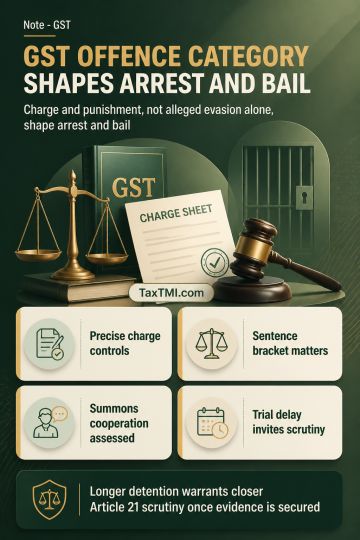
GST offence classification determines whether arrest and bail restrictions apply, while continued custody requires an individualised necessity assessment.
Contents
Summary
Note
Bookmark
Share
✓ Copied successfully !
Print
Print Options
For full text, please login
Login to TaxTMI
Verification Pending
The Email Id has not been verified. Click on the link we have sent on
Section 132 of the CGST Act distinguishes cognizable and non-bailable high-value offences under clauses (a) to (d) from other bailable, non-cognizable offences; classification depends on the precise charge and punishment bracket, not merely alleged evasion. Regular bail in serious GST prosecutions requires an individualised assessment of gravity, cooperation with summons, custodial necessity, evidence security, flight or interference risks, custody duration and realistic trial prospects. Magistrate-triability and a five-year maximum sentence are relevant but not decisive during an ongoing investigation. Arrest safeguards, sanction requirements and undertrial-detention protections apply separately. Continued detention warrants closer Article 21 scrutiny after investigation concludes, evidence is secured, custody becomes prolonged, or trial is delayed.
Section 132 of the CGST Act distinguishes cognizable and non-bailable high-value offences under clauses (a) to (d) from other bailable, non-cognizable offences; classification depends on the precise charge and punishment bracket, not merely alleged evasion. Regular bail in serious GST prosecutions requires an individualised assessment of gravity, cooperation with summons, custodial necessity, evidence security, flight or interference risks, custody duration and realistic trial prospects. Magistrate-triability and a five-year maximum sentence are relevant but not decisive during an ongoing investigation. Arrest safeguards, sanction requirements and undertrial-detention protections apply separately. Continued detention warrants closer Article 21 scrutiny after investigation concludes, evidence is secured, custody becomes prolonged, or trial is delayed.
Note: It is a system-generated summary and is for quick reference only.
 TaxTMI
  TaxTMI
 of 4912