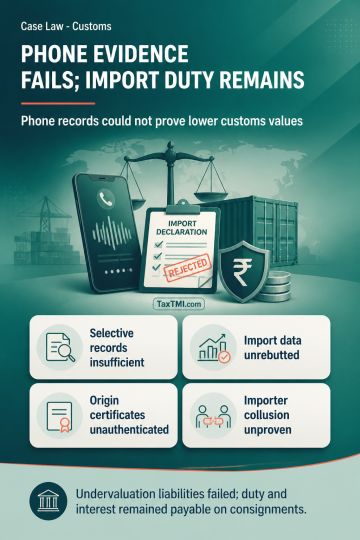
Mobile-phone electronic evidence failed to establish customs undervaluation, while duty survived on non-authentic origin certificates without importer...
Automotive radio classification treats integrated infotainment features as supplementary, placing complete and qualifying unassembled units under the ...
Separate corporate personality prevents directors from being personally liable for company deposits without a guarantee or independent legal undertaki...
Cross-segment derivatives manipulation: integrated order patterns can support interim restraints, while director liability requires responsibility, co...
Power bank definition limits the customs-duty exclusion, preserving concessional treatment for stationary, grid-scale and industrial battery storage s...
Section 132 of the CGST Act distinguishes cognizable and...
GST offence classification determines whether arrest and bail restrictions apply, while continued custody requires an individualised necessity assessment.
Contents
Summary
Note
Bookmark
Share
✓ Copied successfully !
Print
Print Options
For full text, please login
Login to TaxTMI
Verification Pending
The Email Id has not been verified. Click on the link we have sent on
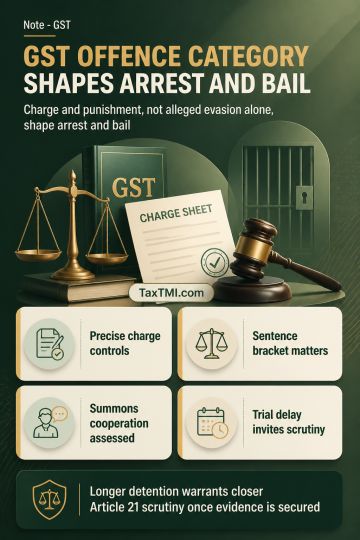
Section 132 of the CGST Act distinguishes cognizable and non-bailable high-value offences under clauses (a) to (d) from other bailable, non-cognizable offences; classification depends on the precise charge and punishment bracket, not merely alleged evasion. Regular bail in serious GST prosecutions requires an individualised assessment of gravity, cooperation with summons, custodial necessity, evidence security, flight or interference risks, custody duration and realistic trial prospects. Magistrate-triability and a five-year maximum sentence are relevant but not decisive during an ongoing investigation. Arrest safeguards, sanction requirements and undertrial-detention protections apply separately. Continued detention warrants closer Article 21 scrutiny after investigation concludes, evidence is secured, custody becomes prolonged, or trial is delayed.
Section 132 of the CGST Act distinguishes cognizable and non-bailable high-value offences under clauses (a) to (d) from other bailable, non-cognizable offences; classification depends on the precise charge and punishment bracket, not merely alleged evasion. Regular bail in serious GST prosecutions requires an individualised assessment of gravity, cooperation with summons, custodial necessity, evidence security, flight or interference risks, custody duration and realistic trial prospects. Magistrate-triability and a five-year maximum sentence are relevant but not decisive during an ongoing investigation. Arrest safeguards, sanction requirements and undertrial-detention protections apply separately. Continued detention warrants closer Article 21 scrutiny after investigation concludes, evidence is secured, custody becomes prolonged, or trial is delayed.
Note: It is a system-generated summary and is for quick reference only.
 TaxTMI
  TaxTMI
 of 4913