Cost-to-cost reimbursement of seconded employees is not service consideration; transfer-pricing markup was deleted and amalgamation amortisation allow...
Crystallisation of liability supports prior-period expense deduction, while functionally distinct divisions require separate transfer-pricing benchmar...
Functional comparability under TNMM requires transaction-specific FAR analysis before benchmarking business-support services provided to associated en...
Advance pricing agreement methodology can guide benchmarking for non-covered years when functions, assets, risks and activities remain materially unch...
Tax-audit exemption for substantially State-funded educational universities prevents audit-failure penalties where income qualifies for statutory exem...
Functional, asset and risk analysis excludes diversified technology companies from captive software development comparables under cost-plus arrangemen...
Section 132 of the CGST Act distinguishes cognizable and...
GST offence classification determines whether arrest and bail restrictions apply, while continued custody requires an individualised necessity assessment.
Contents
Summary
Note
Bookmark
Share
✓ Copied successfully !
Print
Print Options
For full text, please login
Login to TaxTMI
Verification Pending
The Email Id has not been verified. Click on the link we have sent on
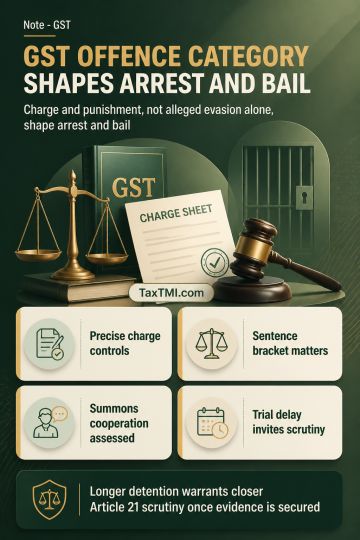
Section 132 of the CGST Act distinguishes cognizable and non-bailable high-value offences under clauses (a) to (d) from other bailable, non-cognizable offences; classification depends on the precise charge and punishment bracket, not merely alleged evasion. Regular bail in serious GST prosecutions requires an individualised assessment of gravity, cooperation with summons, custodial necessity, evidence security, flight or interference risks, custody duration and realistic trial prospects. Magistrate-triability and a five-year maximum sentence are relevant but not decisive during an ongoing investigation. Arrest safeguards, sanction requirements and undertrial-detention protections apply separately. Continued detention warrants closer Article 21 scrutiny after investigation concludes, evidence is secured, custody becomes prolonged, or trial is delayed.
Section 132 of the CGST Act distinguishes cognizable and non-bailable high-value offences under clauses (a) to (d) from other bailable, non-cognizable offences; classification depends on the precise charge and punishment bracket, not merely alleged evasion. Regular bail in serious GST prosecutions requires an individualised assessment of gravity, cooperation with summons, custodial necessity, evidence security, flight or interference risks, custody duration and realistic trial prospects. Magistrate-triability and a five-year maximum sentence are relevant but not decisive during an ongoing investigation. Arrest safeguards, sanction requirements and undertrial-detention protections apply separately. Continued detention warrants closer Article 21 scrutiny after investigation concludes, evidence is secured, custody becomes prolonged, or trial is delayed.
Note: It is a system-generated summary and is for quick reference only.
 TaxTMI
  TaxTMI
 of 4913