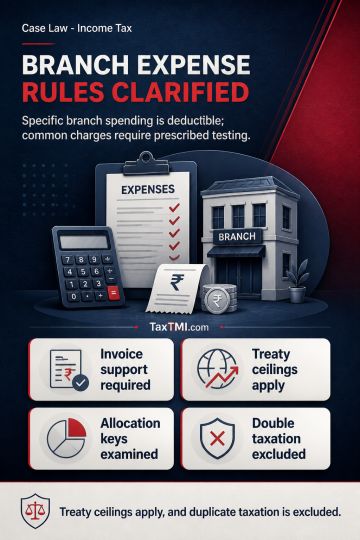
Head Office cost allocation requires prescribed transfer-pricing methods; treaty ceilings bar surcharge and cess, while duplicate taxation is excluded...
Cost-to-cost reimbursement of seconded employees is not service consideration; transfer-pricing markup was deleted and amalgamation amortisation allow...
Crystallisation of liability supports prior-period expense deduction, while functionally distinct divisions require separate transfer-pricing benchmar...
Functional comparability under TNMM requires transaction-specific FAR analysis before benchmarking business-support services provided to associated en...
Advance pricing agreement methodology can guide benchmarking for non-covered years when functions, assets, risks and activities remain materially unch...
Tax-audit exemption for substantially State-funded educational universities prevents audit-failure penalties where income qualifies for statutory exem...
Page of 4907
Press 'Enter' after typing page number.
121 to 140 of 98136 Results
❮
❯
❯❯
0 / 200
Expand Note
Add to Folder
No Folders have been created
+
Are you sure you want to delete "My most important" ?
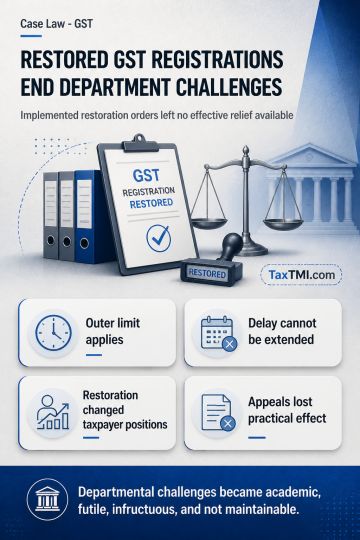
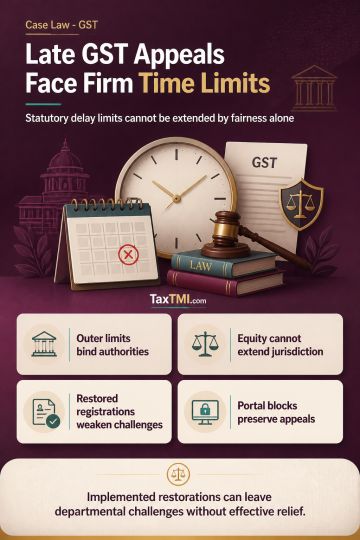
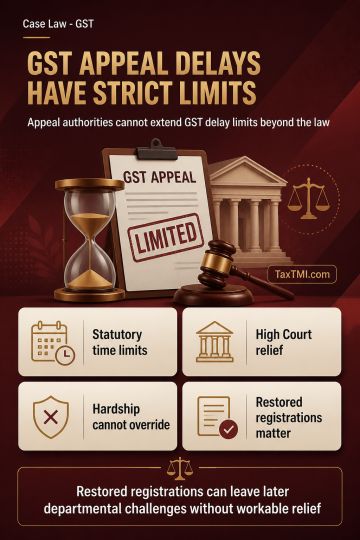
GST appellate jurisdiction to condone delay is confined to the statutory outer limit under section 107(4). High Court writ jurisdiction under Article 226 may mould relief on particular facts, but it does not expand the First Appellate Authority's statutory power; equity and hardship cannot override the prescribed limitation period. Where the Department has implemented an appellate restoration of GST registration, thereby altering taxpayers' legal and commercial position, a subsequent departmental challenge may become infructuous unless the consequences of restoration can be effectively addressed. In such circumstances, no workable relief may be available despite the jurisdictional defect in condoning delay.
GST appellate jurisdiction to condone delay is confined to the statutory outer limit under section 107(4). High Court writ jurisdiction under Article 226 may mould relief on particular facts, but it does not expand the First Appellate Authority's statutory power; equity and hardship cannot override the prescribed limitation period. Where the Department has implemented an appellate restoration of GST registration, thereby altering taxpayers' legal and commercial position, a subsequent departmental challenge may become infructuous unless the consequences of restoration can be effectively addressed. In such circumstances, no workable relief may be available despite the jurisdictional defect in condoning delay.
Note: It is a system-generated summary and is for quick reference only.
 TaxTMI
  TaxTMI
 of 4907