Advance pricing agreement methodology can guide benchmarking for non-covered years when functions, assets, risks and activities remain materially unch...
Tax-audit exemption for substantially State-funded educational universities prevents audit-failure penalties where income qualifies for statutory exem...
Functional, asset and risk analysis excludes diversified technology companies from captive software development comparables under cost-plus arrangemen...
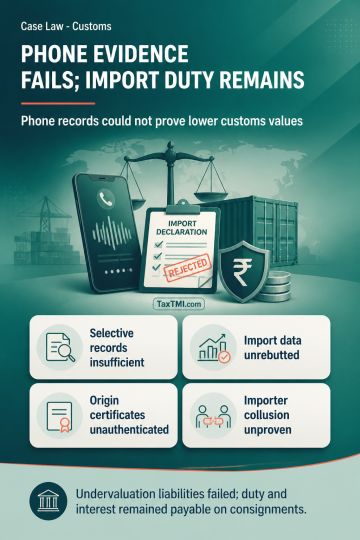
Mobile-phone electronic evidence failed to establish customs undervaluation, while duty survived on non-authentic origin certificates without importer...
Automotive radio classification treats integrated infotainment features as supplementary, placing complete and qualifying unassembled units under the ...
Separate corporate personality prevents directors from being personally liable for company deposits without a guarantee or independent legal undertaki...
Delay in pronouncement resulting from heavy pendency does not,...
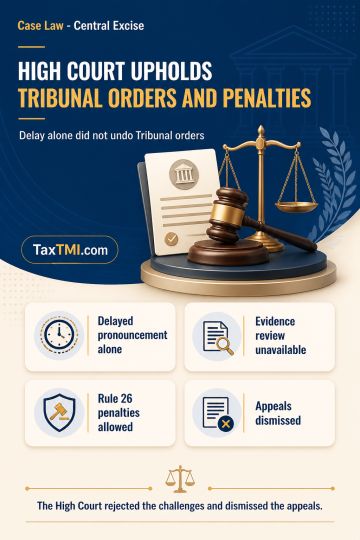
Delayed judgment pronouncement alone does not invalidate Tribunal orders, while rectification cannot reopen evidence or negate confiscation-related penalties.
Contents
Summary
Note
Bookmark
Share
✓ Copied successfully !
Print
Print Options
For full text, please login
Login to TaxTMI
Verification Pending
The Email Id has not been verified. Click on the link we have sent on
Delay in pronouncement resulting from heavy pendency does not, by itself, invalidate a Tribunal order; the High Court therefore declined to interfere on that ground. Rectification cannot be used to reappreciate evidence concerning transit declaration forms or movement of seized goods, because such review falls outside rectification jurisdiction; rejection of the application was sustained. Rule 26 permits penalties against persons dealing with excisable goods when they know or have reason to believe the goods are confiscable. Finding no lack of authority to exercise that discretion, the High Court rejected the penalty challenge and dismissed the appeals.
Delay in pronouncement resulting from heavy pendency does not, by itself, invalidate a Tribunal order; the High Court therefore declined to interfere on that ground. Rectification cannot be used to reappreciate evidence concerning transit declaration forms or movement of seized goods, because such review falls outside rectification jurisdiction; rejection of the application was sustained. Rule 26 permits penalties against persons dealing with excisable goods when they know or have reason to believe the goods are confiscable. Finding no lack of authority to exercise that discretion, the High Court rejected the penalty challenge and dismissed the appeals.
Note: It is a system-generated summary and is for quick reference only.
 TaxTMI
  TaxTMI
 of 4908