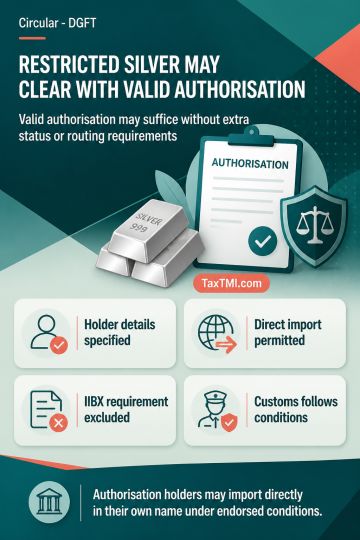
Restricted silver imports may clear under a valid import authorisation without additional status or exchange-routing requirements unless expressly imp...
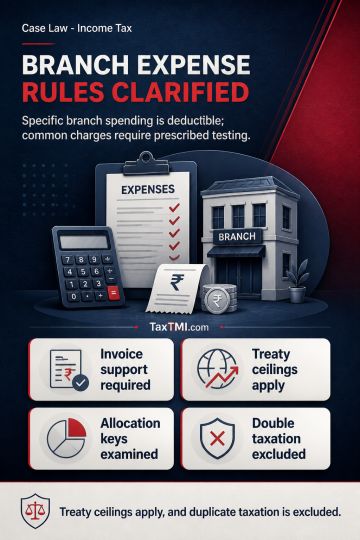
Head Office cost allocation requires prescribed transfer-pricing methods; treaty ceilings bar surcharge and cess, while duplicate taxation is excluded...
Cost-to-cost reimbursement of seconded employees is not service consideration; transfer-pricing markup was deleted and amalgamation amortisation allow...
Crystallisation of liability supports prior-period expense deduction, while functionally distinct divisions require separate transfer-pricing benchmar...
Delay in pronouncement resulting from heavy pendency does not,...
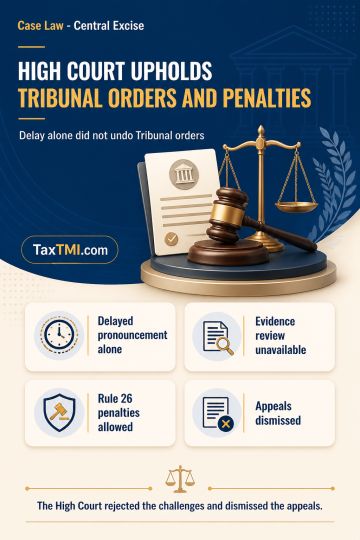
Delayed judgment pronouncement alone does not invalidate Tribunal orders, while rectification cannot reopen evidence or negate confiscation-related penalties.
Contents
Summary
Note
Bookmark
Share
✓ Copied successfully !
Print
Print Options
For full text, please login
Login to TaxTMI
Verification Pending
The Email Id has not been verified. Click on the link we have sent on
Delay in pronouncement resulting from heavy pendency does not, by itself, invalidate a Tribunal order; the High Court therefore declined to interfere on that ground. Rectification cannot be used to reappreciate evidence concerning transit declaration forms or movement of seized goods, because such review falls outside rectification jurisdiction; rejection of the application was sustained. Rule 26 permits penalties against persons dealing with excisable goods when they know or have reason to believe the goods are confiscable. Finding no lack of authority to exercise that discretion, the High Court rejected the penalty challenge and dismissed the appeals.
Delay in pronouncement resulting from heavy pendency does not, by itself, invalidate a Tribunal order; the High Court therefore declined to interfere on that ground. Rectification cannot be used to reappreciate evidence concerning transit declaration forms or movement of seized goods, because such review falls outside rectification jurisdiction; rejection of the application was sustained. Rule 26 permits penalties against persons dealing with excisable goods when they know or have reason to believe the goods are confiscable. Finding no lack of authority to exercise that discretion, the High Court rejected the penalty challenge and dismissed the appeals.
Note: It is a system-generated summary and is for quick reference only.
 TaxTMI
  TaxTMI
 of 4905