Functional comparability under TNMM requires transaction-specific FAR analysis before benchmarking business-support services provided to associated en...
Advance pricing agreement methodology can guide benchmarking for non-covered years when functions, assets, risks and activities remain materially unch...
Tax-audit exemption for substantially State-funded educational universities prevents audit-failure penalties where income qualifies for statutory exem...
Functional, asset and risk analysis excludes diversified technology companies from captive software development comparables under cost-plus arrangemen...
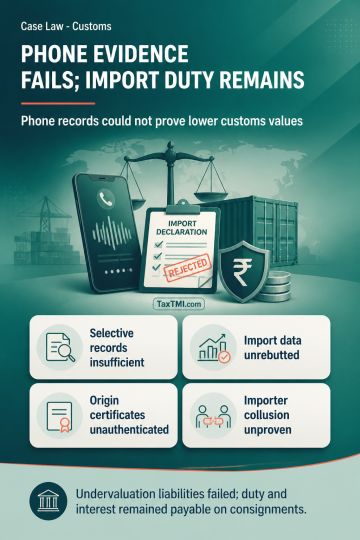
Mobile-phone electronic evidence failed to establish customs undervaluation, while duty survived on non-authentic origin certificates without importer...
Automotive radio classification treats integrated infotainment features as supplementary, placing complete and qualifying unassembled units under the ...
Separate corporate personality prevents directors from being personally liable for company deposits without a guarantee or independent legal undertaki...
Page of 4905
Press 'Enter' after typing page number.
81 to 100 of 98083 Results
❮
❯
❯❯
0 / 200
Expand Note
Add to Folder
No Folders have been created
+
Are you sure you want to delete "My most important" ?
Conditional exemption for parts used in solar photovoltaic...
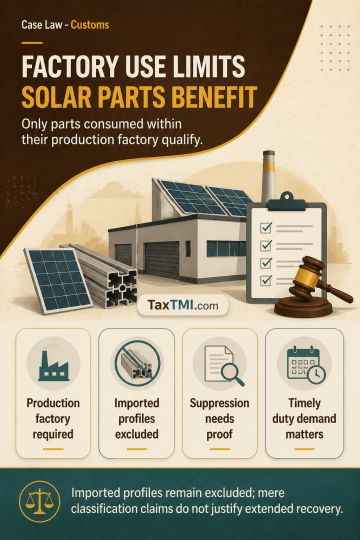
Factory-consumption condition restricts solar module parts exemption and excludes imported aluminium profiles fabricated outside the production factory.
Contents
Summary
Note
Bookmark
Share
✓ Copied successfully !
Print
Print Options
For full text, please login
Login to TaxTMI
Verification Pending
The Email Id has not been verified. Click on the link we have sent on
Conditional exemption for parts used in solar photovoltaic modules is confined to parts consumed within the factory where those parts are produced. Imported or externally procured aluminium profiles remain outside the exemption even if fabricated elsewhere and ultimately used in module manufacture. Extended limitation for recovery of differential customs duty requires wilful misstatement or suppression of material facts; merely claiming a classification or exemption in a Bill of Entry does not establish suppression. Prior audits and earlier proceedings may also negate an allegation that material facts were withheld. Consequential interest and penalties depend on a sustainable, timely duty demand.
Conditional exemption for parts used in solar photovoltaic modules is confined to parts consumed within the factory where those parts are produced. Imported or externally procured aluminium profiles remain outside the exemption even if fabricated elsewhere and ultimately used in module manufacture. Extended limitation for recovery of differential customs duty requires wilful misstatement or suppression of material facts; merely claiming a classification or exemption in a Bill of Entry does not establish suppression. Prior audits and earlier proceedings may also negate an allegation that material facts were withheld. Consequential interest and penalties depend on a sustainable, timely duty demand.
Note: It is a system-generated summary and is for quick reference only.
 TaxTMI
  TaxTMI
 of 4905