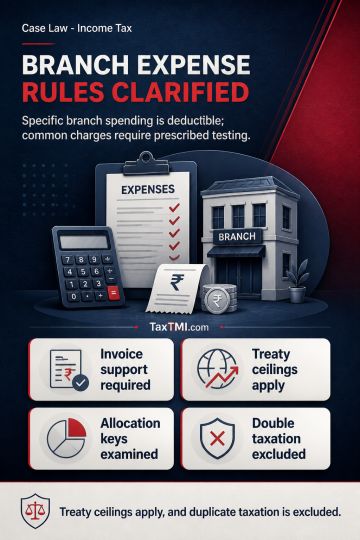
Head Office cost allocation requires prescribed transfer-pricing methods; treaty ceilings bar surcharge and cess, while duplicate taxation is excluded...
Cost-to-cost reimbursement of seconded employees is not service consideration; transfer-pricing markup was deleted and amalgamation amortisation allow...
Crystallisation of liability supports prior-period expense deduction, while functionally distinct divisions require separate transfer-pricing benchmar...
Functional comparability under TNMM requires transaction-specific FAR analysis before benchmarking business-support services provided to associated en...
Advance pricing agreement methodology can guide benchmarking for non-covered years when functions, assets, risks and activities remain materially unch...
Tax-audit exemption for substantially State-funded educational universities prevents audit-failure penalties where income qualifies for statutory exem...
Page of 4907
Press 'Enter' after typing page number.
121 to 140 of 98136 Results
❮
❯
❯❯
0 / 200
Expand Note
Add to Folder
No Folders have been created
+
Are you sure you want to delete "My most important" ?
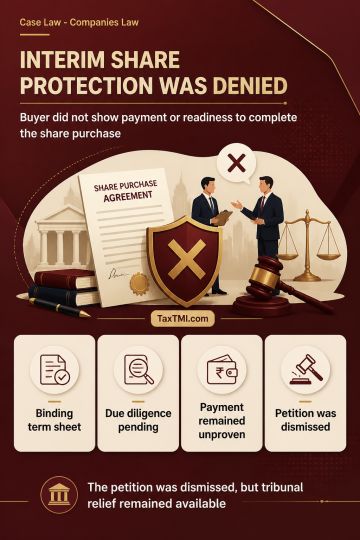
The term sheet constituted a binding understanding, but completion of the share acquisition remained subject to due diligence, regulatory approvals, escrow arrangements, pre-conditions and definitive agreements. Funding obligations were stage-specific; loan advances did not prima facie constitute share-purchase consideration, and the purchaser had not shown timely payment of a material instalment or readiness to perform. Interim protection of escrowed shares was unavailable because the target company had requested status quo from the escrow agent, further securities and shareholder obligations remained disputed, and broader restraints would affect management. The Section 9 petition was dismissed, while preserving recourse to the arbitral tribunal for appropriate interim protection.
The term sheet constituted a binding understanding, but completion of the share acquisition remained subject to due diligence, regulatory approvals, escrow arrangements, pre-conditions and definitive agreements. Funding obligations were stage-specific; loan advances did not prima facie constitute share-purchase consideration, and the purchaser had not shown timely payment of a material instalment or readiness to perform. Interim protection of escrowed shares was unavailable because the target company had requested status quo from the escrow agent, further securities and shareholder obligations remained disputed, and broader restraints would affect management. The Section 9 petition was dismissed, while preserving recourse to the arbitral tribunal for appropriate interim protection.
Note: It is a system-generated summary and is for quick reference only.
 TaxTMI
  TaxTMI
 of 4907