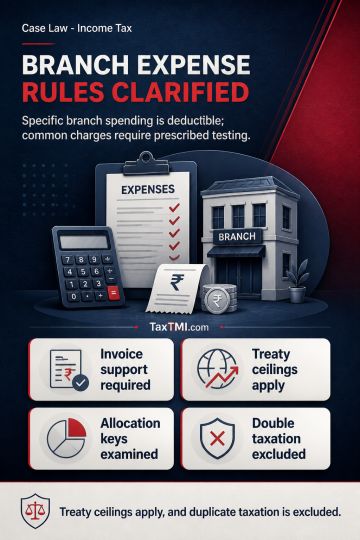
Head Office cost allocation requires prescribed transfer-pricing methods; treaty ceilings bar surcharge and cess, while duplicate taxation is excluded...
Cost-to-cost reimbursement of seconded employees is not service consideration; transfer-pricing markup was deleted and amalgamation amortisation allow...
Crystallisation of liability supports prior-period expense deduction, while functionally distinct divisions require separate transfer-pricing benchmar...
Functional comparability under TNMM requires transaction-specific FAR analysis before benchmarking business-support services provided to associated en...
Page of 4902
Press 'Enter' after typing page number.
1 to 20 of 98021 Results
❮
❯
❯❯
0 / 200
Expand Note
Add to Folder
No Folders have been created
+
Are you sure you want to delete "My most important" ?
Credit-rating restrictions for promoter-connected entities extend conditions concerning common chairmen, directors or employees to securities issued by a promoter's borrowers and subsidiaries, not only associates. Regulation 27(1) was ambiguous on the scope of those conditions and required harmonious construction with the related conflict-of-interest regime in Regulation 28V. Contemporaneous regulatory material and legislative-committee material supported that interpretation. The penalty order was consequently set aside and the appeal allowed.
Credit-rating restrictions for promoter-connected entities extend conditions concerning common chairmen, directors or employees to securities issued by a promoter's borrowers and subsidiaries, not only associates. Regulation 27(1) was ambiguous on the scope of those conditions and required harmonious construction with the related conflict-of-interest regime in Regulation 28V. Contemporaneous regulatory material and legislative-committee material supported that interpretation. The penalty order was consequently set aside and the appeal allowed.
Note: It is a system-generated summary and is for quick reference only.
 TaxTMI
  TaxTMI