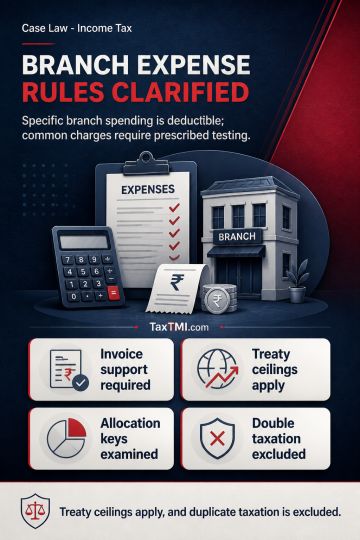
Head Office cost allocation requires prescribed transfer-pricing methods; treaty ceilings bar surcharge and cess, while duplicate taxation is excluded...
Cost-to-cost reimbursement of seconded employees is not service consideration; transfer-pricing markup was deleted and amalgamation amortisation allow...
Crystallisation of liability supports prior-period expense deduction, while functionally distinct divisions require separate transfer-pricing benchmar...
Functional comparability under TNMM requires transaction-specific FAR analysis before benchmarking business-support services provided to associated en...
Advance pricing agreement methodology can guide benchmarking for non-covered years when functions, assets, risks and activities remain materially unch...
Tax-audit exemption for substantially State-funded educational universities prevents audit-failure penalties where income qualifies for statutory exem...
Assignment of GIDC leasehold rights is treated as a transfer of benefits arising from immovable property and therefore falls outside the GST levy under the binding High Court ruling. On that basis, restoration or enhancement of penalties for alleged non-payment of GST did not arise, while the unchallenged confirmation of tax, interest and penalty under Section 73 remained undisturbed. Delayed invoicing and tax payment did not, by themselves, establish suppression with intent to evade tax. A bona fide and reasonable belief that the assignment was non-taxable, later supported by High Court rulings, independently precluded invocation of Section 74 and consequential penalties. The Department's appeal for restoration of penalties was dismissed.
Assignment of GIDC leasehold rights is treated as a transfer of benefits arising from immovable property and therefore falls outside the GST levy under the binding High Court ruling. On that basis, restoration or enhancement of penalties for alleged non-payment of GST did not arise, while the unchallenged confirmation of tax, interest and penalty under Section 73 remained undisturbed. Delayed invoicing and tax payment did not, by themselves, establish suppression with intent to evade tax. A bona fide and reasonable belief that the assignment was non-taxable, later supported by High Court rulings, independently precluded invocation of Section 74 and consequential penalties. The Department's appeal for restoration of penalties was dismissed.
Note: It is a system-generated summary and is for quick reference only.
 TaxTMI
  TaxTMI
 of 4910