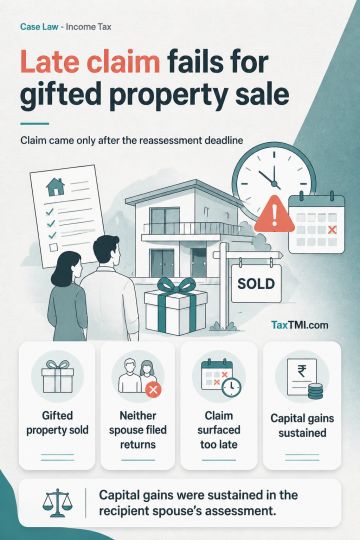
Clubbing of income from gifted property failed where the claim surfaced after reassessment limitation, sustaining capital-gains assessment in spouse's...
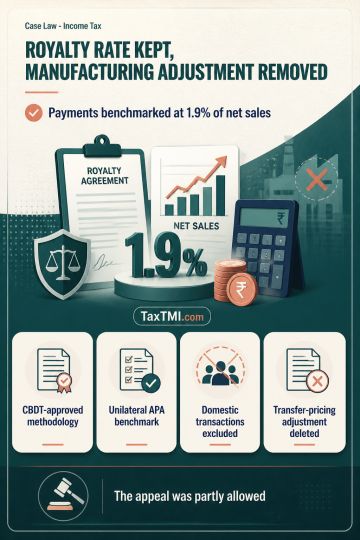
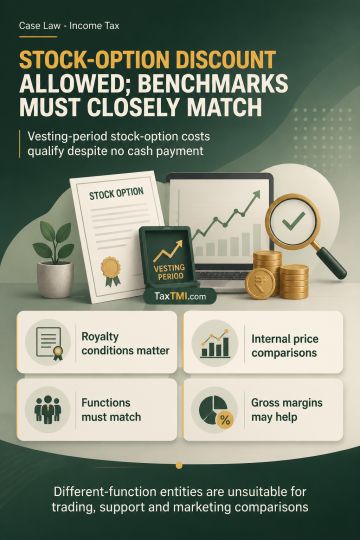
Employee stock-option discount qualifies as revenue expenditure, while royalty and service comparables require reliable functional and transactional b...
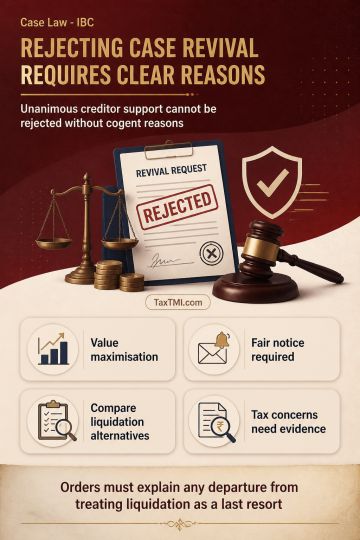
Section 33(1A) gives the Adjudicating Authority residual judicial discretion to restore CIRP; it is not confined to a formal compliance review. Where statutory conditions are met and the Committee of Creditors unanimously supports restoration after deliberation, refusal requires cogent, relevant reasons consistent with value maximisation and the resolution-first objective. Unsubstantiated concerns over monetisation of carried-forward tax losses, without notice or supporting material, cannot displace that decision; tax treatment remains for tax authorities. The availability of an arbitral claim in liquidation requires comparison of value, timing, cost, risk and market interest under both routes. A reasoned order must engage with creditors' deliberations and explain any departure from treating liquidation as a last resort.
Section 33(1A) gives the Adjudicating Authority residual judicial discretion to restore CIRP; it is not confined to a formal compliance review. Where statutory conditions are met and the Committee of Creditors unanimously supports restoration after deliberation, refusal requires cogent, relevant reasons consistent with value maximisation and the resolution-first objective. Unsubstantiated concerns over monetisation of carried-forward tax losses, without notice or supporting material, cannot displace that decision; tax treatment remains for tax authorities. The availability of an arbitral claim in liquidation requires comparison of value, timing, cost, risk and market interest under both routes. A reasoned order must engage with creditors' deliberations and explain any departure from treating liquidation as a last resort.
Note: It is a system-generated summary and is for quick reference only.
 TaxTMI
  TaxTMI
 of 4899