Head Office cost allocation requires prescribed transfer-pricing methods; treaty ceilings bar surcharge and cess, while duplicate taxation is excluded...
Cost-to-cost reimbursement of seconded employees is not service consideration; transfer-pricing markup was deleted and amalgamation amortisation allow...
Crystallisation of liability supports prior-period expense deduction, while functionally distinct divisions require separate transfer-pricing benchmar...
Functional comparability under TNMM requires transaction-specific FAR analysis before benchmarking business-support services provided to associated en...
Advance pricing agreement methodology can guide benchmarking for non-covered years when functions, assets, risks and activities remain materially unch...
Tax-audit exemption for substantially State-funded educational universities prevents audit-failure penalties where income qualifies for statutory exem...
Functional, asset and risk analysis excludes diversified technology companies from captive software development comparables under cost-plus arrangemen...
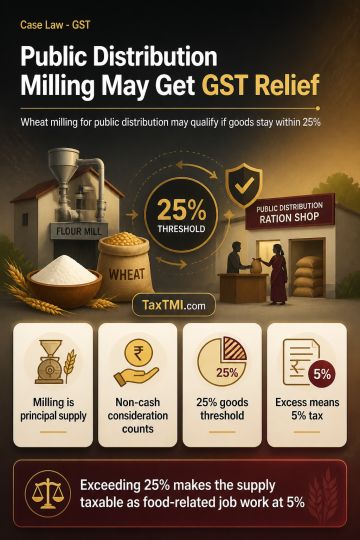
Composite supply of milling allocated wheat, fortifying the flour and packing it for Public Distribution System delivery has milling as its principal supply; fortification and packaging are ancillary. Total consideration includes cash and agreed non-cash consideration represented by retained gunny bags, bran and refractor, rather than their future disposal proceeds. Where goods used for fortification and packing remain within 25 per cent of total composite-supply value, the supply to the State Government qualifies for Serial No. 3A exemption because it relates to public distribution, a function under Article 243G. If the goods component exceeds that threshold, exemption is unavailable and the supply is taxable as food-related job work at 5 per cent.
Composite supply of milling allocated wheat, fortifying the flour and packing it for Public Distribution System delivery has milling as its principal supply; fortification and packaging are ancillary. Total consideration includes cash and agreed non-cash consideration represented by retained gunny bags, bran and refractor, rather than their future disposal proceeds. Where goods used for fortification and packing remain within 25 per cent of total composite-supply value, the supply to the State Government qualifies for Serial No. 3A exemption because it relates to public distribution, a function under Article 243G. If the goods component exceeds that threshold, exemption is unavailable and the supply is taxable as food-related job work at 5 per cent.
Note: It is a system-generated summary and is for quick reference only.
 TaxTMI
  TaxTMI