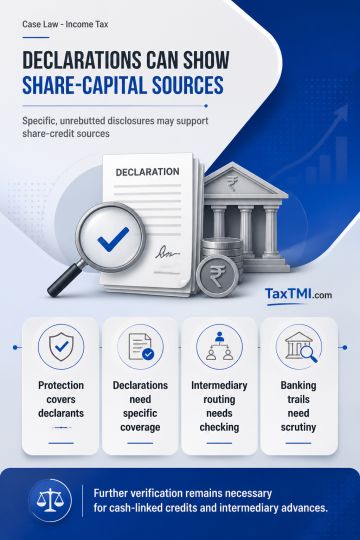
Income Declaration Scheme declarations can evidence share-capital sources, while round-tripped funds and cash-linked credits require further verificat...
Permanent establishment tests: independent subsidiary premises and principal-to-principal dealings did not create Indian taxability for offshore suppl...
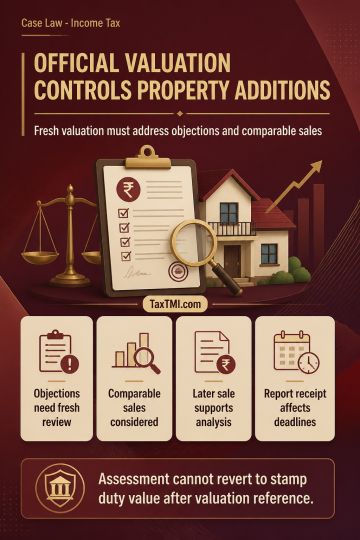
Valuation Officer estimates govern property-value additions once statutory valuation is invoked, requiring fresh consideration of objections and compa...
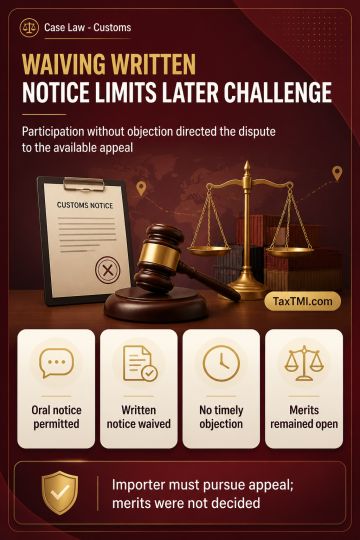
Waiver of written show-cause notice may prevent a later procedural challenge after participation in customs adjudication, preserving statutory appella...
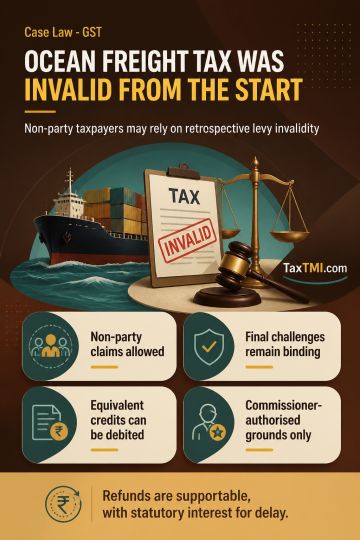
Retrospective invalidity of ocean-freight IGST supports refunds despite non-party status and prior credit utilisation, subject to authorised appeal gr...
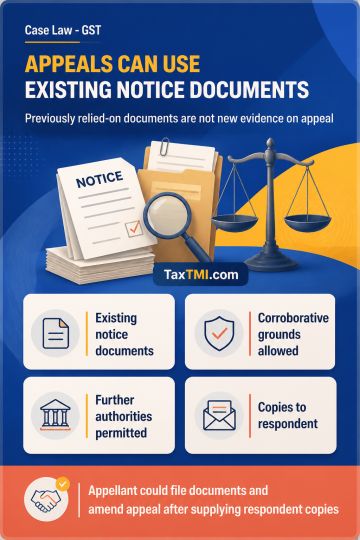
Additional evidence in departmental appeals may include show-cause-notice material without introducing a new case where it merely corroborates existin...
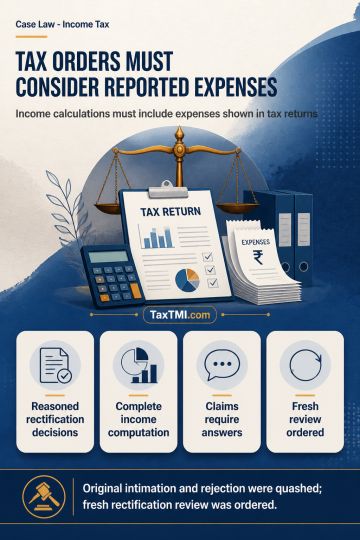
Reasoned rectification orders require consideration of expenditure disclosed in income-tax returns, preventing revision based on incomplete income com...
Page of 4916
Press 'Enter' after typing page number.
501 to 520 of 98302 Results
❮
❯
❯❯
0 / 200
Expand Note
Add to Folder
No Folders have been created
+
Are you sure you want to delete "My most important" ?
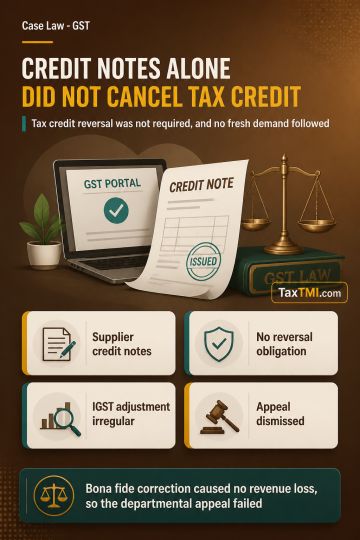
Recipient input tax credit did not require reversal solely because a supplier issued credit notes during the relevant period: neither the Act nor the Rules imposed that obligation, the statutory matching mechanism was inoperative, and Rule 37 concerned non-payment to suppliers. Accordingly, the premise for reversal failed. Excess IGST adjusted against CGST and SGST liabilities was procedurally irregular because the prescribed refund, re-credit or subsequent IGST-adjustment route was not used. However, as a bona fide first-year GST correction causing no revenue loss, it did not justify a fresh tax demand, interest or penalty; the departmental appeal was dismissed.
Recipient input tax credit did not require reversal solely because a supplier issued credit notes during the relevant period: neither the Act nor the Rules imposed that obligation, the statutory matching mechanism was inoperative, and Rule 37 concerned non-payment to suppliers. Accordingly, the premise for reversal failed. Excess IGST adjusted against CGST and SGST liabilities was procedurally irregular because the prescribed refund, re-credit or subsequent IGST-adjustment route was not used. However, as a bona fide first-year GST correction causing no revenue loss, it did not justify a fresh tax demand, interest or penalty; the departmental appeal was dismissed.
Note: It is a system-generated summary and is for quick reference only.
 TaxTMI
 TaxTMI

 of 4916