Suspension of insolvency professional registration prevents continued Resolution Professional appointments and restricts interim stays that effectivel...
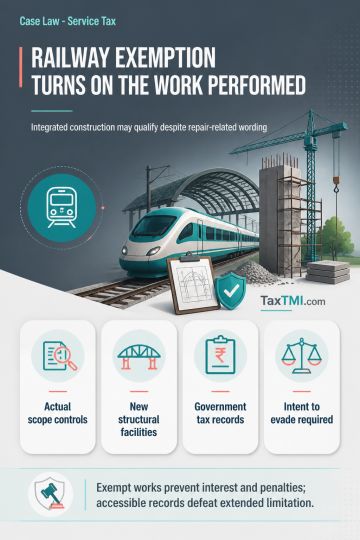
Original works exemption for railway contracts depends on actual integrated construction scope, while accessible tax data defeats suppression allegati...
Survey surrender characterisation determines whether mixed excess stock and business-linked cash face normal taxation or special deemed-income taxatio...
Page of 4902
Press 'Enter' after typing page number.
81 to 100 of 98021 Results
❮
❯
❯❯
0 / 200
Expand Note
Add to Folder
No Folders have been created
+
Are you sure you want to delete "My most important" ?
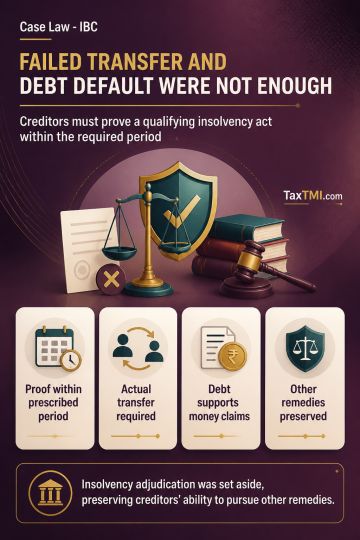
Creditor insolvency petitions require proof that the debtor committed a statutory act of insolvency within the prescribed period; the conditions are conjunctive. An attempted or agreed transfer of property, without an actual transfer, does not fall within the statutory definition. Non-repayment of debt may support a money claim but does not independently constitute an act of insolvency. Because no qualifying statutory act was established, the High Court set aside the insolvency adjudication and all consequential directions, while preserving creditors' ability to pursue other remedies in law.
Creditor insolvency petitions require proof that the debtor committed a statutory act of insolvency within the prescribed period; the conditions are conjunctive. An attempted or agreed transfer of property, without an actual transfer, does not fall within the statutory definition. Non-repayment of debt may support a money claim but does not independently constitute an act of insolvency. Because no qualifying statutory act was established, the High Court set aside the insolvency adjudication and all consequential directions, while preserving creditors' ability to pursue other remedies in law.
Note: It is a system-generated summary and is for quick reference only.
 TaxTMI
  TaxTMI
 of 4902