Cost-to-cost reimbursement of seconded employees is not service consideration; transfer-pricing markup was deleted and amalgamation amortisation allow...
Crystallisation of liability supports prior-period expense deduction, while functionally distinct divisions require separate transfer-pricing benchmar...
Functional comparability under TNMM requires transaction-specific FAR analysis before benchmarking business-support services provided to associated en...
Advance pricing agreement methodology can guide benchmarking for non-covered years when functions, assets, risks and activities remain materially unch...
Tax-audit exemption for substantially State-funded educational universities prevents audit-failure penalties where income qualifies for statutory exem...
Functional, asset and risk analysis excludes diversified technology companies from captive software development comparables under cost-plus arrangemen...
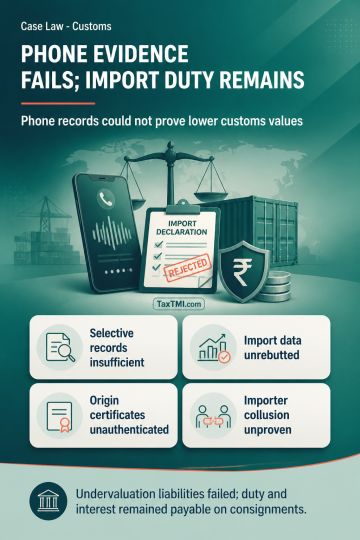
Mobile-phone electronic evidence failed to establish customs undervaluation, while duty survived on non-authentic origin certificates without importer...
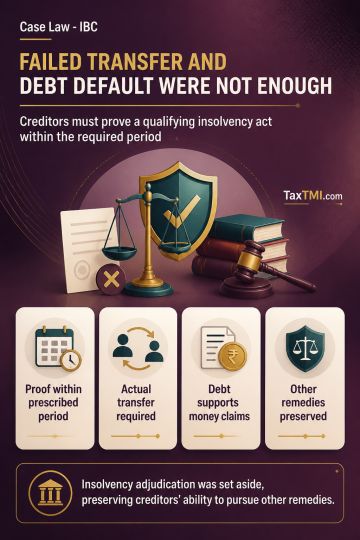
Creditor insolvency petitions require proof that the debtor committed a statutory act of insolvency within the prescribed period; the conditions are conjunctive. An attempted or agreed transfer of property, without an actual transfer, does not fall within the statutory definition. Non-repayment of debt may support a money claim but does not independently constitute an act of insolvency. Because no qualifying statutory act was established, the High Court set aside the insolvency adjudication and all consequential directions, while preserving creditors' ability to pursue other remedies in law.
Creditor insolvency petitions require proof that the debtor committed a statutory act of insolvency within the prescribed period; the conditions are conjunctive. An attempted or agreed transfer of property, without an actual transfer, does not fall within the statutory definition. Non-repayment of debt may support a money claim but does not independently constitute an act of insolvency. Because no qualifying statutory act was established, the High Court set aside the insolvency adjudication and all consequential directions, while preserving creditors' ability to pursue other remedies in law.
Note: It is a system-generated summary and is for quick reference only.
 TaxTMI
  TaxTMI
 of 4902