Infrastructure-development deduction remains available to EPC contractors when substantive statutory conditions outweigh contractor labels in agreemen...
Explained Investment Sources: documented gifts and traceable salary savings supported deletion of additions for property and mutual-fund SIP investmen...
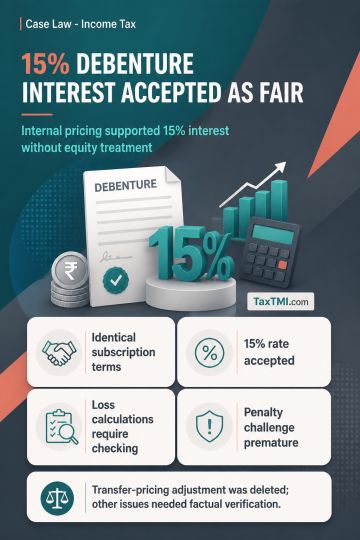
Internal comparable pricing supports arm's-length interest on compulsorily convertible debentures, preventing their recharacterisation as equity for t...
Nominee director protection shields independent financial-institution appointees from criminal liability where they lack involvement in deposit defaul...
PFUTP liability for alleged settlement-price depression requires...
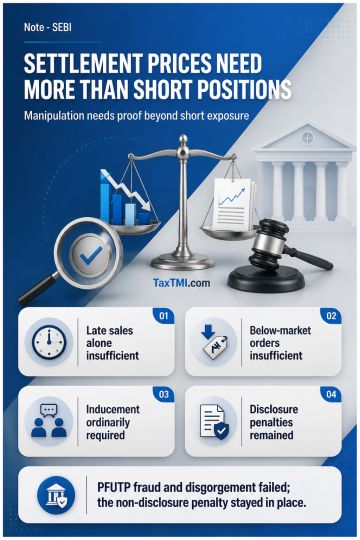
Settlement-price depression requires proof of manipulation, not merely short exposure, late selling, or below-market orders, preserving disclosure penalties.
Contents
Summary
Note
Bookmark
Share
✓ Copied successfully !
Print
Print Options
For full text, please login
Login to TaxTMI
Verification Pending
The Email Id has not been verified. Click on the link we have sent on
PFUTP liability for alleged settlement-price depression requires cogent evidence of a manipulative act directed at producing an artificial price, not merely a large short derivatives position, closing-window cash sales, or sell orders below the last traded price. Fraud under Regulation 2(1)(c) ordinarily requires inducement; where inducement is not directly established, manipulation requires compelling evidence from market-wide activity, execution mechanics, commercial rationale, and causal price impact. Position-limit breaches and agency-based concentration may support disclosure penalties but do not alone prove fraud. Combined exposure across all derivative contracts must be considered where required by the governing framework. Failure to establish intended price depression precluded PFUTP fraud and disgorgement, while the non-disclosure penalty remained.
PFUTP liability for alleged settlement-price depression requires cogent evidence of a manipulative act directed at producing an artificial price, not merely a large short derivatives position, closing-window cash sales, or sell orders below the last traded price. Fraud under Regulation 2(1)(c) ordinarily requires inducement; where inducement is not directly established, manipulation requires compelling evidence from market-wide activity, execution mechanics, commercial rationale, and causal price impact. Position-limit breaches and agency-based concentration may support disclosure penalties but do not alone prove fraud. Combined exposure across all derivative contracts must be considered where required by the governing framework. Failure to establish intended price depression precluded PFUTP fraud and disgorgement, while the non-disclosure penalty remained.
Note: It is a system-generated summary and is for quick reference only.
 TaxTMI
 TaxTMI

 of 4918