Advance pricing agreement methodology can guide benchmarking for non-covered years when functions, assets, risks and activities remain materially unch...
Tax-audit exemption for substantially State-funded educational universities prevents audit-failure penalties where income qualifies for statutory exem...
Functional, asset and risk analysis excludes diversified technology companies from captive software development comparables under cost-plus arrangemen...
Mobile-phone electronic evidence failed to establish customs undervaluation, while duty survived on non-authentic origin certificates without importer...
Automotive radio classification treats integrated infotainment features as supplementary, placing complete and qualifying unassembled units under the ...
Separate corporate personality prevents directors from being personally liable for company deposits without a guarantee or independent legal undertaki...
PFUTP liability for alleged settlement-price depression requires...
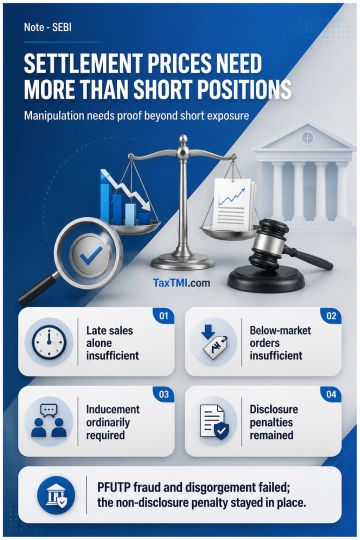
Settlement-price depression requires proof of manipulation, not merely short exposure, late selling, or below-market orders, preserving disclosure penalties.
Contents
Summary
Note
Bookmark
Share
✓ Copied successfully !
Print
Print Options
For full text, please login
Login to TaxTMI
Verification Pending
The Email Id has not been verified. Click on the link we have sent on
PFUTP liability for alleged settlement-price depression requires cogent evidence of a manipulative act directed at producing an artificial price, not merely a large short derivatives position, closing-window cash sales, or sell orders below the last traded price. Fraud under Regulation 2(1)(c) ordinarily requires inducement; where inducement is not directly established, manipulation requires compelling evidence from market-wide activity, execution mechanics, commercial rationale, and causal price impact. Position-limit breaches and agency-based concentration may support disclosure penalties but do not alone prove fraud. Combined exposure across all derivative contracts must be considered where required by the governing framework. Failure to establish intended price depression precluded PFUTP fraud and disgorgement, while the non-disclosure penalty remained.
PFUTP liability for alleged settlement-price depression requires cogent evidence of a manipulative act directed at producing an artificial price, not merely a large short derivatives position, closing-window cash sales, or sell orders below the last traded price. Fraud under Regulation 2(1)(c) ordinarily requires inducement; where inducement is not directly established, manipulation requires compelling evidence from market-wide activity, execution mechanics, commercial rationale, and causal price impact. Position-limit breaches and agency-based concentration may support disclosure penalties but do not alone prove fraud. Combined exposure across all derivative contracts must be considered where required by the governing framework. Failure to establish intended price depression precluded PFUTP fraud and disgorgement, while the non-disclosure penalty remained.
Note: It is a system-generated summary and is for quick reference only.
 TaxTMI
  TaxTMI
 of 4901