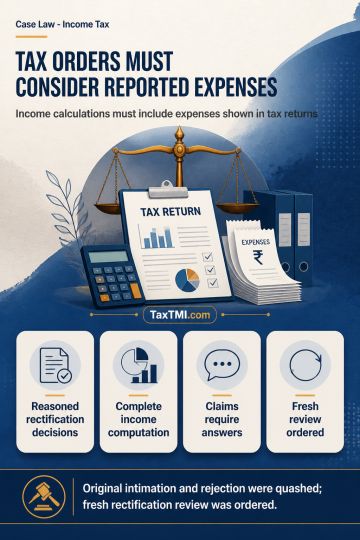
Reasoned rectification orders require consideration of expenditure disclosed in income-tax returns, preventing revision based on incomplete income com...
Modified returns after business reorganisations cannot trigger fresh scrutiny once the original assessment was complete, invalidating related transfer...
Third-party loose sheets require reliable nexus before supporting unexplained expenditure additions; presumptions do not establish payer identity or o...
TNMM comparability using audited accounts and working-capital adjustments can eliminate unwarranted transfer-pricing additions where verified margins ...
Gross-profit additions on disputed purchases require reasoned appellate determination; disclosed claims alone do not support inaccurate-particulars pe...
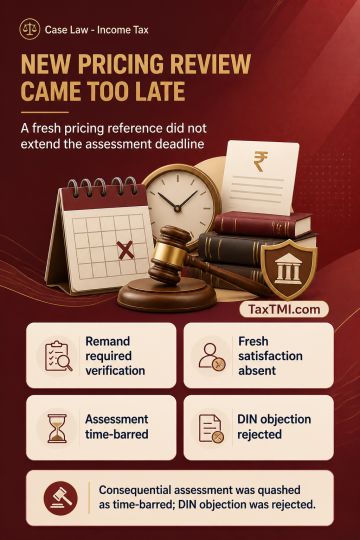
Limitation after transfer-pricing remand: fresh TPO reference did not extend the assessment deadline, rendering the consequential assessment time-barr...
Interim judicial restraint on tax deduction prevents default, while supporting reasonable cause and penalty deletion for foreign-leg LFC reimbursement...
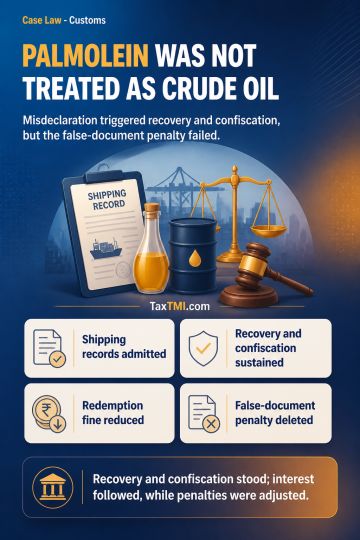
Palmolein classification defeated the crude-oil concession; material misdeclaration sustained recovery and confiscation, while separate false-document...
Article 227 supervisory intervention in ongoing arbitration is...
Article 227 review permits intervention in arbitration only for manifest, patent inherent jurisdictional defects, not representational authority disputes.
Contents
Summary
Note
Bookmark
Share
✓ Copied successfully !
Print
Print Options
For full text, please login
Login to TaxTMI
Verification Pending
The Email Id has not been verified. Click on the link we have sent on
Article 227 supervisory intervention in ongoing arbitration is confined to a manifest and patent lack of inherent jurisdiction. Where the arbitration agreement, its invocation for a joint venture, and commencement of the reference are undisputed, a dispute over a liquidator's authority to represent the joint venture and continue proceedings falls within the arbitral tribunal's competence. A joint venture constituent that remains silent after notice of the liquidator's asserted authority may be treated as having acquiesced. Equitable supervisory relief is unavailable where intervention seeks to terminate a pre-existing claim rather than protect the joint venture's interests, particularly where the conduct is in bad faith.
Article 227 supervisory intervention in ongoing arbitration is confined to a manifest and patent lack of inherent jurisdiction. Where the arbitration agreement, its invocation for a joint venture, and commencement of the reference are undisputed, a dispute over a liquidator's authority to represent the joint venture and continue proceedings falls within the arbitral tribunal's competence. A joint venture constituent that remains silent after notice of the liquidator's asserted authority may be treated as having acquiesced. Equitable supervisory relief is unavailable where intervention seeks to terminate a pre-existing claim rather than protect the joint venture's interests, particularly where the conduct is in bad faith.
Note: It is a system-generated summary and is for quick reference only.
 TaxTMI
  TaxTMI
 of 4905