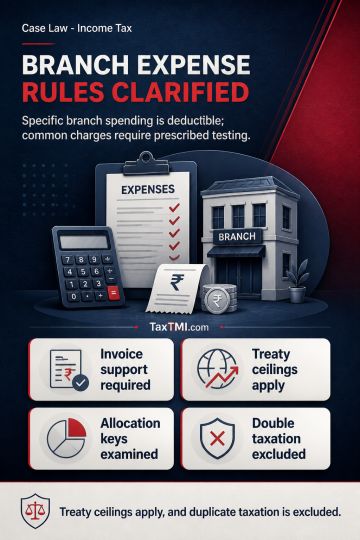
Head Office cost allocation requires prescribed transfer-pricing methods; treaty ceilings bar surcharge and cess, while duplicate taxation is excluded...
Cost-to-cost reimbursement of seconded employees is not service consideration; transfer-pricing markup was deleted and amalgamation amortisation allow...
Crystallisation of liability supports prior-period expense deduction, while functionally distinct divisions require separate transfer-pricing benchmar...
Functional comparability under TNMM requires transaction-specific FAR analysis before benchmarking business-support services provided to associated en...
Page of 4902
Press 'Enter' after typing page number.
1 to 20 of 98021 Results
❮
❯
❯❯
0 / 200
Expand Note
Add to Folder
No Folders have been created
+
Are you sure you want to delete "My most important" ?
Article 227 supervisory intervention in ongoing arbitration is...
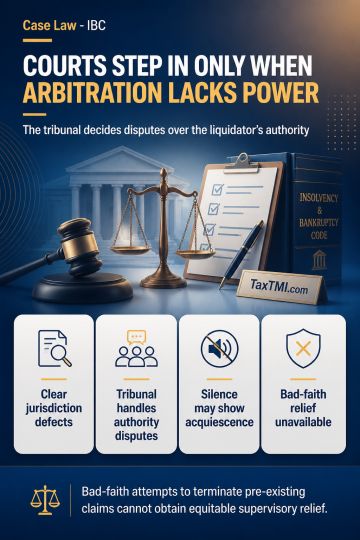
Article 227 review permits intervention in arbitration only for manifest, patent inherent jurisdictional defects, not representational authority disputes.
Contents
Summary
Note
Bookmark
Share
✓ Copied successfully !
Print
Print Options
For full text, please login
Login to TaxTMI
Verification Pending
The Email Id has not been verified. Click on the link we have sent on
Article 227 supervisory intervention in ongoing arbitration is confined to a manifest and patent lack of inherent jurisdiction. Where the arbitration agreement, its invocation for a joint venture, and commencement of the reference are undisputed, a dispute over a liquidator's authority to represent the joint venture and continue proceedings falls within the arbitral tribunal's competence. A joint venture constituent that remains silent after notice of the liquidator's asserted authority may be treated as having acquiesced. Equitable supervisory relief is unavailable where intervention seeks to terminate a pre-existing claim rather than protect the joint venture's interests, particularly where the conduct is in bad faith.
Article 227 supervisory intervention in ongoing arbitration is confined to a manifest and patent lack of inherent jurisdiction. Where the arbitration agreement, its invocation for a joint venture, and commencement of the reference are undisputed, a dispute over a liquidator's authority to represent the joint venture and continue proceedings falls within the arbitral tribunal's competence. A joint venture constituent that remains silent after notice of the liquidator's asserted authority may be treated as having acquiesced. Equitable supervisory relief is unavailable where intervention seeks to terminate a pre-existing claim rather than protect the joint venture's interests, particularly where the conduct is in bad faith.
Note: It is a system-generated summary and is for quick reference only.
 TaxTMI
  TaxTMI