Advance pricing agreement methodology can guide benchmarking for non-covered years when functions, assets, risks and activities remain materially unch...
Tax-audit exemption for substantially State-funded educational universities prevents audit-failure penalties where income qualifies for statutory exem...
Functional, asset and risk analysis excludes diversified technology companies from captive software development comparables under cost-plus arrangemen...
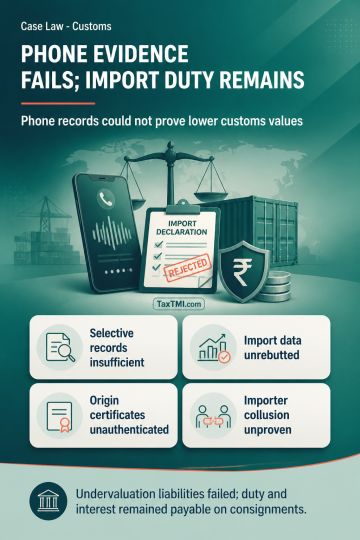
Mobile-phone electronic evidence failed to establish customs undervaluation, while duty survived on non-authentic origin certificates without importer...
Automotive radio classification treats integrated infotainment features as supplementary, placing complete and qualifying unassembled units under the ...
Separate corporate personality prevents directors from being personally liable for company deposits without a guarantee or independent legal undertaki...
Berry ratio is unsuitable as a profit level indicator for a jewellery manufacturer that bears material, inventory, price and manufacturing risks, because value-added expenses exclude material costs, capital deployment and risks; total cost is the more reliable base. Sales transfer-pricing adjustments based on that ratio were deleted. Notional interest on associated-enterprise receivables requires parity analysis against unrelated customers: where identical 180-day, interest-free credit terms applied, the adjustment was deleted. For a later year, verification was required and any interest confined to delays beyond 180 days at six-month LIBOR plus verified bank spread. Transfer-pricing adjustments could not be included in book profit contrary to binding directions.
Berry ratio is unsuitable as a profit level indicator for a jewellery manufacturer that bears material, inventory, price and manufacturing risks, because value-added expenses exclude material costs, capital deployment and risks; total cost is the more reliable base. Sales transfer-pricing adjustments based on that ratio were deleted. Notional interest on associated-enterprise receivables requires parity analysis against unrelated customers: where identical 180-day, interest-free credit terms applied, the adjustment was deleted. For a later year, verification was required and any interest confined to delays beyond 180 days at six-month LIBOR plus verified bank spread. Transfer-pricing adjustments could not be included in book profit contrary to binding directions.
Note: It is a system-generated summary and is for quick reference only.
 TaxTMI
  TaxTMI
 of 4908