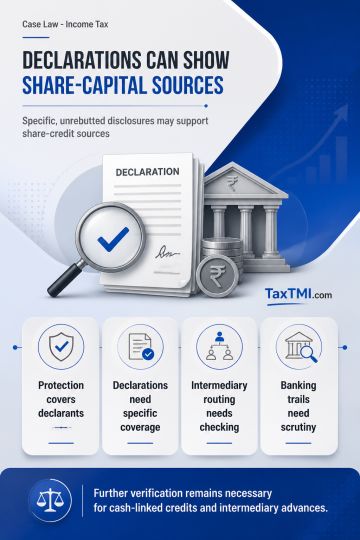
Income Declaration Scheme declarations can evidence share-capital sources, while round-tripped funds and cash-linked credits require further verificat...
Permanent establishment tests: independent subsidiary premises and principal-to-principal dealings did not create Indian taxability for offshore suppl...
Valuation Officer estimates govern property-value additions once statutory valuation is invoked, requiring fresh consideration of objections and compa...
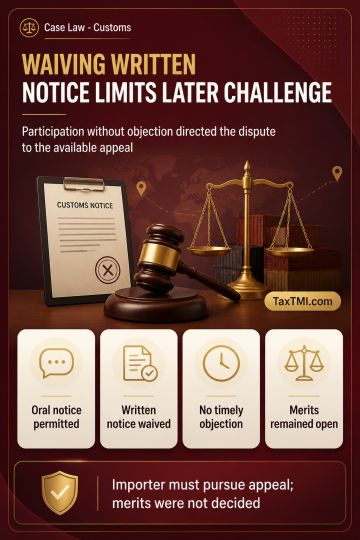
Waiver of written show-cause notice may prevent a later procedural challenge after participation in customs adjudication, preserving statutory appella...
Retrospective invalidity of ocean-freight IGST supports refunds despite non-party status and prior credit utilisation, subject to authorised appeal gr...
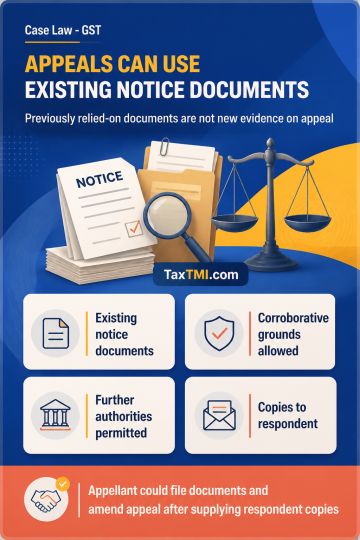
Additional evidence in departmental appeals may include show-cause-notice material without introducing a new case where it merely corroborates existin...
Berry ratio is unsuitable as a profit level indicator for a jewellery manufacturer that bears material, inventory, price and manufacturing risks, because value-added expenses exclude material costs, capital deployment and risks; total cost is the more reliable base. Sales transfer-pricing adjustments based on that ratio were deleted. Notional interest on associated-enterprise receivables requires parity analysis against unrelated customers: where identical 180-day, interest-free credit terms applied, the adjustment was deleted. For a later year, verification was required and any interest confined to delays beyond 180 days at six-month LIBOR plus verified bank spread. Transfer-pricing adjustments could not be included in book profit contrary to binding directions.
Berry ratio is unsuitable as a profit level indicator for a jewellery manufacturer that bears material, inventory, price and manufacturing risks, because value-added expenses exclude material costs, capital deployment and risks; total cost is the more reliable base. Sales transfer-pricing adjustments based on that ratio were deleted. Notional interest on associated-enterprise receivables requires parity analysis against unrelated customers: where identical 180-day, interest-free credit terms applied, the adjustment was deleted. For a later year, verification was required and any interest confined to delays beyond 180 days at six-month LIBOR plus verified bank spread. Transfer-pricing adjustments could not be included in book profit contrary to binding directions.
Note: It is a system-generated summary and is for quick reference only.
 TaxTMI
  TaxTMI
 of 4905