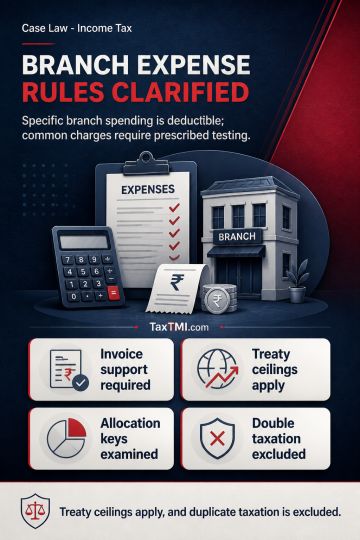
Head Office cost allocation requires prescribed transfer-pricing methods; treaty ceilings bar surcharge and cess, while duplicate taxation is excluded...
Cost-to-cost reimbursement of seconded employees is not service consideration; transfer-pricing markup was deleted and amalgamation amortisation allow...
Crystallisation of liability supports prior-period expense deduction, while functionally distinct divisions require separate transfer-pricing benchmar...
Functional comparability under TNMM requires transaction-specific FAR analysis before benchmarking business-support services provided to associated en...
Advance pricing agreement methodology can guide benchmarking for non-covered years when functions, assets, risks and activities remain materially unch...
Tax-audit exemption for substantially State-funded educational universities prevents audit-failure penalties where income qualifies for statutory exem...
Page of 4907
Press 'Enter' after typing page number.
121 to 140 of 98136 Results
❮
❯
❯❯
0 / 200
Expand Note
Add to Folder
No Folders have been created
+
Are you sure you want to delete "My most important" ?
Section 129 transit penalties may operate on a strict-liability basis, but still require proof of a statutory breach attracting the penalty. Where invoices, e-way bills and bilty documents matched the goods, the buyer was identifiable, and historical records supported use of its former address, a repeated consignee-address entry was treated as a bona fide documentary error. In the absence of evidence of a fictitious purchaser, diversion, clandestine unloading, value suppression, or tax evasion, the discrepancy did not establish a substantive transit violation. The transit penalty and consequential recovery were annulled, while tax lawfully payable on the supply remained unaffected.
Section 129 transit penalties may operate on a strict-liability basis, but still require proof of a statutory breach attracting the penalty. Where invoices, e-way bills and bilty documents matched the goods, the buyer was identifiable, and historical records supported use of its former address, a repeated consignee-address entry was treated as a bona fide documentary error. In the absence of evidence of a fictitious purchaser, diversion, clandestine unloading, value suppression, or tax evasion, the discrepancy did not establish a substantive transit violation. The transit penalty and consequential recovery were annulled, while tax lawfully payable on the supply remained unaffected.
Note: It is a system-generated summary and is for quick reference only.
 TaxTMI
  TaxTMI
 of 4907