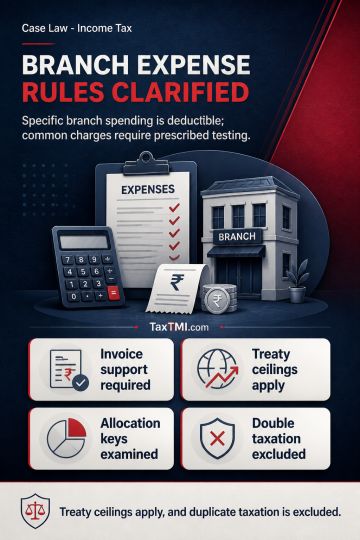
Head Office cost allocation requires prescribed transfer-pricing methods; treaty ceilings bar surcharge and cess, while duplicate taxation is excluded...
Cost-to-cost reimbursement of seconded employees is not service consideration; transfer-pricing markup was deleted and amalgamation amortisation allow...
Crystallisation of liability supports prior-period expense deduction, while functionally distinct divisions require separate transfer-pricing benchmar...
Functional comparability under TNMM requires transaction-specific FAR analysis before benchmarking business-support services provided to associated en...
Advance pricing agreement methodology can guide benchmarking for non-covered years when functions, assets, risks and activities remain materially unch...
Tax-audit exemption for substantially State-funded educational universities prevents audit-failure penalties where income qualifies for statutory exem...
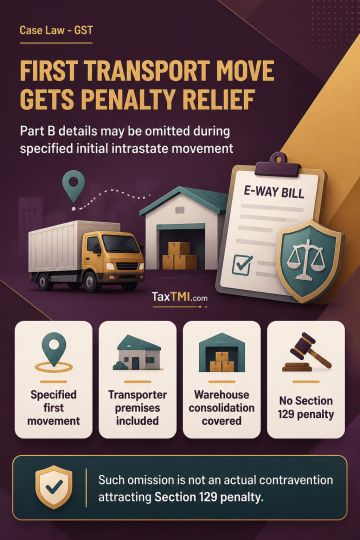
Rule 138(3)'s third proviso permits Part B conveyance details to remain unfilled during the specified initial intrastate movement from a consignor's business premises to a transporter's premises for further transportation. The exception covers movement to a transporter's warehouse for consolidation before onward dispatch, rather than every short-distance journey. A permitted omission does not constitute an actual contravention attracting a Section 129 penalty, despite its overriding language. Appeals below the statutory monetary threshold may be admitted where a substantive issue concerning this exception and the resulting penalty warrants consideration on merits.
Rule 138(3)'s third proviso permits Part B conveyance details to remain unfilled during the specified initial intrastate movement from a consignor's business premises to a transporter's premises for further transportation. The exception covers movement to a transporter's warehouse for consolidation before onward dispatch, rather than every short-distance journey. A permitted omission does not constitute an actual contravention attracting a Section 129 penalty, despite its overriding language. Appeals below the statutory monetary threshold may be admitted where a substantive issue concerning this exception and the resulting penalty warrants consideration on merits.
Note: It is a system-generated summary and is for quick reference only.
 TaxTMI
  TaxTMI
 of 4910