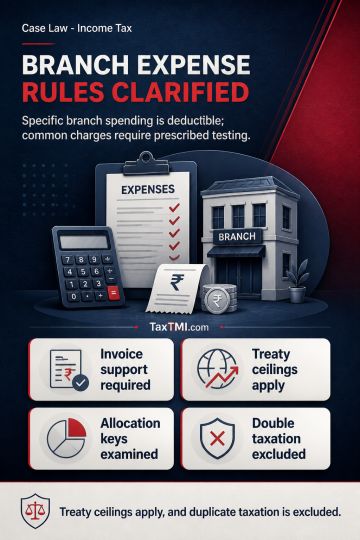
Head Office cost allocation requires prescribed transfer-pricing methods; treaty ceilings bar surcharge and cess, while duplicate taxation is excluded...
Cost-to-cost reimbursement of seconded employees is not service consideration; transfer-pricing markup was deleted and amalgamation amortisation allow...
Crystallisation of liability supports prior-period expense deduction, while functionally distinct divisions require separate transfer-pricing benchmar...
Functional comparability under TNMM requires transaction-specific FAR analysis before benchmarking business-support services provided to associated en...
Advance pricing agreement methodology can guide benchmarking for non-covered years when functions, assets, risks and activities remain materially unch...
Page of 4912
Press 'Enter' after typing page number.
221 to 240 of 98239 Results
❮
❯
❯❯
0 / 200
Expand Note
Add to Folder
No Folders have been created
+
Are you sure you want to delete "My most important" ?
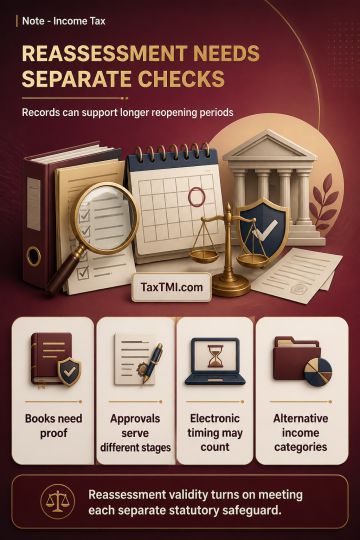
Reassessment validity depends on distinct safeguards governing notice, limitation and approvals. Under section 149(1)(b), extended limitation may apply where books, documents or evidence reveal qualifying escaped income represented as an asset, relevant expenditure, or entries in books of account; these are alternative statutory categories. Digital and handwritten cash-book records may constitute books of account when supported by possession, control, corroboration and taxpayer nexus. Section 151 sanction requires genuine consideration of the reopening proposal and material, but need not contain elaborate reasons. Approval for a section 143(2) notice must precede its issuance, and contemporaneous electronic communication may establish timing despite a later postal receipt. Section 148B approval for the assessment order remains distinct from notice-stage and scrutiny-notice approvals.
Reassessment validity depends on distinct safeguards governing notice, limitation and approvals. Under section 149(1)(b), extended limitation may apply where books, documents or evidence reveal qualifying escaped income represented as an asset, relevant expenditure, or entries in books of account; these are alternative statutory categories. Digital and handwritten cash-book records may constitute books of account when supported by possession, control, corroboration and taxpayer nexus. Section 151 sanction requires genuine consideration of the reopening proposal and material, but need not contain elaborate reasons. Approval for a section 143(2) notice must precede its issuance, and contemporaneous electronic communication may establish timing despite a later postal receipt. Section 148B approval for the assessment order remains distinct from notice-stage and scrutiny-notice approvals.
Note: It is a system-generated summary and is for quick reference only.
 TaxTMI
  TaxTMI
 of 4912