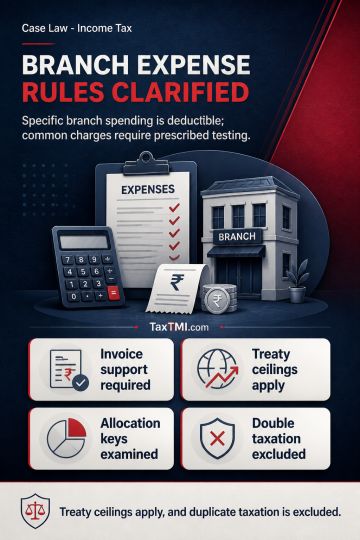
Head Office cost allocation requires prescribed transfer-pricing methods; treaty ceilings bar surcharge and cess, while duplicate taxation is excluded...
Cost-to-cost reimbursement of seconded employees is not service consideration; transfer-pricing markup was deleted and amalgamation amortisation allow...
Crystallisation of liability supports prior-period expense deduction, while functionally distinct divisions require separate transfer-pricing benchmar...
Functional comparability under TNMM requires transaction-specific FAR analysis before benchmarking business-support services provided to associated en...
Page of 4908
Press 'Enter' after typing page number.
121 to 140 of 98141 Results
❮
❯
❯❯
0 / 200
Expand Note
Add to Folder
No Folders have been created
+
Are you sure you want to delete "My most important" ?
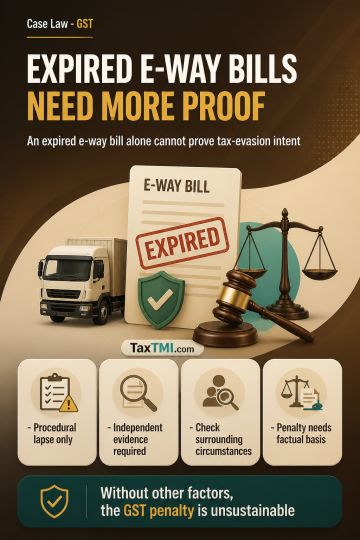
Expiry of an e-way bill constitutes a procedural or documentary lapse and, without independent evidence, does not by itself establish an intention to evade tax for imposing a GST penalty. Penalty requires assessment of surrounding circumstances, including whether goods were diverted, the transaction was suppressed, goods differed from declarations, or the destination was undisclosed. Where none of these factors is present, the penalty lacks a factual basis and is unsustainable.
Expiry of an e-way bill constitutes a procedural or documentary lapse and, without independent evidence, does not by itself establish an intention to evade tax for imposing a GST penalty. Penalty requires assessment of surrounding circumstances, including whether goods were diverted, the transaction was suppressed, goods differed from declarations, or the destination was undisclosed. Where none of these factors is present, the penalty lacks a factual basis and is unsustainable.
Note: It is a system-generated summary and is for quick reference only.
 TaxTMI
  TaxTMI
 of 4908