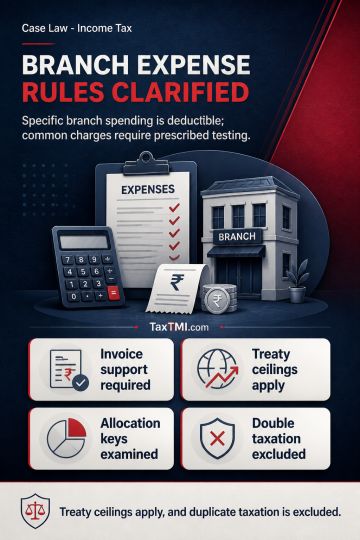
Head Office cost allocation requires prescribed transfer-pricing methods; treaty ceilings bar surcharge and cess, while duplicate taxation is excluded...
Cost-to-cost reimbursement of seconded employees is not service consideration; transfer-pricing markup was deleted and amalgamation amortisation allow...
Crystallisation of liability supports prior-period expense deduction, while functionally distinct divisions require separate transfer-pricing benchmar...
Functional comparability under TNMM requires transaction-specific FAR analysis before benchmarking business-support services provided to associated en...
Advance pricing agreement methodology can guide benchmarking for non-covered years when functions, assets, risks and activities remain materially unch...
Page of 4912
Press 'Enter' after typing page number.
221 to 240 of 98239 Results
❮
❯
❯❯
0 / 200
Expand Note
Add to Folder
No Folders have been created
+
Are you sure you want to delete "My most important" ?
Section 122(1A) of the CGST Act may impose a penalty on any person, including an unregistered or non-taxable person, rather than only a taxable person. It applies only where a specified contravention under Section 122(1) is established and it is independently proved that the person retained the transaction's benefit and that the transaction occurred at that person's instance. As a penal provision, it operates prospectively for underlying acts or transactions occurring from 1 January 2021, rather than by reference to the show-cause notice date. Statutory appeals remain available for fact-specific findings despite writ determination of recurring legal questions.
Section 122(1A) of the CGST Act may impose a penalty on any person, including an unregistered or non-taxable person, rather than only a taxable person. It applies only where a specified contravention under Section 122(1) is established and it is independently proved that the person retained the transaction's benefit and that the transaction occurred at that person's instance. As a penal provision, it operates prospectively for underlying acts or transactions occurring from 1 January 2021, rather than by reference to the show-cause notice date. Statutory appeals remain available for fact-specific findings despite writ determination of recurring legal questions.
Note: It is a system-generated summary and is for quick reference only.
 TaxTMI
  TaxTMI
 of 4912