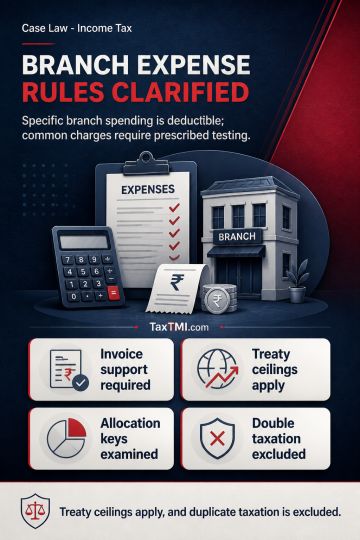
Head Office cost allocation requires prescribed transfer-pricing methods; treaty ceilings bar surcharge and cess, while duplicate taxation is excluded...
Cost-to-cost reimbursement of seconded employees is not service consideration; transfer-pricing markup was deleted and amalgamation amortisation allow...
Crystallisation of liability supports prior-period expense deduction, while functionally distinct divisions require separate transfer-pricing benchmar...
Functional comparability under TNMM requires transaction-specific FAR analysis before benchmarking business-support services provided to associated en...
Advance pricing agreement methodology can guide benchmarking for non-covered years when functions, assets, risks and activities remain materially unch...
Page of 4912
Press 'Enter' after typing page number.
221 to 240 of 98239 Results
❮
❯
❯❯
0 / 200
Expand Note
Add to Folder
No Folders have been created
+
Are you sure you want to delete "My most important" ?
Input tax credit claimed on invoices from a supplier whose registration was retrospectively cancelled requires examination of the facts and evidence for each underlying transaction. Retrospective cancellation alone does not establish credit ineligibility unless specific material shows that invoices were fictitious or sham, or that supplies were not received. Differences between figures in GST returns, standing alone, likewise do not establish an erroneous credit claim. A demand cannot be sustained on a ground materially different from the basis of the original proceedings. Subsequent amendments in GST records may be relevant to determining limited credit eligibility.
Input tax credit claimed on invoices from a supplier whose registration was retrospectively cancelled requires examination of the facts and evidence for each underlying transaction. Retrospective cancellation alone does not establish credit ineligibility unless specific material shows that invoices were fictitious or sham, or that supplies were not received. Differences between figures in GST returns, standing alone, likewise do not establish an erroneous credit claim. A demand cannot be sustained on a ground materially different from the basis of the original proceedings. Subsequent amendments in GST records may be relevant to determining limited credit eligibility.
Note: It is a system-generated summary and is for quick reference only.
 TaxTMI
  TaxTMI
 of 4912