Cost-to-cost reimbursement of seconded employees is not service consideration; transfer-pricing markup was deleted and amalgamation amortisation allow...
Crystallisation of liability supports prior-period expense deduction, while functionally distinct divisions require separate transfer-pricing benchmar...
Functional comparability under TNMM requires transaction-specific FAR analysis before benchmarking business-support services provided to associated en...
Advance pricing agreement methodology can guide benchmarking for non-covered years when functions, assets, risks and activities remain materially unch...
Tax-audit exemption for substantially State-funded educational universities prevents audit-failure penalties where income qualifies for statutory exem...
Functional, asset and risk analysis excludes diversified technology companies from captive software development comparables under cost-plus arrangemen...
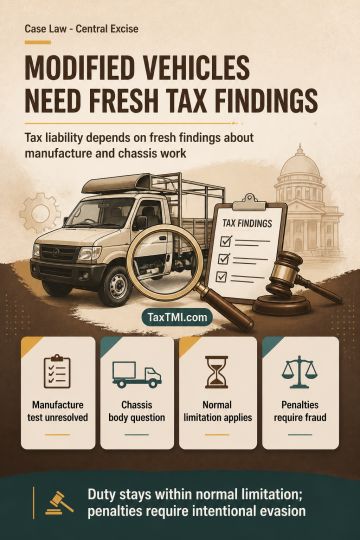
Excise liability for modifications to fully built motor vehicles depends on whether refining or remaking amounts to manufacture and, where a Chapter Note is invoked, whether a body was built on the chassis as received. These foundational questions require fresh determination before excisability and chassis-based exemption can be resolved. Extended limitation requires a positive, deliberate suppression or misstatement intended to evade duty; registration, returns, departmental scrutiny and a bona fide exemption belief do not establish that standard merely because the departmental view later changes. Any duty determined is confined to the normal limitation period. Penalties for the manufacturer and its Executive Director require the same fraud or intentional-evasion conditions and therefore do not arise absent such conduct.
Excise liability for modifications to fully built motor vehicles depends on whether refining or remaking amounts to manufacture and, where a Chapter Note is invoked, whether a body was built on the chassis as received. These foundational questions require fresh determination before excisability and chassis-based exemption can be resolved. Extended limitation requires a positive, deliberate suppression or misstatement intended to evade duty; registration, returns, departmental scrutiny and a bona fide exemption belief do not establish that standard merely because the departmental view later changes. Any duty determined is confined to the normal limitation period. Penalties for the manufacturer and its Executive Director require the same fraud or intentional-evasion conditions and therefore do not arise absent such conduct.
Note: It is a system-generated summary and is for quick reference only.
 TaxTMI
  TaxTMI
 of 4913