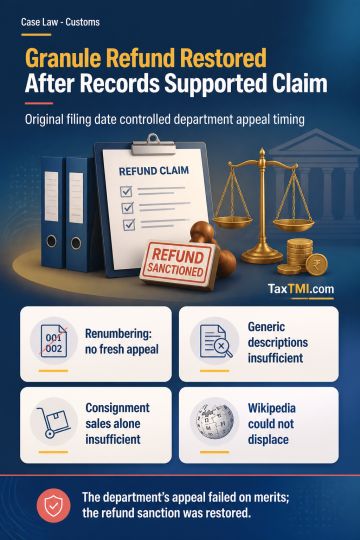
Departmental appeal limitation after call-book recall preserves original filing, while documented correlation supports SAD refund on imported granules...
Income-tax prosecution fails when appellate remand removes its factual foundation; directors require company arraignment for vicarious criminal liabil...
Capital character of assignment consideration prevents taxation as residuary income, while unsupported interest-related expenditure remains non-deduct...
Make-available condition shields regional support-service receipts from Indian taxation where no independent capability or permanent establishment exi...
Transfer-pricing treatment of corporate guarantees and convertible loans followed prior-year consistency, with taxable foreign dividends excluded from...
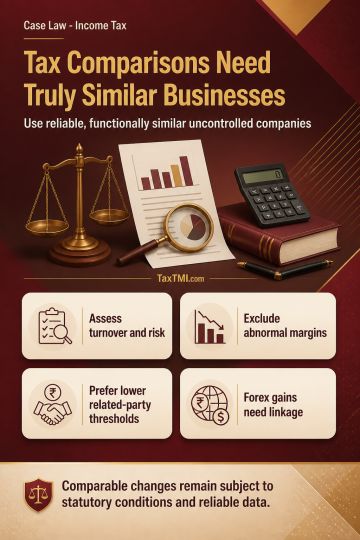
Transfer-pricing benchmarking confines adjustments to associated-enterprise transactions and integrates delayed receivables through TNMM working-capit...
Medical relief status protects government-contracted mobile healthcare from commercial classification, while provisional registration cancellation req...
Charitable registration cancellation requires proof that educational activities abandoned their objects; incidental receipts and retained surplus are ...
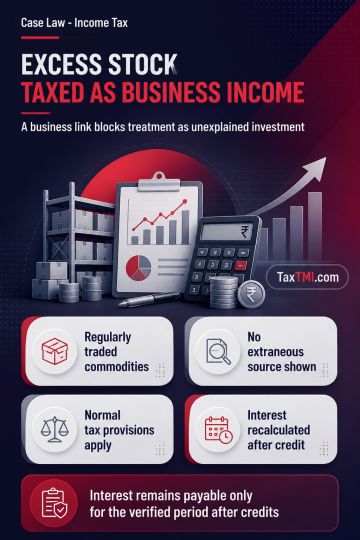
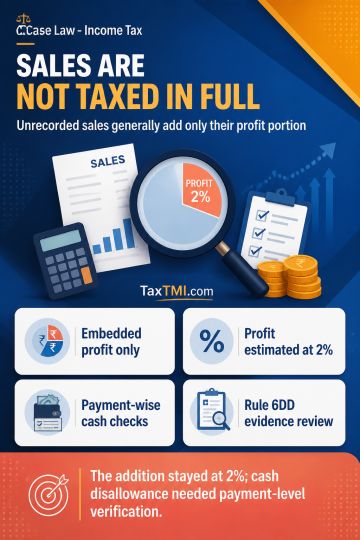
Suppressed turnover arising from unrecorded sales generated in a disclosed business is assessable only to the embedded profit, absent evidence of unexplained investment or an independent undisclosed activity. Because gross receipts recover both cost and profit, historical profitability provides an objective estimation basis; a moderately higher margin may apply to incremental out-of-books realisation. Profit was estimated at 2%, restricting the turnover addition to that amount; the evidentiary value of individual Excel sheets remained undecided. Cash-payment disallowance requires payment-wise, person-wise and day-wise verification against the prescribed limit, rather than yearly ledger aggregates. Claimed Rule 6DD exceptions require supporting-material verification, and the disallowance was remanded for that limited examination.
Suppressed turnover arising from unrecorded sales generated in a disclosed business is assessable only to the embedded profit, absent evidence of unexplained investment or an independent undisclosed activity. Because gross receipts recover both cost and profit, historical profitability provides an objective estimation basis; a moderately higher margin may apply to incremental out-of-books realisation. Profit was estimated at 2%, restricting the turnover addition to that amount; the evidentiary value of individual Excel sheets remained undecided. Cash-payment disallowance requires payment-wise, person-wise and day-wise verification against the prescribed limit, rather than yearly ledger aggregates. Claimed Rule 6DD exceptions require supporting-material verification, and the disallowance was remanded for that limited examination.
Note: It is a system-generated summary and is for quick reference only.
 TaxTMI
 TaxTMI

 of 4916