Road restoration charges constitute taxable services when requested for commercial pipeline activity, requiring reverse-charge GST from the business r...
Interest on delayed release of requisitioned cash includes statutory pre-assessment interest and restitutionary compensation for unlawful post-assessm...
Incomplete inventory records justify rejecting accounts, while profit estimation requires relevant comparable material and interest falls under other ...
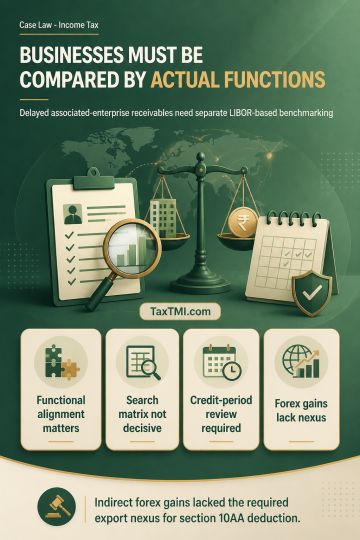
Transfer-pricing comparability requires functional alignment; delayed associated-enterprise receivables need separate LIBOR-based benchmarking, while ...
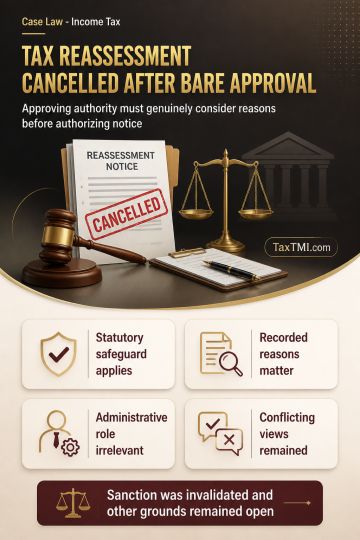
Extended reassessment limitation in search cases requires asset-linked escaped income, invalidating additions based only on unexplained money or expen...
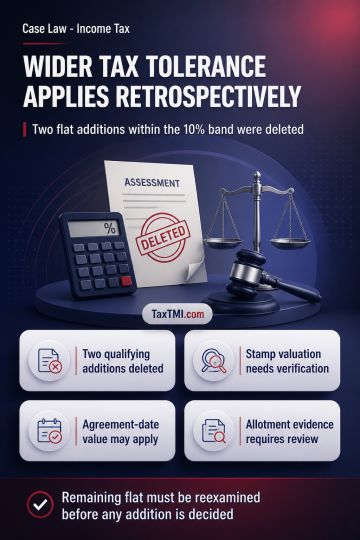
Enhanced tolerance band under section 43CA applies retrospectively, deleting qualifying deemed-sale additions while disputed stamp valuation requires ...
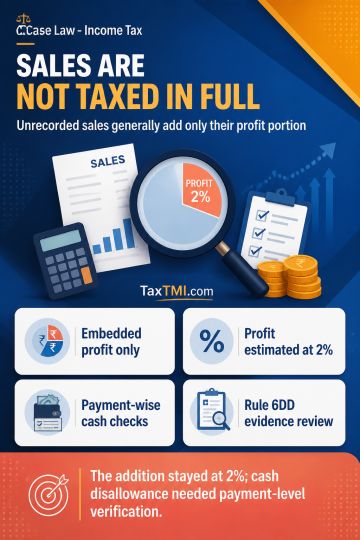
Suppressed turnover arising from unrecorded sales generated in a disclosed business is assessable only to the embedded profit, absent evidence of unexplained investment or an independent undisclosed activity. Because gross receipts recover both cost and profit, historical profitability provides an objective estimation basis; a moderately higher margin may apply to incremental out-of-books realisation. Profit was estimated at 2%, restricting the turnover addition to that amount; the evidentiary value of individual Excel sheets remained undecided. Cash-payment disallowance requires payment-wise, person-wise and day-wise verification against the prescribed limit, rather than yearly ledger aggregates. Claimed Rule 6DD exceptions require supporting-material verification, and the disallowance was remanded for that limited examination.
Suppressed turnover arising from unrecorded sales generated in a disclosed business is assessable only to the embedded profit, absent evidence of unexplained investment or an independent undisclosed activity. Because gross receipts recover both cost and profit, historical profitability provides an objective estimation basis; a moderately higher margin may apply to incremental out-of-books realisation. Profit was estimated at 2%, restricting the turnover addition to that amount; the evidentiary value of individual Excel sheets remained undecided. Cash-payment disallowance requires payment-wise, person-wise and day-wise verification against the prescribed limit, rather than yearly ledger aggregates. Claimed Rule 6DD exceptions require supporting-material verification, and the disallowance was remanded for that limited examination.
Note: It is a system-generated summary and is for quick reference only.
 TaxTMI
 TaxTMI

 of 4918