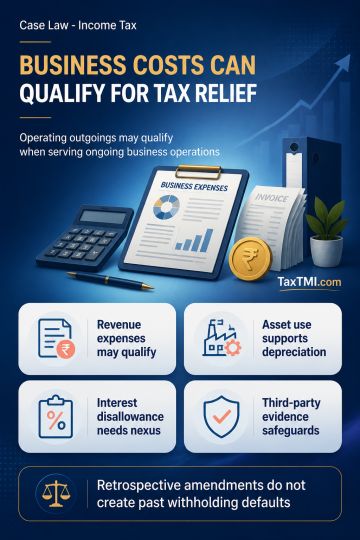
Business expenditure and depreciation rules allow operational outgoings while limiting disallowances for personal elements and unsupported third-party...
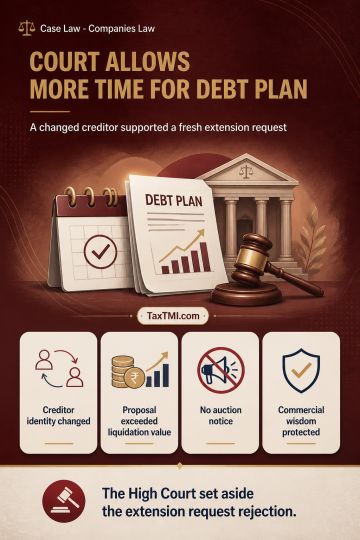
Compromise-and-arrangement extensions may accommodate debt assignment where creditor commercial judgment supports value maximisation and avoids proced...
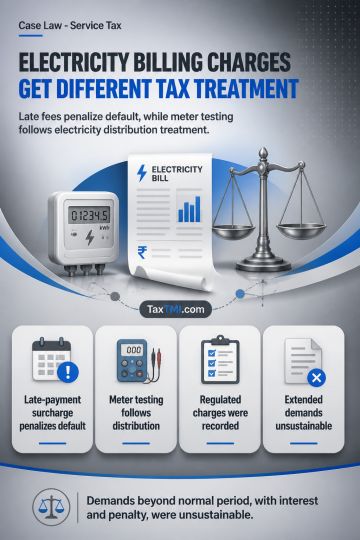
Delayed-payment surcharge is not taxable tolerance consideration where it penalises default, while meter testing follows electricity distribution trea...
Sufficient cause for delayed revenue income-tax appeals requires bona fides, due diligence and a credible explanation; otherwise limitation bars appea...
Inverted-duty-structure refunds remain available for unchanged-rate apparel supplies despite trader status and require tax-period-specific computation...
Page of 4918
Press 'Enter' after typing page number.
1521 to 1540 of 98352 Results
❮
❯
❯❯
0 / 200
Expand Note
Add to Folder
No Folders have been created
+
Are you sure you want to delete "My most important" ?
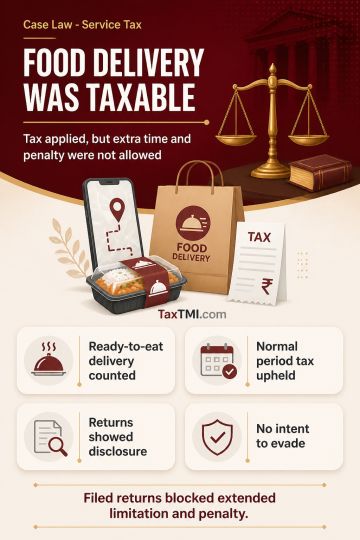
Free home delivery of ready-to-eat food, involving preparation at the supplier's premises and delivery at a customer-specified time and place, was treated as a taxable service with a significant service element. From July 2012, supplying food for human consumption in this manner fell within declared services and also within the earlier concept of outdoor catering. Service tax was consequently sustainable for the normal limitation period. The extended limitation period and related penalty were not sustainable because the supplier was registered, filed ST-3 returns, paid service tax, and the allegations arose from its own records, with no evidence of suppression intended to evade tax.
Free home delivery of ready-to-eat food, involving preparation at the supplier's premises and delivery at a customer-specified time and place, was treated as a taxable service with a significant service element. From July 2012, supplying food for human consumption in this manner fell within declared services and also within the earlier concept of outdoor catering. Service tax was consequently sustainable for the normal limitation period. The extended limitation period and related penalty were not sustainable because the supplier was registered, filed ST-3 returns, paid service tax, and the allegations arose from its own records, with no evidence of suppression intended to evade tax.
Note: It is a system-generated summary and is for quick reference only.
 TaxTMI
 TaxTMI

 of 4918