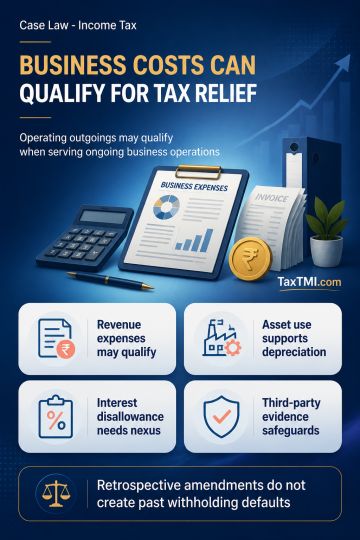
Business expenditure and depreciation rules allow operational outgoings while limiting disallowances for personal elements and unsupported third-party...
Compromise-and-arrangement extensions may accommodate debt assignment where creditor commercial judgment supports value maximisation and avoids proced...
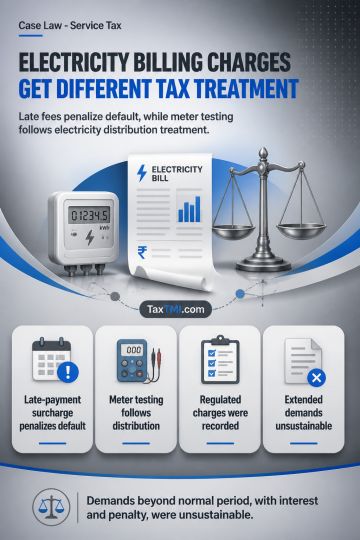
Delayed-payment surcharge is not taxable tolerance consideration where it penalises default, while meter testing follows electricity distribution trea...
Sufficient cause for delayed revenue income-tax appeals requires bona fides, due diligence and a credible explanation; otherwise limitation bars appea...
Inverted-duty-structure refunds remain available for unchanged-rate apparel supplies despite trader status and require tax-period-specific computation...
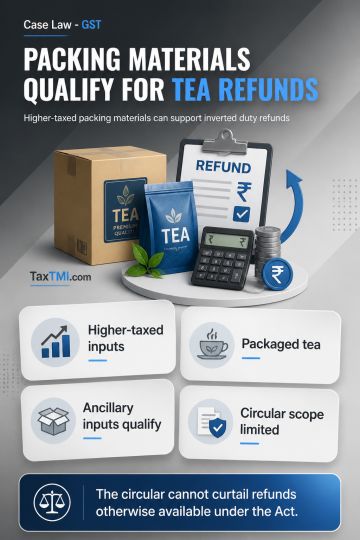
Refund of accumulated input tax credit under the inverted duty structure extends to higher-taxed packing materials used for marketing packaged tea. Section 54(3)(ii) applies where input tax rates exceed the output supply rate, and the plural term "inputs" does not distinguish between principal and ancillary inputs. Packing materials used in the course or furtherance of business therefore qualify as eligible inputs, notwithstanding that bulk tea and packaged tea attract the same GST rate. Circular No. 135/5/2020-GST addresses credit accumulation caused by GST-rate reductions on the same goods over time; it does not cover accumulation arising from higher-taxed packing materials and cannot curtail a refund otherwise available under the Act.
Refund of accumulated input tax credit under the inverted duty structure extends to higher-taxed packing materials used for marketing packaged tea. Section 54(3)(ii) applies where input tax rates exceed the output supply rate, and the plural term "inputs" does not distinguish between principal and ancillary inputs. Packing materials used in the course or furtherance of business therefore qualify as eligible inputs, notwithstanding that bulk tea and packaged tea attract the same GST rate. Circular No. 135/5/2020-GST addresses credit accumulation caused by GST-rate reductions on the same goods over time; it does not cover accumulation arising from higher-taxed packing materials and cannot curtail a refund otherwise available under the Act.
Note: It is a system-generated summary and is for quick reference only.
 TaxTMI
 TaxTMI

 of 4920