Form 26AS evidence requires successor-entity accounting verification after business transfer, while invoice-supported related-party advertising expend...
Money-laundering judgment timing requires awaiting the scheduled-offence decision despite continuation of the underlying trial where outcomes directly...
Accredited investor eligibility expands through securities-market exposure, while alternative investment fund disputes require prescribed resolution a...
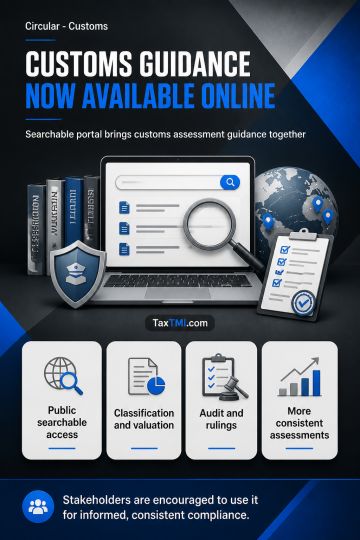
Customs Assessment Portal centralises classification and valuation guidance to support consistent, transparent and informed compliance across stakehol...
Page of 4918
Press 'Enter' after typing page number.
101 to 120 of 98359 Results
❮
❯
❯❯
0 / 200
Expand Note
Add to Folder
No Folders have been created
+
Are you sure you want to delete "My most important" ?
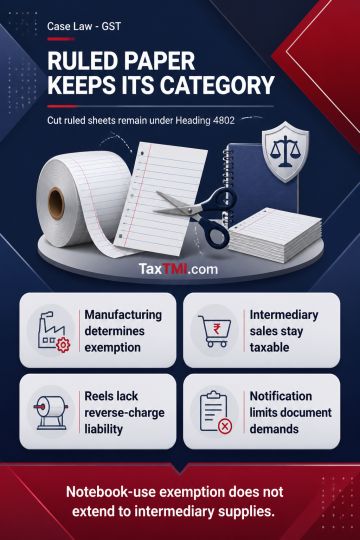
Ruled or lined loose paper sheets produced by cutting uncoated paper remain within Heading 4802, rather than Heading 4820, because loose sheets cut to size are excluded from the finished-stationery heading. Paper is classified under tariff item 48026190 in rolls and 48026290 in sheets. The end-use exemption for paper used in specified notebooks depends on actual use by the manufacturer; supplies through intermediaries remain independently taxable. Recipients of uncoated paper reels have no reverse-charge liability because the goods are not notified for reverse charge, while input tax credit remains subject to statutory conditions. Documentary requirements cannot be imposed where the exemption notification does not prescribe them.
Ruled or lined loose paper sheets produced by cutting uncoated paper remain within Heading 4802, rather than Heading 4820, because loose sheets cut to size are excluded from the finished-stationery heading. Paper is classified under tariff item 48026190 in rolls and 48026290 in sheets. The end-use exemption for paper used in specified notebooks depends on actual use by the manufacturer; supplies through intermediaries remain independently taxable. Recipients of uncoated paper reels have no reverse-charge liability because the goods are not notified for reverse charge, while input tax credit remains subject to statutory conditions. Documentary requirements cannot be imposed where the exemption notification does not prescribe them.
Note: It is a system-generated summary and is for quick reference only.
 TaxTMI
 TaxTMI

 of 4918