Income-tax prosecution fails when appellate remand removes its factual foundation; directors require company arraignment for vicarious criminal liabil...
Capital character of assignment consideration prevents taxation as residuary income, while unsupported interest-related expenditure remains non-deduct...
Make-available condition shields regional support-service receipts from Indian taxation where no independent capability or permanent establishment exi...
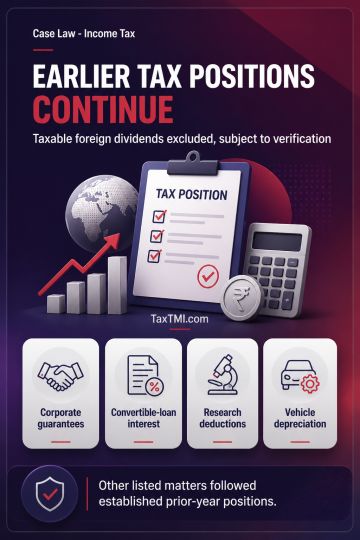
Transfer-pricing treatment of corporate guarantees and convertible loans followed prior-year consistency, with taxable foreign dividends excluded from...
Transfer-pricing benchmarking confines adjustments to associated-enterprise transactions and integrates delayed receivables through TNMM working-capit...
Medical relief status protects government-contracted mobile healthcare from commercial classification, while provisional registration cancellation req...
Charitable registration cancellation requires proof that educational activities abandoned their objects; incidental receipts and retained surplus are ...
Prospective customs notification amendments cannot bar provisional release consideration for earlier imports when bills of lading predate their commen...
Page of 4918
Press 'Enter' after typing page number.
1641 to 1660 of 98359 Results
❮
❯
❯❯
0 / 200
Expand Note
Add to Folder
No Folders have been created
+
Are you sure you want to delete "My most important" ?
Post-clearance amendment of Bills of Entry may support preferential tariff claims under the India-Japan CEPA where a Certificate of Origin is issued retrospectively. Appendix-A to Annexure-2 of the CEPA Rules permits an importer lacking the certificate at importation to seek refund of excess duty after producing the certificate and supporting documents. Section 149 of the Customs Act must be applied harmoniously with those Rules, allowing later submission of the Certificate of Origin from the date of clearance. Reassessment and concessional duty under the relevant exemption notification remain subject to admissibility of the certificate and claim.
Post-clearance amendment of Bills of Entry may support preferential tariff claims under the India-Japan CEPA where a Certificate of Origin is issued retrospectively. Appendix-A to Annexure-2 of the CEPA Rules permits an importer lacking the certificate at importation to seek refund of excess duty after producing the certificate and supporting documents. Section 149 of the Customs Act must be applied harmoniously with those Rules, allowing later submission of the Certificate of Origin from the date of clearance. Reassessment and concessional duty under the relevant exemption notification remain subject to admissibility of the certificate and claim.
Note: It is a system-generated summary and is for quick reference only.
 TaxTMI
 TaxTMI

 of 4918