 TaxTMI
 TaxTMI


 30 Oct 2026

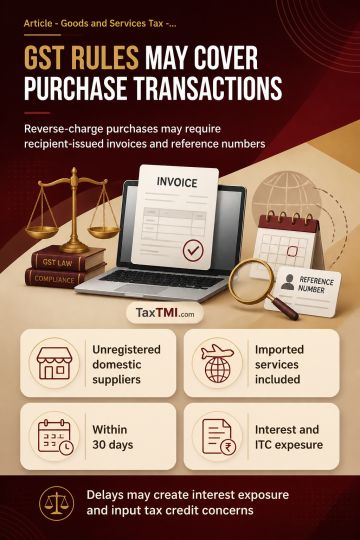
The GST compliance landscape is set for a significant transformation with the introduction of recipient-generated e-invoicing for specified Reverse Charge Mechanism (RCM) transactions. Under the new framework, eligible businesses will be required to generate self-invoices and obtain Invoice Reference Numbers (IRNs) not for outward supplies alone, but for certain inward supplies received from unregistered persons and import of services.
As per the GSTN advisory, two new e-invoice transaction categories, RCMDOM and RCMIMP, have been introduced to enable reporting of self-invoices for domestic RCM procurements from unregistered suppliers and imported services respectively. The facility is proposed to apply to taxpayers with Aggregate Annual Turnover of Rs. 5 crore and above, subject to the notified legal provisions.
Key Compliance Challenge
The amendment assumes greater significance because Section 13(3) of the CGST Act triggers the time of supply for services under reverse charge, while Rule 47A provides a specific timeline for issuance of self-invoices. Consequently, businesses may have only 30 days from the date of receipt of the service to prepare, report and generate self e-invoices for eligible transactions.
This effectively means that compliance monitoring can no longer remain confined to outward supplies and sales teams. Procurement, finance, accounts payable, legal, foreign remittance, and shared service centres will now have to work in close coordination to identify RCM transactions immediately upon receipt of services and ensure timely e-invoice generation.
Interest and ITC Litigation Exposure:
Failure to generate self e-invoices within the prescribed timeline could potentially create exposure to Interest liability arising from delayed discharge of GST under reverse charge. Questions on admissibility and time-barring of input tax credit (ITC) may also crop up incase E-Invoice is not made within 30th November of the FY next to the year of receipt of service, unlike in the past when following Circular 211 the time barring period was calculated from the date of Self Invoice generation.
Delayed identification of RCM transactions, particularly for imported services, group company transactions, royalty payments, employee recoveries, professional services from unregistered vendors, and digital service procurements, may become a compliance risk area.
Industry Must Act Now:
Though the functionality is presently available in the sandbox environment and the production rollout date is yet to be notified, GSTN has urged taxpayers, ERP providers, GST Suvidha Providers and Application Service Providers to begin system testing and readiness activities. Businesses should immediately:
Map all RCM service transactions.
Identify transactions requiring self-invoicing.
Configure ERP workflows for RCMDOM and RCMIMP reporting.
Introduce automated tracking of service receipt dates.
Establish maker-checker controls for self-invoice generation.
Align finance and procurement teams on the 30-day compliance timeline.
Conduct periodic reviews to mitigate interest and litigation risk.