 TaxTMI
 TaxTMI


 29 Oct 2026

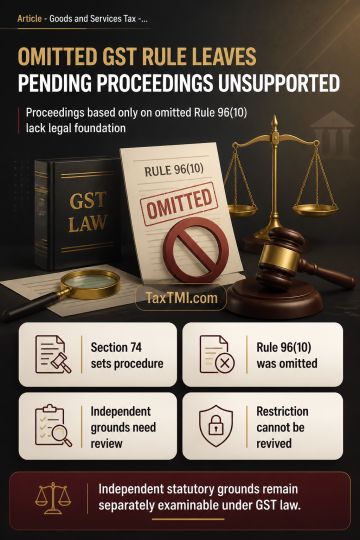
Omission of Rule 96(10) Raises Questions About Pending GST Proceedings
Omitting a statutory rule raises an important question about proceedings initiated under that rule before its omission. Can the Department continue such proceedings and confirm tax demands after the provision has ceased to operate? The answer depends on the legal effect of the omission and on whether the law contains a saving provision that permits pending proceedings to continue. This question is particularly important where adjudication orders have been passed after the relevant rule was omitted.
The controversy arose under Rule 96(10) of the CGST Rules, 2017, which restricted refunds of IGST paid on exports in specified circumstances. The Central Government omitted this rule through Notification No. 20/2024-Central Tax dated 08.10.2024, without incorporating any saving or sunset clause. Consequently, disputes arose over whether proceedings initiated under Sections 73 and 74 of the CGST Act, relying on Rule 96(10), could continue after its omission.
The Allahabad High Court examined this issue in M/s Complete Surveying Technologies Pvt. Ltd. v. State of U.P. and Others, 2026 (10) TMI 952 - ALLAHABAD HIGH COURT, decided on 12.10.2026. Following the Supreme Court's judgment in Goodluck India Ltd. v. Union of India, 2026 (8) TMI 719 - Supreme Court, and an earlier Division Bench decision of the Allahabad High Court, the Court set aside the taxpayer's challenged orders. The judgment provides important guidance on the consequences of omitting a rule without preserving pending proceedings and the limits of departmental action after such omission.
Proceedings Under Section 74 Continued Despite Omission of the Rule
The petitioner, M/S Complete Surveying Technologies Pvt. Ltd., manufactured, supplied, and exported surveying equipment and accessories. It operated two factories in Noida and was registered under GST law. The Department initiated proceedings under Section 74 of the UPGST/CGST Act, 2017, relying on Rule 96(10) of the CGST Rules for the financial years 2019-20 to 2023-24.
The Deputy Commissioner, UPGST, Noida-14, Gautam Budh Nagar, passed an adjudication order dated 31.12.2024. The taxpayer challenged the relevant orders before the Additional Commissioner Grade-II (Appeal), State Tax Department, Noida. The Additional Commissioner Grade-II (Appeal), State Tax Department, Noida, dismissed the appeals relating to the financial years 2022-23 and 2023-24 on 05.05.2026. Notably, both the adjudication order and the appellate decision were passed after the omission of Rule 96(10) on 08.10.2024.
The taxpayer approached the Allahabad High Court, contending that the proceedings and orders could not survive because they were founded on the omitted rule. The taxpayer relied on the Supreme Court's judgment in Goodluck India Ltd. v. Union of India, 2026 (8) TMI 719, and the Allahabad High Court's earlier decision in Saran Impex and Another v. State of U.P. and Another-2026 (10) TMI 1152 - ALLAHABAD HIGH COURT. The State's counsel did not dispute the taxpayer's legal proposition. The principal question before the Court was whether orders passed under Section 74, relying on Rule 96(10), remained legally sustainable after the rule's omission.
Omission Without a Saving Clause Affects Pending Proceedings
Before its omission, Rule 96(10) restricted refunds of IGST paid on exports where specified exemptions or benefits had been availed. The provision led to proceedings against exporters over refunds claimed or received under GST law. Notification No. 20/2024-Central Tax dated 08.10.2024 omitted the rule with effect from that date, but did not expressly preserve proceedings already initiated under it.
An important distinction arises between the period during which a rule remained in force and the continuation of proceedings after its omission. The fact that a rule applied when a transaction took place does not necessarily mean that proceedings based upon that rule can continue after its omission. Whether such proceedings survive depends on the statutory framework and whether a saving clause or another legal mechanism preserves their continuation.
In the present case, the proceedings had not been concluded before 08.10.2024. The adjudication order was passed on 31.12.2024, and the relevant appellate decision followed on 05.05.2026. The Court therefore had to examine whether the Department could continue to enforce the restrictions of Rule 96(10) through proceedings under Section 74 after the rule had ceased to operate. The Supreme Court's interpretation in Goodluck India Ltd. governed this question.
The Supreme Court Explains Why Pending Proceedings Cannot Continue
In Goodluck India Ltd. v. Union of India, 2026 (8) TMI 719, the Supreme Court examined whether omitting Rule 96(10) would benefit taxpayers whose refund proceedings were pending on 08.10.2024. The Department relied on the GST Council's recommendation that the omission should operate prospectively. However, the Supreme Court observed that such a recommendation was advisory and did not bind the rule-making authority. The notification actually issued had omitted Rule 96(10) without incorporating any saving or sunset clause.
The Supreme Court relied upon the Constitution Bench judgment in Kolhapur Canesugar Works Ltd. v. Union of India, 2000 (2) TMI 823 - Supreme Court. The Constitution Bench had explained that proceedings initiated under an omitted rule could continue only where a saving clause or another statutory mechanism permitted their continuation. Applying this principle, the Supreme Court held that the omission of Rule 96(10), without a saving clause, extended to proceedings pending on the date of its omission. The fact that the rule operated before 08.10.2024 did not, by itself, justify continuing proceedings under its restrictions after that date.
The Supreme Court also considered the amendment's purpose. The Court omitted Rule 96(10) because it created unnecessary complications without serving the intended benefit. The Court reasoned that the omission was intended to end these complications rather than preserve them through pending proceedings. Accordingly, it declined to interfere with the Gujarat High Court's decision in Addwrap Packaging Private Limited v. Union of India, 2025-VIL-587-GUJ. The judgment's essential principle is that restrictions under Rule 96(10) cannot continue to be enforced in proceedings pending on 08.10.2024 merely because the transactions relate to an earlier period.
CBIC Accepts the Supreme Court's Interpretation of Rule 96(10)
An important subsequent development was the issuance of Office Memorandum F. No. CBIC-20010/21/2026-GST dated 24.08.2026 by the GST Policy Wing of the Central Board of Indirect Taxes and Customs (CBIC). The memorandum examined the Supreme Court's judgment in Goodluck India Ltd. and acknowledged that, without a saving clause, the omission of Rule 96(10) applies to proceedings pending on 08.10.2024. Consequently, the restrictions contained in the omitted rule cannot continue to be enforced in such proceedings.
The CBIC also referred to the Constitution Bench judgment in Kolhapur Canesugar Works Ltd. and noted that, in the circumstances examined by the Supreme Court, Section 6 of the General Clauses Act, 1897 does not apply to the omission of a rule. It further observed that the Central Excise Act, 1944 and the Customs Act, 1962 subsequently incorporated specific saving provisions through Sections 38A and 159A, respectively. However, the GST law contains no corresponding saving provision. The memorandum therefore recognised the legal consequences of omitting Rule 96(10) without preserving pending proceedings.
Significantly, the CBIC, with the approval of Member (GST), accepted the Supreme Court's judgment. This administrative acceptance reinforces departmental authorities' obligation to apply the settled legal position when dealing with proceedings founded on Rule 96(10). The memorandum does not prevent the Department from examining matters independently permissible under the GST law, but it does not permit continued enforcement of the restrictions contained in the omitted rule in proceedings covered by the Supreme Court's decision.
Earlier Division Bench Decision Had Already Settled the Issue
Before deciding the present petition, a Division Bench of the Allahabad High Court examined the same controversy in Saran Impex and Another v. State of U.P. and Another, 2026 (10) TMI 1152 - ALLAHABAD HIGH COURT and connected petitions. Those petitions challenged proceedings initiated under Sections 73 and 74 of the CGST Act, based on Rule 96(10), for different financial years. Some proceedings were at the show cause notice stage, while others concerned the continuation of departmental action under the omitted provision.
The Division Bench considered the Supreme Court's judgment in Goodluck India Ltd. and the omission of Rule 96(10) through Notification No. 20/2024-Central Tax dated 08.10.2024. It held that proceedings not concluded by the date of omission could not continue on the strength of Rule 96(10). The Court also recorded that the CBIC had accepted the Supreme Court's judgment through its Office Memorandum dated 24.08.2026.
Accordingly, the Division Bench allowed the writ petitions and quashed the individual adjudication notices and orders challenged before it. This decision became directly relevant to the proceedings against Complete Surveying Technologies because the Department relied on Rule 96(10), and the impugned adjudication and appellate orders were passed after its omission. The present case therefore involved applying an already settled legal principle rather than interpreting the omitted rule afresh.
Proceedings Under Section 74 Cannot Be Sustained Solely on the Omitted Rule
Section 74 of the CGST Act provides a statutory mechanism to determine tax not paid or short paid, erroneous refunds, and wrongly availed or utilised ITC in cases involving fraud, wilful misstatement, or suppression of facts to evade tax, subject to the applicable statutory conditions. However, the existence of this adjudication machinery does not independently establish a tax liability. The Department must identify a legally sustainable basis for the demand and establish the relevant statutory requirements.
In the present case, the proceedings under Section 74 were founded upon the restrictions contained in Rule 96(10). Once the Supreme Court had settled that the omitted rule could not continue to govern proceedings pending on 08.10.2024, the Department could not sustain those proceedings merely by relying upon Section 74. The power to adjudicate a demand and the legal foundation of that demand are separate matters. A statutory procedure cannot, by itself, preserve a restriction that has ceased to operate in the pending proceedings.
This distinction is important because the judgment does not invalidate Section 74 or prevent its lawful application in other circumstances. Its effect is confined to proceedings that depend on the omitted Rule 96(10) and fall within the Supreme Court's interpretation. Where the Department has an independent and legally sustainable ground for action, the matter must be examined separately under the applicable statutory provisions. However, the omitted rule cannot serve as the continuing foundation for proceedings pending on the date of its omission.
The High Court Sets Aside the Orders but Preserves Lawful Departmental Action
The Allahabad High Court observed that the Supreme Court's decision in Goodluck India Ltd., the earlier Division Bench judgment in Saran Impex, and the CBIC Office Memorandum dated 24.08.2026 covered the legal issue. The State's counsel did not dispute the legal position. Consequently, the Court concluded that the proceedings founded on Rule 96(10) were vitiated and that the impugned orders could not be sustained.
The High Court disposed of the writ petition and set aside the taxpayer's challenged orders. Importantly, however, the Court expressly left it open to the respondents to take appropriate measures as warranted by law. This reservation does not authorise reviving the same proceedings merely by invoking the omitted Rule 96(10). It preserves only such independent action as may otherwise be legally permissible under the applicable statutory provisions.
Thus, the relief granted must be understood in its proper context. The Court has neither directed payment of any refund nor finally determined the taxpayer's liability on grounds independent of Rule 96(10). Its decision concerns the legal sustainability of the impugned proceedings and orders founded on the omitted restriction. The judgment therefore protects taxpayers against continued enforcement of Rule 96(10) in pending proceedings while preserving the Department's authority to act independently in accordance with law.
Author's Note: Refund Relief Following Omission of Rule 96(10)
A related development deserves mention. In M/s Sudeep Industries v. Union of India & Ors., 2026 (10) TMI 1457 - GUJARAT HIGH COURT, decided on 09.10.2026, the Gujarat High Court considered a claim for refund of un-recredited IGST, interest, and penalty previously paid in connection with Rule 96(10). Following Goodluck India Ltd. and earlier Gujarat High Court decisions, the Court recognised the petitioner's entitlement, quashed the refund rejection order, and directed processing of the claim within twelve weeks from receipt of its order. The decision is significant for similarly placed exporters seeking refund of amounts already paid, although its application must be assessed against the facts and procedural position of each case. (Paragraphs 3-9.)
***