Opportunity to furnish unsecured-loan confirmations is required before reassessment initiation; proceedings require fresh consideration after taxpayer...
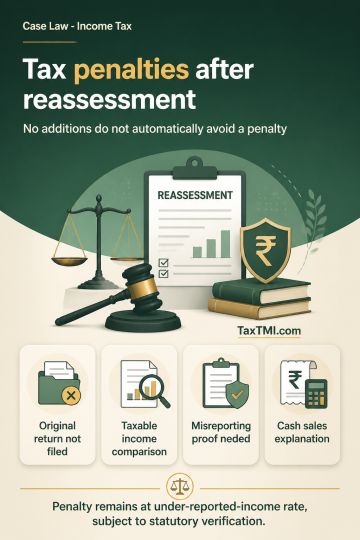
Under-reporting on a first reassessment return attracts penalty, while enhanced misreporting penalty requires proof of a statutory misreporting catego...
Form 26AS evidence requires successor-entity accounting verification after business transfer, while invoice-supported related-party advertising expend...
Reassessment for AY 2017-18 was held within limitation because the earlier notice issued on 29.04.2021 was treated as a deemed notice under section 148A(b) in light of Union of India v. Ashish Agarwal and Union of India v. Rajeev Bansal. The Court held that the saving of defences under section 149 did not help the assessee, as the notice remained issuable under the old regime up to 31.03.2024 where escaped income crossed the applicable threshold. It further held that alleged escaped income exceeding Rs. 50 lakhs and represented as immovable property attracted the extended ten-year period. The challenge to the order under section 148A(d), the consequential notice under section 148, and the assessment order on limitation grounds was rejected and the writ petition dismissed.
Reassessment for AY 2017-18 was held within limitation because the earlier notice issued on 29.04.2021 was treated as a deemed notice under section 148A(b) in light of Union of India v. Ashish Agarwal and Union of India v. Rajeev Bansal. The Court held that the saving of defences under section 149 did not help the assessee, as the notice remained issuable under the old regime up to 31.03.2024 where escaped income crossed the applicable threshold. It further held that alleged escaped income exceeding Rs. 50 lakhs and represented as immovable property attracted the extended ten-year period. The challenge to the order under section 148A(d), the consequential notice under section 148, and the assessment order on limitation grounds was rejected and the writ petition dismissed.
Note: It is a system-generated summary and is for quick reference only.
 TaxTMI
  TaxTMI
 of 4920