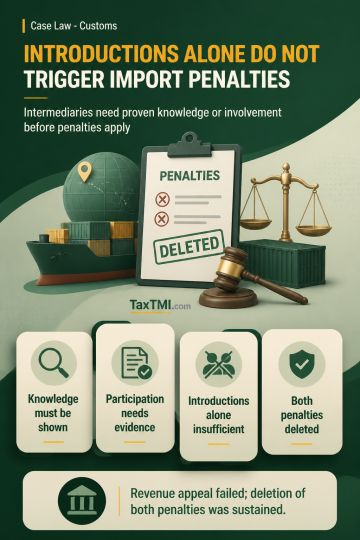
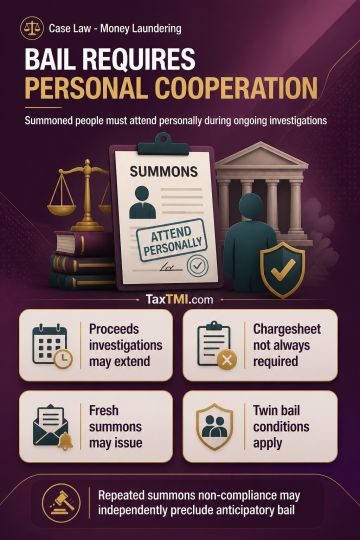
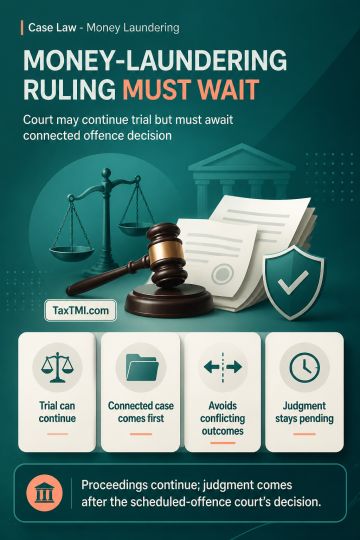
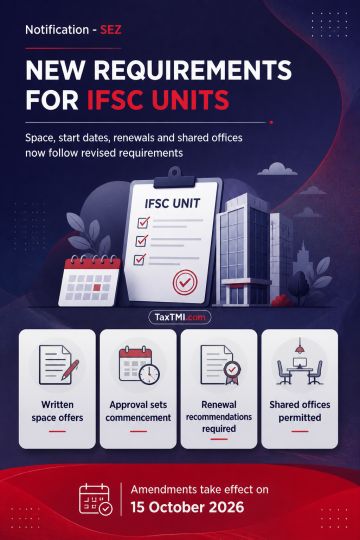
Form 26AS evidence requires successor-entity accounting verification after business transfer, while invoice-supported related-party advertising expend...
Money-laundering judgment timing requires awaiting the scheduled-offence decision despite continuation of the underlying trial where outcomes directly...
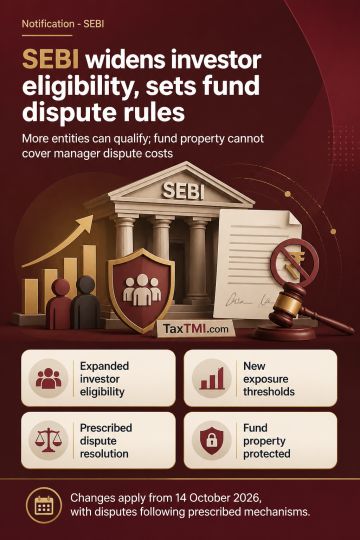
Accredited investor eligibility expands through securities-market exposure, while alternative investment fund disputes require prescribed resolution a...
Customs Assessment Portal centralises classification and valuation guidance to support consistent, transparent and informed compliance across stakehol...
Page of 4918
Press 'Enter' after typing page number.
101 to 120 of 98359 Results
❮
❯
❯❯
0 / 200
Expand Note
Add to Folder
No Folders have been created
+
Are you sure you want to delete "My most important" ?
Event management activity involving planning and organising weddings, exhibitions and similar events was treated as taxable Event Management Service. For valuation, only the commission retained by the appellant could form part of the assessable value; amounts collected merely for payment to third-party vendors were excluded, so the demand on gross receipts failed. Loose papers, uncertified computer printouts and uncorroborated statements were held insufficient to prove clandestine transactions, and the burden remained on the Revenue. The extended period of limitation was wrongly invoked for want of proof of suppression or intent to evade, and the proceedings, including penalties, were set aside as time-barred.
Event management activity involving planning and organising weddings, exhibitions and similar events was treated as taxable Event Management Service. For valuation, only the commission retained by the appellant could form part of the assessable value; amounts collected merely for payment to third-party vendors were excluded, so the demand on gross receipts failed. Loose papers, uncertified computer printouts and uncorroborated statements were held insufficient to prove clandestine transactions, and the burden remained on the Revenue. The extended period of limitation was wrongly invoked for want of proof of suppression or intent to evade, and the proceedings, including penalties, were set aside as time-barred.
Note: It is a system-generated summary and is for quick reference only.
 TaxTMI
  TaxTMI
 of 4918